
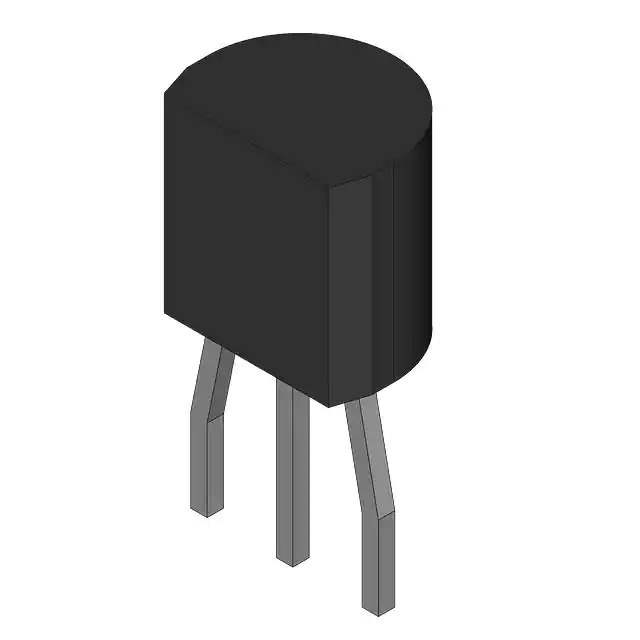
50 V and 100 mA ceilings decide the fit; missing resistor values and package details decide usability.
Quick Engineering Summary
| Field | Value |
|---|---|
| Manufacturer | ON Semiconductor |
| Category | Transistors (BJT) - Single |
| Package | Bulk |
| Core function | TRANS PREBIAS PNP 50V 100MA |
| Key electrical range | TRANS PREBIAS PNP 50V 100MA |
| Reported stock | 39000 pcs reported — confirm on RFQ |
50 V and 100 mA narrow the job fast
50 V is the collector-emitter breakdown ceiling named in the product description, and 100 mA is the collector-current ceiling beside it. That narrows the job quickly. It points DTA114E toward small-signal high-side or pull-up switching duties and rules it out where current headroom is thin or the rail needs comfortable margin above 50 V.
The more consequential detail is that DTA114E is explicitly a prebias PNP. That can remove two external resistors and simplify a bias network, but this listing never gives the built-in resistor values, never states whether the transistor type field is populated, and never gives saturation or gain conditions, so the headline limits tell you where it cannot go while the missing resistor-network data still decides whether it fits the circuit you actually have.
That missing context matters because, with a prebiased device, the internal network is not a side note. It sets how the part is driven, how it turns off, and how it behaves with the logic source already in the design. Without those values, the electrical picture stays incomplete even though the top-line ceilings are clear.
That missing resistor data is the real design gate
And that is the real gate. With an ordinary PNP, you choose the base network yourself; with DTA114E, the internal network is the part. If R1 and R2 are absent from the listing, you do not yet know the base drive, turn-off behavior, or how hard the device will pull under your logic source.
The same problem carries through the rest of the omitted electricals. There is no hFE condition, no VCE(sat) condition, no collector cutoff current, no transition frequency, and no power maximum. A 100 mA ceiling without those companion numbers does not close dissipation, switching speed, or low-voltage drop questions. DTA114E may still be the right simplifier for a bias stage, but right now the simplification is only conceptual, not verified.
Active status helps, but the buy call is still conditional
Buyable, with conditions.
Lifecycle is the easy part: Active is repeated across the status fields, and the listed stock quantity is 39000. For a running line, that supports a straightforward buy decision if DTA114E is already qualified in the circuit. For a new design, available stock should not distract from the missing electrical definition. Resolve the compliance conflict before release; one field says RoHS Compliant while another says RoHS Non-Compliant, and REACH is marked Affected.
What the listing still does not tell you
Wrong for final signoff today. Right for an early shortlist if the circuit only needs a prebiased PNP inside 50 V and 100 mA.
The gaps are concrete: internal resistor values, package or case outline, supplier device package, power maximum, and pinout are absent.
View the Win-Source product page for DTA114E.
Key Takeaways for Engineers & Buyers
- Keep DTA114E on circuits that stay inside the 50 V collector-emitter ceiling.
- Treat the 100 mA collector rating as a ceiling; don't use DTA114E to solve load-drive current margin.
- Resolve the RoHS conflict before release, and reserve stock early if the build needs the listed 39000 pieces.