
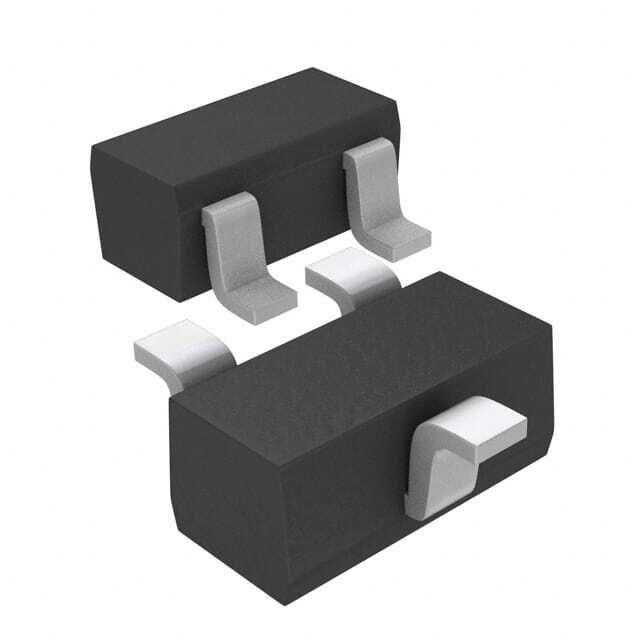
50 V, 20 mA, 150 mW in EMT3, with built-in 10 kOhms and 10 kOhms resistors shaping the fit.
Quick Engineering Summary
| Field | Value |
|---|---|
| Manufacturer | Rohm Semiconductor |
| Category | Transistors (BJT) - Single, Pre - Biased |
| Package | EMT3 |
| Core function | TRANS PREBIAS PNP 50V EMT3 |
| Key electrical range | Supply and Demand Status: Balance |
| Reported stock | 1340 pcs reported — confirm on RFQ |
Can you safely design this in now?
Can you buy it and keep building with it? Yes, if the application really wants a pre-biased PNP rather than a general-purpose small-signal transistor. The part is listed Active with no lifecycle conflict, and the series field includes Automotive and AEC-Q101, which gives it a stronger qualification story than the average digital transistor entry. EU RoHS is compliant, and MSL 1 (Unlimited) removes a common handling nuisance.
The real constraint is supply timing. Stock is listed at 1340, the standard package is Reel - TR with 3000 per package, and lead time is 19 Weeks. That works for prototypes or a controlled release, but a steady build needs the reel plan locked early instead of leaning on spot availability.
The weak point is current; the useful part is integration
20 mA is not much. It is the collector current ceiling, so this part is out for relay drive, lamp drive, and any load path where startup or fault current can run away before the transistor settles.
The reason to use it is the built-in bias network. R1 is 10 kOhms and R2 is 10 kOhms, which points DTA114EEFRATL toward logic-level inversion, pull-up side switching, and housekeeping control where board area and BOM count matter more than raw drive. The 50 V collector-emitter breakdown is a ceiling too; it shows the part can sit on higher-voltage sense or control nodes than many low-voltage logic transistors, but it does not settle switching loss, transient survival, or thermal headroom on its own.
150 mW is the number that keeps this honest
150 mW decides the fit. More than the 50 V headline, that power ceiling keeps DTA114EEFRATL in signal-path switching and bias control rather than in anything that spends real time with meaningful voltage across it and current through it at once.
The rest of the listed electricals line up with that reading. hFE is given as 20 @ 5mA, 5V, so the gain point is modest and tied to a specific test condition rather than broad drive authority. Vce saturation is 300mV @ 500µA, 10mA, useful because it frames the part around small-current switching instead of squeezing the last millivolt from a heavier load. Collector cutoff current is 500nA, a good fit for control nodes where off-state leakage matters more than speed. The 250 MHz transition frequency is listed, but without switching waveforms it does not by itself qualify DTA114EEFRATL for fast edge work.
Fit it where resistor-integrated PNP control saves parts
So that narrows the job nicely. DTA114EEFRATL earns its place when the integrated resistors remove two external parts and the current stays small. On dense automotive control boards, sensor enables, reset trees, and simple high-side logic inversion are the obvious homes because the package is EMT3, the mounting is surface mount, and the qualification field is AEC-Q101.
It is a poor fit for designs that need surge tolerance, inductive load drive, or thermal margin you can model tightly from the listing alone. The package cross-reference points to SC-75 and SOT-416, yet the page still does not give the drawing or pinout, so footprint confirmation has to come from the datasheet before layout is frozen.
The same limitation shows up in thermal and transient work. There is no IFSM-style surge figure, no thermal resistance, and no derating curve, so you cannot turn the 150 mW ceiling into ambient headroom with confidence, especially when the package is this small and the application may hold the device in a partially dissipative state for long stretches rather than brief switching events.
Two more gaps matter once the job moves beyond slow control. There is no junction capacitance and no switching-time data, so edge-rate impact and node loading stay open questions. DTA114EEFRATL may be exactly right for a compact bias-and-switch function, but those missing items are what close the review for timing-sensitive or thermally constrained use.
View the Win-Source product page for DTA114EEFRATL.
Key Takeaways for Engineers & Buyers
- Keep DTA114EEFRATL on low-current nodes only; 20 mA is the collector ceiling, not a target.
- Budget around the 150 mW limit before committing this EMT3 footprint to any always-on bias path.
- Place orders in reel multiples early if the line will consume volume; package quantity is 3000 and lead time is 19 Weeks.