
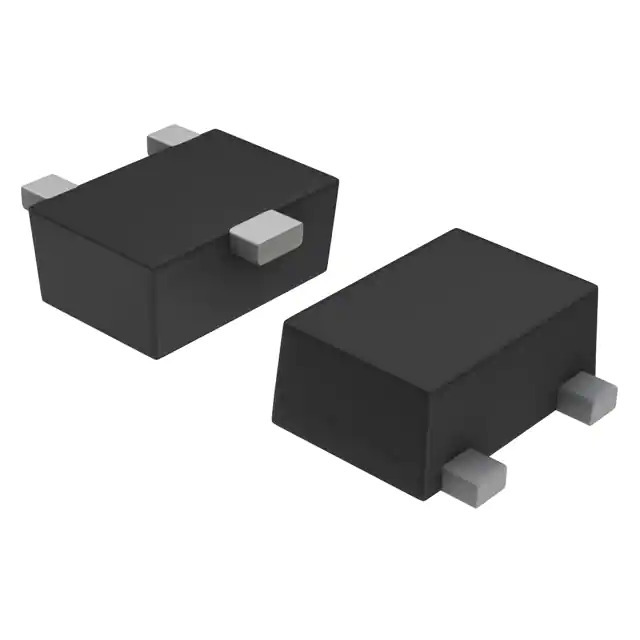
50 V, 100 mA, and 260 mW ceilings in SOT-723 decide if this pre-biased PNP fits the control path
Quick Engineering Summary
| Field | Value |
|---|---|
| Manufacturer | ON Semiconductor |
| Category | Transistors (BJT) - Single, Pre - Biased |
| Package | Tape & Reel |
| Core function | TRANS PREBIAS PNP 50V SOT723 |
| Key electrical range | Current - Collector (Ic) (Max): 100 mA; Current - Collector Cutoff (Max): 500nA; DC Current Gain (hFE) (Min) @ Ic, Vce: 80 @ 5mA, 10V; Power - Max: 260 mW |
| Reported stock | 23178 pcs reported — confirm on RFQ |
A sensible small-signal choice, if the package is the point
It fits.
For new design-in, the case is straightforward. The lifecycle status is Active, the signals are consistent, and the part earns attention when you want a PNP switch with the bias resistors already inside the device instead of spending board area on two externals.
The key numbers are ceilings, not comfortable operating targets. The 50 V collector-emitter breakdown is a rail limit, useful when a control node sits above the range many tiny logic transistors tolerate, but it says nothing about switching speed or transient behavior; the 100 mA collector current is also a ceiling, and in this package the 260 mW power limit will usually end the discussion first if you try to push DTA114YM3T5G beyond light-load interface duty.
That points to the real fit: enable lines, pull-up or high-side signal gating, and compact bias-controlled stages where SOT-723 is worth the handling trade. EU RoHS is covered, and MSL 1 helps on the assembly side.
The resistor network is the feature, not a footnote
And that is the point of the part: the built-in network is fixed at 10 kOhms for R1 and 47 kOhms for R2. DTA114YM3T5G is not a generic small PNP you tune later with external bias values. You choose it when those values match the drive source and turn-off behavior you need.
260 mW is the limit that keeps this out of load driving
260 mW sets the boundary. Pair it with the 100 mA collector-current ceiling and the message is plain: DTA114YM3T5G belongs in control circuitry, not at the edge of a real load.
The listed saturation figure gives one grounded reference point for low-current switching loss. Vce saturation is 250mV at 300µA and 10mA, but only at that test condition. It does not establish heavier-current operation, and it does not show how the drop shifts across the rest of the current range. The minimum hFE of 80 at 5mA and 10V is similarly bounded, useful for checking that a light-current control stage is plausible, not for assuming broad gain behavior everywhere.
Small package, real stocking advantage
The weak point comes first: SOT-723 is tiny. This is not the part to choose when handwork, probing room, or thermal slack matters more than area.
The upside is practical. If your board is already committed to that footprint, DTA114YM3T5G sits in a healthy position to keep a line moving, with 23178 in stock and Tape & Reel packaging aligned with automated placement.
Act on the footprint, not the quantity alone. If DTA114YM3T5G is already on a released board, secure the reel-built line item now and avoid a late ECO driven by package mismatch rather than lifecycle trouble.
What the listing still doesn't answer
No pinout is shown here. That matters before anything else, because package drawing, thermal resistance, and switching figures such as transition time are also absent.
For a pre-biased transistor in a very small package, those omissions matter more than another line of static limits. DTA114YM3T5G also has no listed junction capacitance or pulse-current figure, so fast-edge loading and surge tolerance cannot be judged from this page.
View the Win-Source product page for DTA114YM3T5G.
Key Takeaways for Engineers & Buyers
- Keep DTA114YM3T5G on low-power switching nodes; 260 mW is the package power ceiling.
- Use the built-in 10 kOhms and 47 kOhms bias network deliberately; it fixes the drive behavior.
- Reserve stock against the running build now if this exact SOT-723 footprint is already released.