
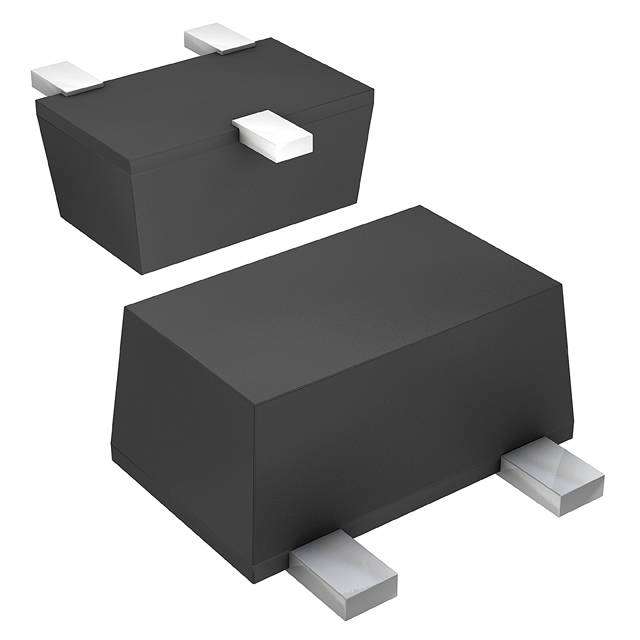
50V VCEO ceiling, 100mA collector limit, 200mW dissipation, UMT3F package with built-in 10k and 47k resistors
Quick Engineering Summary
| Field | Value |
|---|---|
| Manufacturer | Rohm Semiconductor |
| Category | Transistors (BJT) - Single, Pre - Biased |
| Package | UMT3F |
| Core function | TRANS PREBIAS PNP 50V UMT3F |
| Key electrical range | Collector Cut-off Current(Max): 500nA; Frequency - Transition: 250MHz; Maximum Current Collector: 100mA; Maximum Power Dissipation: 200mW |
| Reported stock | 1 pcs reported — confirm on RFQ |
Use it, but for the right job
Good fit.
DTA114YUBTL is an Active pre-biased PNP in UMT3F, and the built-in resistor pair is the real reason to choose it: 10k on the base path and 47k from emitter to base let you collapse a small transistor-plus-resistor network into one SMD part.
Its limits need to stay framed as limits. The 50V VCEO is a ceiling for collector-emitter stress, not a rail to run against, and the 100mA maximum collector current does not settle pulse behavior or thermal headroom by itself. EU RoHS is compliant. For sustaining and new builds alike, the part looks healthy on lifecycle; supply is the only item here that needs immediate attention.
Not for power switching
Power switching is not its job. The 200mW maximum power dissipation and 100mA maximum collector current keep DTA114YUBTL in small-signal switching and biasing roles. It fits board-level logic inversion, pull-up or high-side signal gating, and spots where the integrated 10k and 47k resistors remove two external parts.
300mV tells you how hard saturation was tested
300mV @ 250μA, 5mA is the listed maximum VCE(sat), and the test point matters more than the headline. It shows DTA114YUBTL was characterized in a light-current switching condition, so the number helps when you are checking low-current saturation loss, but it does not answer heavier collector loading near the 100mA ceiling.
The 68 @ 5mA, 5V minimum hFE is similar: useful for showing the device is not starved at that operating point, but not a blanket promise across the whole current range. The 500nA collector cut-off current maximum is low enough to keep this part credible in bias networks and signal paths where off-state drift matters.
50V is the line you do not cross
50V is the decisive figure.
For DTA114YUBTL, that VCEO maximum collector-emitter breakdown voltage is the boundary between a sensible signal-side PNP choice and a field return waiting to happen, because once the rail or transient environment can push past that ceiling, the rest of the attractive details stop mattering.
Package and topology narrow the fit further. UMT3F, with SC-85 called out in the row data, points to dense SMT layouts where saving two resistor placements is worth more than chasing raw transistor flexibility. The 250MHz transition frequency says the transistor itself is not especially slow, but this listing still does not tell you enough to treat it as a high-speed switching answer on its own; the integrated resistor network shapes the real edge behavior, and that behavior is not described here.
Buy it for compact pre-biased PNP duties, not as a generic PNP stand-in. Reel - TR packaging suits assembly flow, but the immediate constraint is quantity: one stock unit is what shows up in the listing, even though quantity shows 1788. Lock that down before you release DTA114YUBTL onto a production BOM.
The gaps are the usual ones that actually matter. There is no package drawing or pinout here, so footprint and orientation cannot be closed from this page. There is no thermal resistance figure, so the 200mW dissipation ceiling cannot be translated into ambient headroom. There is no saturation curve beyond the single 300mV @ 250μA, 5mA point, and no derating curve either. Those missing pieces decide how comfortably DTA114YUBTL survives outside a narrow small-signal role.
View the Win-Source product page for DTA114YUBTL.
Key Takeaways for Engineers & Buyers
- Match the bias network to the built-in 10k R1 and 47k R2 before committing DTA114YUBTL.
- Keep DTA114YUBTL off rails that can exceed the 50V VCEO ceiling.
- Resolve the stock split early: 1 on hand is not enough for a release build.