
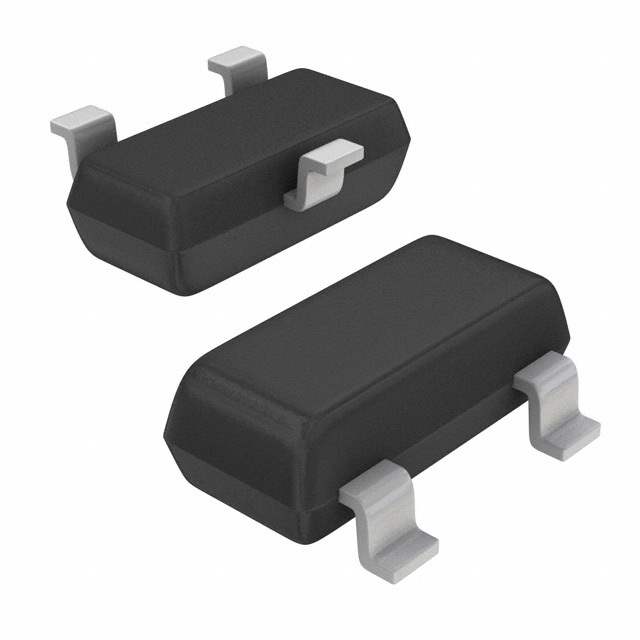
50V VCEO, 20mA collector ceiling, 150mW dissipation, EMT3 package, and 100k/100k built-in bias resistors
Quick Engineering Summary
| Field | Value |
|---|---|
| Manufacturer | Rohm Semiconductor |
| Category | Transistors (BJT) - Single, Pre - Biased |
| Package | EMT3 |
| Core function | TRANS PREBIAS PNP 50V EMT3 |
| Key electrical range | Collector Cut-off Current(Max): 500nA; Frequency - Transition: 250MHz; Maximum Current Collector: 20mA; Maximum Power Dissipation: 150mW |
| Reported stock | 30015 pcs reported — confirm on RFQ |
Not for load drive; useful for small-signal high-side switching
This part is wrong for load drive. The 20mA maximum collector current is a ceiling, not a target, and the 150mW maximum power dissipation rules out relay coils, LED strings, or any switch position where fault energy can build up in a tiny EMT3 body.
It fits much better where its description says it does: compact high-side or pull-up switching with a pre-biased PNP. The built-in 100k base resistor and 100k emitter-base resistor remove two external parts and keep the bias network consistent from build to build. The 50V VCEO ceiling gives useful rail headroom that many logic-side transistor networks lack, but current margin still stays bounded by the same 20mA and 150mW limits.
The listed 300mV max VCE(sat) at 250µA and 5mA matters only at that test point, and it supports a narrower claim than it first appears to: the device can saturate under light load, but that does not say it will remain cool or low-drop as conditions move toward the 20mA ceiling. For new design-in, DTA115EEBTL is a clean fit when board area matters more than discrete bias flexibility, and EU RoHS compliance removes one obvious objection.
Those limits narrow the use case fast
And they narrow it quickly. 50V, 20mA, and 150mW have to be read together, with the thermal budget usually ending the discussion first.
The 82 minimum hFE at 5mA and 5V helps around that operating point. It doesn’t rescue an overloaded switch.
Can you keep a line running on it?
Yes — that is the first buying question, and the answer here is better than average. Lifecycle is Active, supply-and-demand status is Sufficient, and stock quantity is 30015, which supports a running line rather than a spot buy.
Packaging is the practical constraint. The part is listed only as Reel - TR, so it belongs in automated placement planning, not as a casual bench-stock transistor. Storage is called out as dry storage cabinet and humidity protection package, and that handling note should stay attached to incoming material.
The missing data is what closes the circuit call
Some gaps matter.
This listing leaves out the pinout, package drawing, and thermal resistance, so the part is easy to place on a schematic and harder to sign off electrically from this page alone. The internal resistor values are given for the pre-biased transistor, but the transfer behavior around real input voltages still depends on curves that are not shown. ECAD models are not included either, only a note to request them. If the part is headed into a dense layout or a thermally busy corner of the board, get the package drawing and thermal data before freezing the footprint.
View the Win-Source product page for DTA115EEBTL.
Key Takeaways for Engineers & Buyers
- Keep DTA115EEBTL on low-current switching nodes; 20mA collector current is the ceiling.
- Budget dissipation from the 150mW limit before using DTA115EEBTL as a rail-side switch.
- Lock reel usage and feeder setup now; stock is 30015 and packaging is Reel - TR.