
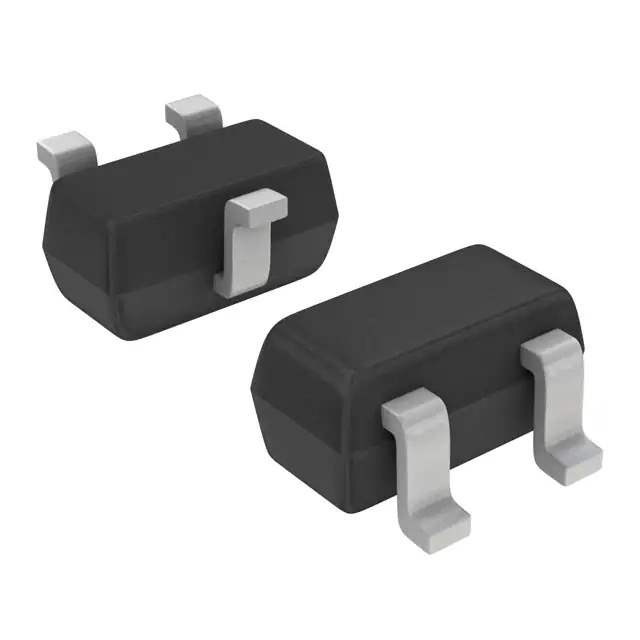
50 V VCEO ceiling, 100 mA collector limit, 200 mW power ceiling in SC-75/SOT-416
Quick Engineering Summary
| Field | Value |
|---|---|
| Manufacturer | ON Semiconductor |
| Category | Transistors (BJT) - Single, Pre - Biased |
| Package | Tape & Reel |
| Core function | TRANS PREBIAS PNP 50V 0. |
| Key electrical range | Current - Collector (Ic) (Max): 100 mA; Current - Collector Cutoff (Max): 500nA; DC Current Gain (hFE) (Min) @ Ic, Vce: 80 @ 5mA, 10V; Power - Max: 200 mW |
| Reported stock | 22000 pcs reported — confirm on RFQ |
50 V says rail fit; Discontinued says no new design
50 V is the number that sets the first boundary. It tells you where this pre-biased PNP can sit in a signal or small-load path without crossing its collector-emitter breakdown ceiling, but it does not make DTA115EET1 a candidate for fresh design work when lifecycle is already Discontinued.
That leaves a simple call: no new design-in. For existing production, it remains a sustaining buy when the circuit already expects a PNP digital transistor with 100 kOhms on R1 and 100 kOhms on R2, and EU RoHS compliance is required.
The weak point is lifecycle, not the tiny package
The weak point comes first: DTA115EET1 is discontinued. The part definition is still specific enough to support hold-position builds, with a built-in 100 kOhms and 100 kOhms bias network in SC-75, SOT-416.
100 mA is a ceiling, and 200 mW closes the thermal door fast
100 mA is the collector ceiling. Pair it with the 200 mW power ceiling and the message is clear: DTA115EET1 belongs in light switching and biasing jobs, not in roles that lean on current headroom just because voltage is still inside limits.
The listed 250mV @ 300µA, 10mA saturation figure is useful, but only in a narrow way. It shows what the part can do at 10mA collector current with 300µA base drive through the internal network; it does not describe behavior at heavier load, and the listing gives no curve showing how dissipation rises across the rest of the operating range.
The 80 @ 5mA, 10V minimum hFE also stays tied to its stated condition. It is not a blanket promise across every bias point.
What would a buyer ask first: can we keep the line running?
Can we keep the line running? Yes, for now. The available quantity is 22000, and packing is Tape & Reel with a standard package of 3,000 pcs.
That supports a controlled sustaining purchase when the board is already locked to DTA115EET1 and the SC-75, SOT-416 footprint cannot move without a respin. Stock answers the immediate build question. Lifecycle answers the strategic one, and that answer is worse.
A discontinued pre-biased transistor does not belong on an open production release, especially when the internal resistor values are part of the function rather than a convenience. Use DTA115EET1 only against scheduled demand, pull forward the exact quantity needed for existing production, and shift engineering effort to a qualified alternate path instead of treating current stock as proof of continuity.
There is still a fit argument for the installed base. Surface mount, SC-75, SOT-416, and a PNP pre-biased structure suit dense logic-level interface spots, transistor arrays broken into singles, or housekeeping control nodes where board area matters. Not for load driving.
The missing details are the ones that close the real review
And those gaps matter because the listing still leaves out the pinout and package drawing, so footprint confirmation cannot happen here. It also omits thermal resistance and any derating curve, the details that decide ambient headroom once you get near the 200 mW ceiling.
There is no switching-time data either. For a pre-biased transistor, that gap matters more than another line of static specs.
View the Win-Source product page for DTA115EET1.
Key Takeaways for Engineers & Buyers
- Block new BOM releases on DTA115EET1; lifecycle is Discontinued.
- Check rail stress against the 50 V collector-emitter ceiling before any last-time build.
- Confirm the built-in bias network fits the drive scheme: R1 is 100 kOhms and R2 is 100 kOhms.