
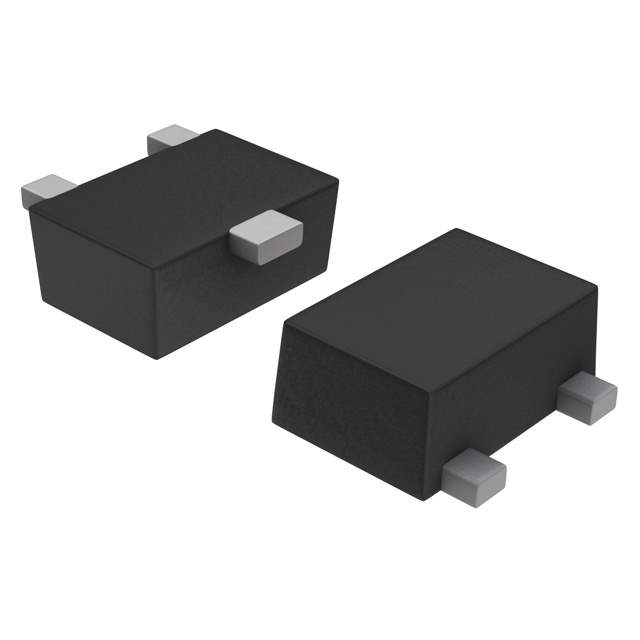
50V VCEO ceiling, 100mA collector limit, 260mW dissipation ceiling, SOT-723 package
Quick Engineering Summary
| Field | Value |
|---|---|
| Manufacturer | ON Semiconductor |
| Category | Transistors (BJT) - Single, Pre - Biased |
| Package | SOT-723 |
| Core function | TRANS PREBIAS PNP 50V SOT723 |
| Key electrical range | Collector Cut-off Current(Max): 500nA; Maximum Current Collector: 100mA; Maximum Power Dissipation: 260mW; Supply and Demand Status: Sufficient |
| Reported stock | 149460 pcs reported — confirm on RFQ |
50V is the real gate on where DTA115EM3T5G belongs
50V sets the boundary. It is the VCEO ceiling, not a rail you design up to, and that alone puts DTA115EM3T5G in low-energy high-side bias and small-signal switching work rather than anywhere rail noise, transients, or avalanche behavior will decide the outcome.
The rest of the limits tighten the fit quickly. Maximum collector current is 100mA, and maximum power dissipation is 260mW. Those are hard ceilings, so this part belongs in housekeeping paths, level shifting, and simple load gating, not in circuits that spend real time carrying current or burning power across the device.
There is one useful operating reference point. VCE(sat) is listed at 250mV max at 300μA and 10mA, which anchors the saturation claim to an actual test condition, but only that condition; move to a different current corner and the listing stops answering the important questions.
The built-in resistor network is the real convenience here. R1 is 100k and R2 is 100k, which cuts BOM count and placement effort on dense logic-facing boards in SOT-723. It also fixes the input behavior. If the drive scheme needs a different resistor ratio, DTA115EM3T5G is the wrong shortcut.
Can you keep DTA115EM3T5G on a running line?
Can I buy it repeatedly without turning every build into an exception? Yes. Lifecycle is Active, stock is listed at 149460, packaging is Reel - TR, and supply-demand status is marked sufficient, so DTA115EM3T5G reads like a normal production buy, not a cleanup purchase.
One practical constraint remains: SOT-723. If the line already handles very small SMT discretes, fine. If not, the package will slow adoption through handling, inspection, and rework more than lifecycle will. Put the reel buy against assemblies that already accept SOT-723, and keep EU RoHS in the same approval path.
The missing curves matter more than the listed gain
The weak point is documentation depth. The strong point is that the gaps are clear: pinout, package drawing, thermal resistance, derating curve, and switching behavior are not shown here.
SOT-723 tells you this is a density play, not a load switch
260mW is the decisive number. Pair it with the 100mA maximum collector current and DTA115EM3T5G reads as a compact control transistor for crowded boards, not a part for sustained load current just because the collector rating exists.
And the gain figure only helps in context: hFE is 80 minimum at 5mA and 10V. That supports low-current signal work around the stated test condition. It does not describe behavior at the 100mA ceiling, and it does not fill in the missing thermal data. Collector cut-off current is 500nA max, a useful leakage ceiling when off-state drift matters more than current handling.
View the Win-Source product page for DTA115EM3T5G.
Key Takeaways for Engineers & Buyers
- Keep DTA115EM3T5G on low-power bias and switching nodes; 260mW is the dissipation ceiling.
- Match the built-in network to the drive source: R1 is 100k and R2 is 100k.
- Buy on reel for the running line while stock shows 149460.