
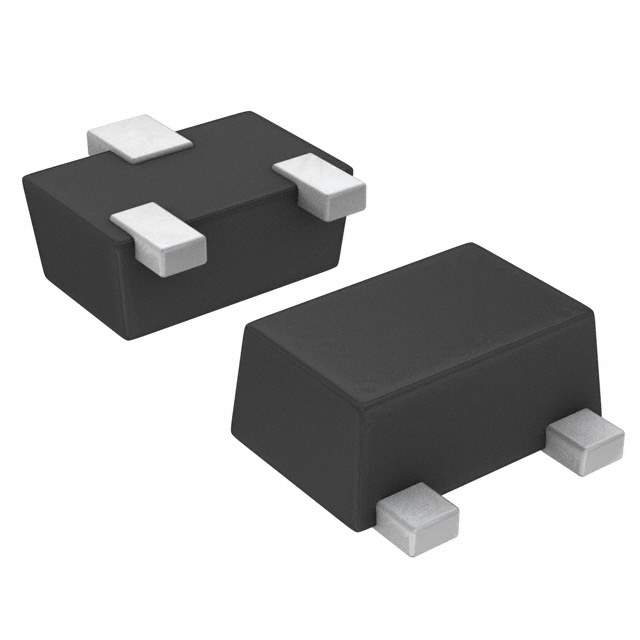
50V VCEO, 100mA collector, 150mW dissipation, VMT3 package define the limits of this pre-biased PNP.
Quick Engineering Summary
| Field | Value |
|---|---|
| Manufacturer | Rohm Semiconductor |
| Category | Transistors (BJT) - Single, Pre - Biased |
| Package | VMT3 |
| Core function | TRANS PREBIAS PNP 50V 0. |
| Key electrical range | Collector Cut-off Current(Max): 500nA (ICBO); Frequency - Transition: 250MHz; Maximum Current Collector: 100mA; Maximum Power Dissipation: 150mW |
| Reported stock | 8000 pcs reported — confirm on RFQ |
Not for load switching; fine for small-signal biasing
This is the wrong part for load switching. The 100mA collector current is a ceiling, not a target, and the 150mW maximum power dissipation is usually the tighter limit because a tiny VMT3 body leaves little thermal headroom.
It fits better in compact high-side or pull-up style signal control, where the built-in 100k base resistor removes one external part and current stays modest. DTA115TMT2L is Active, with no stated lifecycle conflict, so new design-in is reasonable. EU RoHS is compliant.
The weak point is power, not voltage
The weak point comes first: 150mW maximum power dissipation leaves little room for sloppy biasing or sustained conduction. That number does not establish ambient capability by itself, and it does not support any heatsink assumption. It tells you this device belongs in light-duty switching and bias networks, not in circuits expected to absorb board-level mistakes.
Voltage is the cleaner limit. The 50V VCEO rating is a hard ceiling, so if collector-emitter stress can approach 50V, you are already at the edge and need another device. The listed 300mV max VCE(sat) at 100µA and 1mA is useful only in that test condition; it points to low-current switching behavior, not saturation loss near the 100mA ceiling.
Can you buy it for a running line?
Yes, if the package and packaging fit your flow. DTA115TMT2L is listed with 8000 in stock and reel - TR packaging, which suits automated SMT consumption better than hand-loaded service stock, especially when the package is VMT3 and the alternate package naming in the row points to SOT-723 scale handling.
The built-in resistor network is the whole reason to pick it. You get a PNP pre-biased transistor with only R1 listed, at 100k, so it belongs in simple inverter stages, level-shifted enables, and pull-up side control where that resistor value is intentional. If you need freedom to tune base drive with an external resistor pair, this part takes that option off the table from the start.
One more number matters. The 500nA ICBO max is a leakage ceiling, not a typical promise, but it still sets a small off-state collector leakage target for signal paths that care about unwanted bias current. The 250MHz transition frequency is listed too, yet without switching waveforms or capacitance data it does not settle pulse-edge behavior on a real board.
The missing data is the real review blocker
Key details are missing. Pinout, package drawing, thermal resistance, and resistor tolerance on the 100k R1 value are still needed before layout and thermal review can close.
View the Win-Source product page for DTA115TMT2L.
Key Takeaways for Engineers & Buyers
- Keep VCEO below the 50V ceiling; this part does not close higher-voltage rail decisions.
- Budget dissipation against the 150mW maximum before treating the 100mA collector rating as usable current.
- Buy on reel if DTA115TMT2L is going to line build; packaging is TR and listed stock is 8000.