
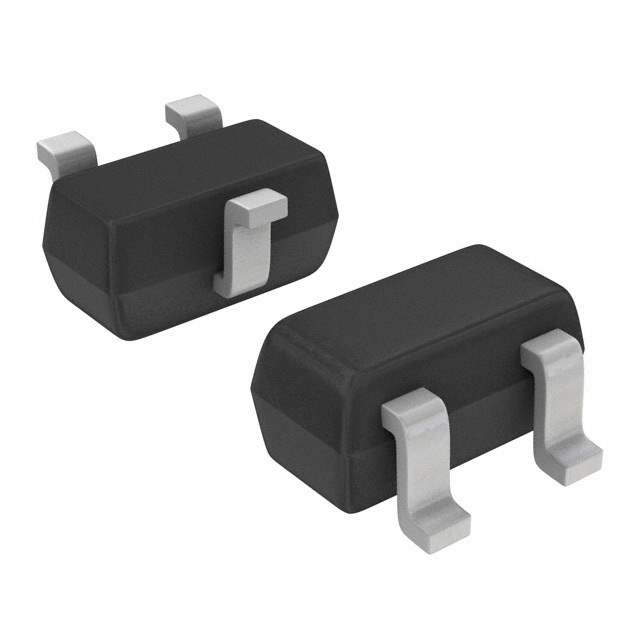
50V VCEO ceiling, 100mA collector limit, 200mW dissipation cap in SC-75/SOT-416
Quick Engineering Summary
| Field | Value |
|---|---|
| Manufacturer | ON Semiconductor |
| Category | Transistors (BJT) - Single, Pre - Biased |
| Package | SC-75, SOT-416 |
| Core function | TRANS PREBIAS PNP 50V 0. |
| Key electrical range | Collector Cut-off Current(Max): 500nA; Maximum Current Collector: 100mA; Maximum Power Dissipation: 200mW; Supply and Demand Status: Balance |
| Reported stock | 122000 pcs reported — confirm on RFQ |
Wrong for fresh programs, still usable on a running line
Not for a new platform. DTA123EET1 is marked EOL, and that settles the design-in question before the electrical limits even come up.
It still fits existing production that already expects a PNP pre-biased transistor with 2.2k on R1 and 2.2k on R2 in SC-75, SOT-416. That built-in resistor network is the real fit call: compact bias-and-switch work where board area matters and the surrounding circuit was drawn for a digital transistor rather than a bare BJT. RoHS is still unsettled. One field says RoHS Compliant and another says RoHS Non-Compliant, so DTA123EET1 belongs on compliance hold until that conflict is cleared.
50V is a ceiling, not permission to run hot
50V sets the tone. VCEO is a breakdown ceiling, not a normal operating target, and the same goes for the 100mA collector rating and 200mW dissipation cap.
The package says small-signal switching, not load driving
The constraint is heat. SC-75, SOT-416 and SMD mounting point to tight board-level control work, not jobs that ask a tiny package to absorb much power or shrug off rough rail transients.
The listed 250mV @ 5mA, 10mA for VCE(sat) is useful only at that test corner. It shows a low saturation drop at modest current, but says nothing about behavior near the 100mA collector ceiling, so it does not close the loss budget for heavier switching. The minimum hFE of 8 @ 5mA, 10V points the same way. This is a modest-gain, pre-biased transistor for simple interface and inversion duties, where the built-in 2.2k and 2.2k resistors save parts count and placement time. Keep DTA123EET1 in logic-adjacent switching and bias networks. Keep it out of designs that need wide current headroom or thermal forgiveness.
Stock exists, but the real risk is what the listing omits
The weak point is closure, not availability. There are 122000 pieces shown, and reel - TR packaging works for line loading if you need this exact footprint and resistor setup.
The bigger problem is what is missing. There is no pinout, no package drawing, and no thermal resistance figure, so land pattern, orientation, and ambient headroom cannot be closed from this page. There is also no derating curve and no switching data such as transition or storage behavior, leaving the time-domain side of DTA123EET1 open right where pre-biased transistors often get used for fast logic-level switching.
ECAD is listed only as contact us to download, so layout work stays gated by external files. For an existing build, buy only against a defined production need and lock the mechanical and thermal documents before release. For anything new, DTA123EET1 asks for too many exceptions at once: EOL lifecycle, unresolved RoHS status, and missing package-level detail.
View the Win-Source product page for DTA123EET1.
Key Takeaways for Engineers & Buyers
- Block new design-in; DTA123EET1 is marked EOL.
- Check rail and load against the 50V VCEO ceiling and 100mA collector ceiling.
- Resolve the RoHS conflict before release; one field says compliant and another says non-compliant.