
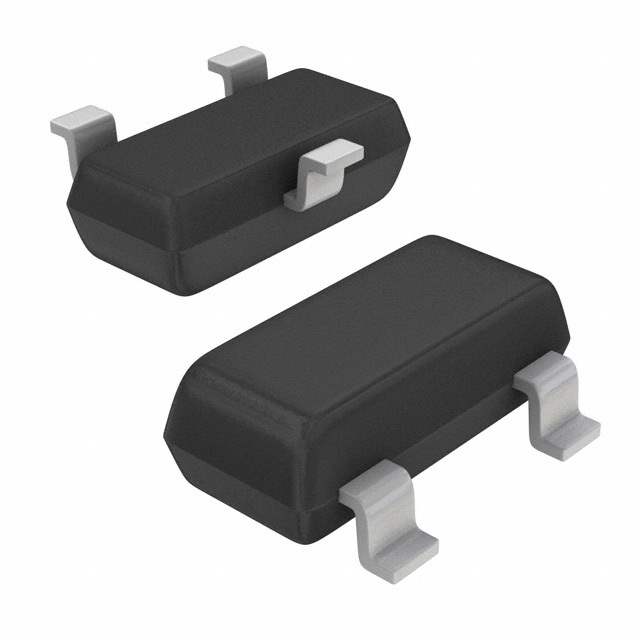
50V VCEO, 100mA collector ceiling, 150mW dissipation limit, EMT3 package, with 2.2k/2.2k built-in bias resistors
Quick Engineering Summary
| Field | Value |
|---|---|
| Manufacturer | Rohm Semiconductor |
| Category | Transistors (BJT) - Single, Pre - Biased |
| Package | EMT3 |
| Core function | TRANS PREBIAS PNP 50V 0. |
| Key electrical range | Collector Cut-off Current(Max): 500nA; Frequency - Transition: 250MHz; Maximum Current Collector: 100mA; Maximum Power Dissipation: 150mW |
| Reported stock | 5300 pcs reported — confirm on RFQ |
Then the real decision is whether the ceilings fit
And they are ceilings, not operating targets. DTA123EETL sets a 50V VCEO limit, a 100mA maximum collector current, and 150mW maximum power dissipation in EMT3. Those numbers carry most of the design-in case because they bound rail headroom, load current, and how much switching loss the package can absorb before the part is being asked to do work it was never meant to do.
The built-in 2.2k R1 and 2.2k R2 are the other clear reason to choose this device over a plain small-signal PNP. They lock in a fixed bias network and trim the BOM when the control source is already defined, so turn-on behavior stays predictable without adding external resistors. That convenience cuts both ways. If the base-drive scheme needs a different resistor split, DTA123EETL is no longer the tidy answer.
The listed 300mV max VCE(sat) at 500µA, 10mA is useful, but only at that stated condition. It shows the part can pull into saturation at light current with modest drop; it does not clear a higher-current switch path, and it does not stand in for a forward-loss curve. The 500nA maximum collector cut-off current also matters in low-leakage bias and shutdown paths where an off-state node cannot tolerate much drift. In practice, DTA123EETL fits compact pre-biased PNP stages when the fixed resistor network suits the circuit and the design stays comfortably inside the voltage, current, and dissipation ceilings. EU RoHS compliance supports that call.
Can you keep a running line on it?
What does supply look like right now? Stock is 5300 and packaging is Reel - TR. With lifecycle listed as Active, the real question is whether 5300 pieces fits your build cadence.
Wrong for power switching, right for compact bias stages
Wrong for power switching. A 100mA collector-current ceiling and 150mW dissipation ceiling mark this as a control element, not a load-driving workhorse.
It does fit small SMT bias, level-shift, and inverter duty where a PNP with integrated resistors simplifies placement and assembly. The 250MHz transition frequency says it is not a sluggish transistor, but that number alone does not qualify it for fast switching edges or RF work because the listing does not include capacitance or switching-time data. The minimum hFE of 20 at 20mA, 5V is enough to frame gain at that test point, not to generalize across every collector current.
The missing data is what closes layout and stress review
The constraint is missing detail. Four practical items still need the datasheet: pinout, package drawing, thermal resistance, and switching-time or capacitance data.
Pinout and drawing decide whether EMT3 drops cleanly into your footprint; the listing names EMT3 and also carries SC-75, SOT-416 in the row data, but that still is not a land pattern. Thermal resistance is absent, so the 150mW ceiling cannot be translated into ambient headroom on your board. Switching-time and junction-capacitance figures are absent too, leaving edge speed and node loading unresolved. Those are the gaps that hold up layout release.
View the Win-Source product page for DTA123EETL.
Key Takeaways for Engineers & Buyers
- Keep DTA123EETL out of loads that can force more than 100mA collector current.
- Budget dissipation against the 150mW ceiling before using DTA123EETL as a saturated switch.
- Confirm the EMT3 land pattern and pinout from the datasheet before layout.