
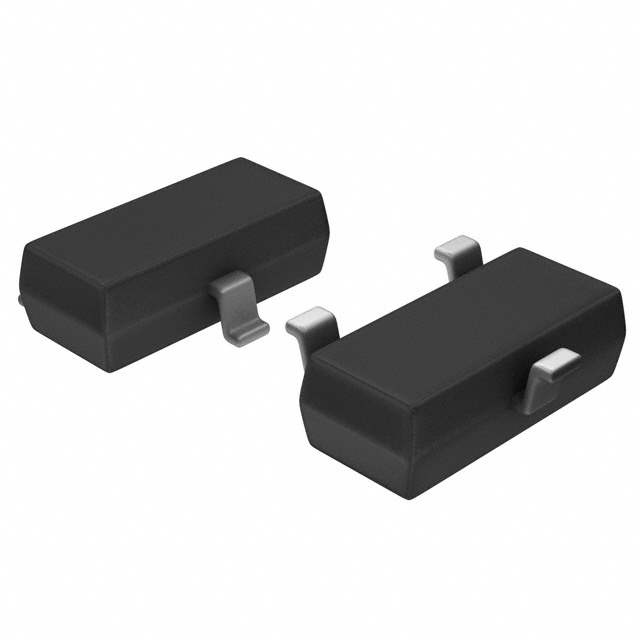
50V VCEO, 100mA collector, 200mW dissipation, SMT3 package, with built-in 2.2k/2.2k bias resistors
Quick Engineering Summary
| Field | Value |
|---|---|
| Manufacturer | Rohm Semiconductor |
| Category | Transistors (BJT) - Single, Pre - Biased |
| Package | SMT3 |
| Core function | TRANS PREBIAS PNP 50V 0. |
| Key electrical range | Collector Cut-off Current(Max): 500nA (ICBO); Frequency - Transition: 250MHz; Maximum Current Collector: 100mA; Maximum Power Dissipation: 200mW |
| Reported stock | 4662 pcs reported — confirm on RFQ |
The real limit here is power, not just voltage
The constraint is power first. DTA123EKAT146 is easy to place electrically, but the 200mW maximum power dissipation will end a design faster than the 50V headline if the load asks the package to shed real heat.
The other hard ceiling is 100mA maximum collector current. That rules out loads that treat this like a general-purpose power transistor. The listed 300mV max VCE(sat) at 500µA and 10mA is useful at that test point, but it says nothing about saturation loss near the 100mA ceiling. Keep it in low-current switching and level-control work, where the built-in bias network saves parts count without turning thermal margin into the limiting factor.
50V is enough rail margin for control paths
50V sets the first screen. It gives DTA123EKAT146 credible rail margin on higher-voltage control paths where a small pre-biased transistor might otherwise get ruled out early.
The built-in resistors are the other reason to use it. R1 is 2.2k and R2 is 2.2k, so this is not a blank BJT waiting for an external bias network. That plays well in dense SMT3 layouts where BOM count matters more than transistor flexibility. It does not fit circuits that need custom base-drive shaping, because those resistor values are already fixed inside the part.
200mW keeps it in signal switching, not load driving
200mW is the decisive figure. It puts DTA123EKAT146 in signal-path switching, pull-up or pull-down inversion, and simple transistor interfaces, not in jobs where the transistor carries meaningful load power for long stretches.
The gain listing is modest too: hFE minimum is 20 at 20mA and 5V. That supports a switch-and-control role, not a weak-drive rescue strategy. The 250MHz transition frequency is interesting, but without switching waveforms or capacitance data, it does not qualify the part for fast edge-sensitive work.
The buy call is good, but one field needs explaining
The weak point is the lifecycle paperwork. DTA123EKAT146 is marked Active in the lifecycle fields and Status, yet there is also an Estimated EOL Date of 2024. Those statements conflict, so the explicit Active status carries more weight than the estimate, but this is still the item to clear before a long program locks it in.
The supply picture is much better. Stock quantity is 4662, packaging is Reel - TR, supply and demand is marked Balance, and the part is called common-used with high popularity. Taken together, that reads like a workable line item for ongoing builds rather than a thin-stock niche device, and EU RoHS compliance removes the compliance friction called out on some borderline sourcing decisions.
So the buy call is solid, with one caveat that deserves direct follow-up. Reconcile the lifecycle note while inventory is available, then buy in reel form that matches the SMT line instead of treating DTA123EKAT146 as a convenience part for spot demand.
What the listing still does not answer
What is the package, exactly? There is no pinout or package drawing here, even though the text also names TO-236-3, SC-59, and SOT-23-3 around the SMT3 callout. RθJC, a derating curve, pulse or surge current, and capacitance data are also absent.
View the Win-Source product page for DTA123EKAT146.
Key Takeaways for Engineers & Buyers
- Keep DTA123EKAT146 on rails that stay inside the 50V VCEO ceiling.
- Treat 100mA collector and 200mW dissipation as separate ceilings when sizing load current.
- Lock reel usage and line-side storage around TR packaging and dry storage handling.