
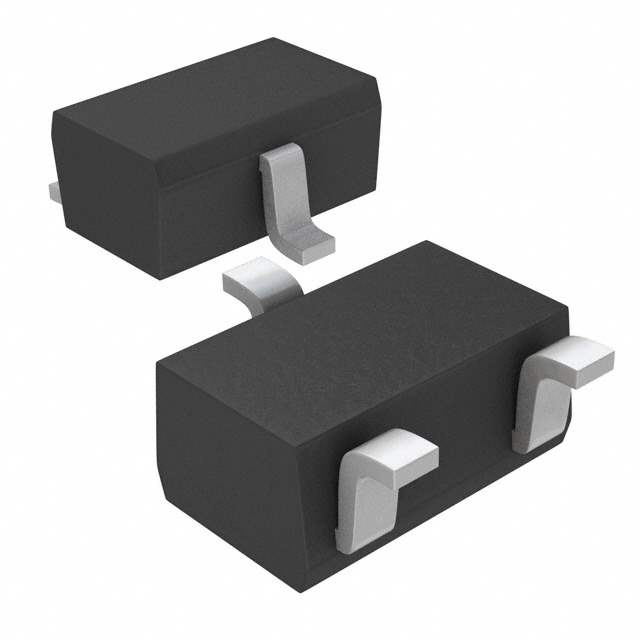
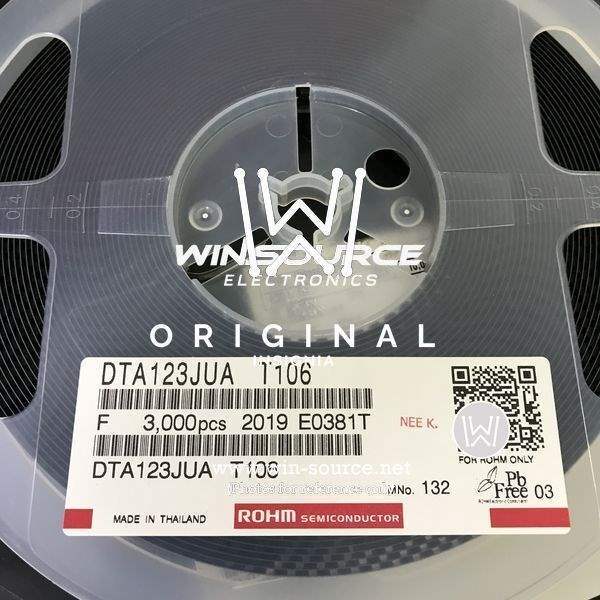
50V VCEO ceiling, 100mA collector limit, 200mW dissipation ceiling, UMT3 pre-biased PNP
Quick Engineering Summary
| Field | Value |
|---|---|
| Manufacturer | Rohm Semiconductor |
| Category | Transistors (BJT) - Single, Pre - Biased |
| Package | UMT3 |
| Core function | TRANS PREBIAS PNP 50V 0. |
| Key electrical range | Collector Cut-off Current(Max): 500nA; Frequency - Transition: 250MHz; Maximum Current Collector: 100mA; Maximum Power Dissipation: 200mW |
| Reported stock | 248200 pcs reported — confirm on RFQ |
50V is useful, but the lifecycle call stays conservative
50V is what puts DTA123JUAT106 in the conversation. For a pre-biased PNP in UMT3, that collector-emitter breakdown ceiling leaves room for higher-voltage small-signal switching and bias networks where lower-voltage digital transistors get ruled out early.
The lifecycle call still lands on sustaining use. One field says Active, another says not suitable for new design, and that conflict outweighs the attractive stock figure of 248200. If DTA123JUAT106 is already qualified on a running line, the listed stock, sufficient supply status, and reel packaging support continued builds. For a fresh design, the safer move is to avoid adding a new dependency with mixed lifecycle signals.
EU RoHS compliance is clear, but it does not answer the sourcing question. The practical fit is narrow: compact SMD bias-and-switch work where the built-in resistor network cuts placements and keeps the front end simple, while the 100mA collector limit and 200mW dissipation ceiling keep the part in modest-duty territory. Small part, small budget.
200mW is the real ceiling in UMT3
200mW is the decisive limit. The 100mA collector rating is a maximum, but in UMT3 the power ceiling closes the design faster whenever appreciable voltage remains across the device.
Can you keep a line running on DTA123JUAT106?
Can you keep buying it for production? Yes, if this is an existing part on an existing build. With 248200 in stock, TR reel packaging, and sufficient supply status, DTA123JUAT106 looks supportable for scheduled builds rather than emergency coverage.
Treat it like a sustaining component. Pull in the quantity needed for the next build window, keep storage aligned with the listed dry storage cabinet and humidity protection package condition, and don't spread it into new assemblies just because current stock is deep.
The resistor network helps, but the missing curves still matter
And the built-in network is still the main reason to use it. R1 is 2.2k and R2 is 47k, so DTA123JUAT106 fits simple bias-and-drive stages where one placement replaces a transistor plus two external resistors. The listed hFE minimum of 80 at 10mA, 5V and VCE(sat) maximum of 300mV at 250μA, 5mA point to modest current switching, not heavy saturation duty.
The missing items are concrete. There is no pinout, no package drawing, no thermal resistance, and no derating curve here. Transition frequency is listed as 250MHz, but without capacitance data or those package details, that number alone does not close a high-speed switching review.
View the Win-Source product page for DTA123JUAT106.
Key Takeaways for Engineers & Buyers
- Treat 50V VCEO as a ceiling; keep rail transients and fault cases inside it.
- Check load current against the 100mA collector limit and the 200mW dissipation ceiling together.
- Lock reel usage and incoming storage to TR handling with dry storage cabinet and humidity protection package.