
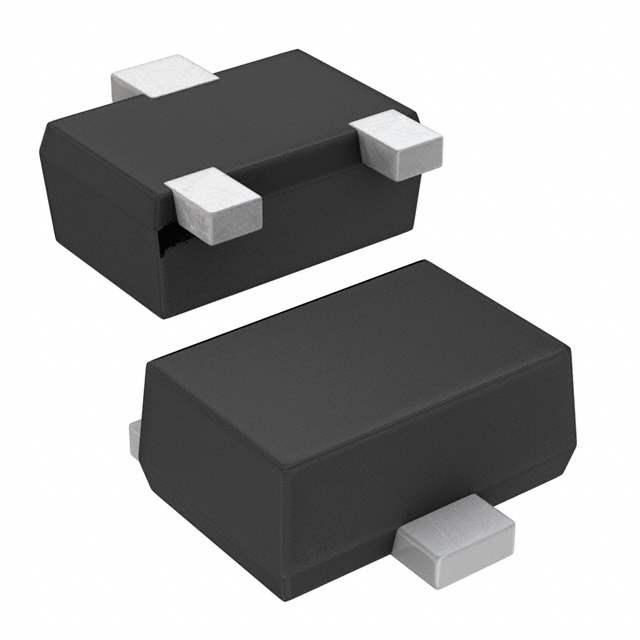
50V VCEO, 100mA collector ceiling, 200mW dissipation limit, UMT3F pre-biased PNP
Quick Engineering Summary
| Field | Value |
|---|---|
| Manufacturer | Rohm Semiconductor |
| Category | Transistors (BJT) - Single, Pre - Biased |
| Package | UMT3F |
| Core function | TRANS PREBIAS PNP 50V UMT3F |
| Key electrical range | Collector Cut-off Current(Max): 500nA; Frequency - Transition: 250MHz; Maximum Current Collector: 100mA; Maximum Power Dissipation: 200mW |
| Reported stock | 36000 pcs reported — confirm on RFQ |
50V is the first gate, but the resistor pair is the real commitment
50V sets the first boundary. It tells you quickly whether DTA123JUBTL belongs on the rail at all, because collector-emitter breakdown is capped there and anything above it ends the conversation before switching behavior, leakage, or package fit even matter.
The more consequential choice is the built-in network. R1 is 2.2k and R2 is 47k, so this is not a generic PNP you can drop into a stage and tune later with external base resistance. Those values either line up with the drive scheme or they do not. When they fit, the part can simplify a compact high-side small-signal switch or inverter; when they do not, the device starts the design in the wrong place.
The remaining limits need to be read as ceilings. Maximum collector current is 100mA, and maximum power dissipation is 200mW. That combination does not support treating 100mA as a routine operating point in any ambient, especially with no derating curve and no RθJC listed here. The listed VCE(sat) is 300mV at 250μA and 5mA, which gives a bounded low-current switching reference and nothing more for heavier collector load.
Availability strengthens the case. Active lifecycle status, reel packaging, and 36000 in stock make this look like a real new design-in option rather than a part being kept alive for legacy support, and EU RoHS compliance removes a common sourcing obstacle.
200mW is the ceiling that keeps the 100mA rating honest
200mW is the decisive limit. In a UMT3F body, that ceiling keeps DTA123JUBTL from being treated like an easy 100mA switch, especially since the listing gives no thermal resistance or derating curve.
The weak point is missing package detail, not availability
The weak point is documentation depth. The listing names UMT3F and also points to SC-85, but it does not include the pinout or package drawing, and those details decide whether DTA123JUBTL drops into an existing footprint without a board spin.
Past that, the fit is straightforward. This is a surface-mount, pre-biased PNP for compact signal-level switching where the fixed 2.2k and 47k network is intentional, leakage stays low at 500nA max, and transition frequency at 250MHz keeps it out of the obviously slow bucket. It is not the part to pick when you need to tune base drive or push collector current as a normal operating point.
View the Win-Source product page for DTA123JUBTL.
Buy it for reels, not for loose flexibility
Buy it.
The purchasing constraint is packaging: DTA123JUBTL is listed on Reel - TR, with 36000 available. That suits a running SMT line more than hand-build or mixed-footprint prototyping. Lock the footprint against the UMT3F or SC-85 package data before releasing the BOM, then buy in reel form if the built-in resistor values already match the circuit.
View the Win-Source product page for DTA123JUBTL.
Key Takeaways for Engineers & Buyers
- Keep VCEO below the 50V ceiling; that number decides rail compatibility, not operating margin by itself.
- Budget heat against the 200mW maximum before using the 100mA collector rating as a design target.
- Match the built-in 2.2k R1 and 47k R2 to the drive network; DTA123JUBTL is not a blank small-signal PNP.