
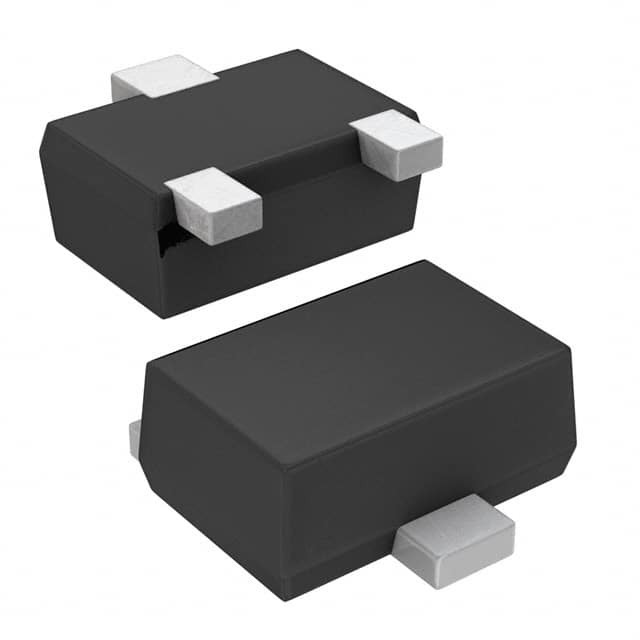
50 V, 100 mA, 150 mW pre-biased PNP in UMT3F for running lines, not a clean new design pick
Quick Engineering Summary
| Field | Value |
|---|---|
| Manufacturer | Rohm Semiconductor |
| Category | Transistors (BJT) - Single, Pre - Biased |
| Package | UMT3F |
| Core function | TRANS PREBIAS PNP 50V UMT3F |
| Key electrical range | Supply and Demand Status: Balance |
| Reported stock | 2460 pcs reported — confirm on RFQ |
Wrong for fresh platforms, still usable on a running line
Don’t use this for a new platform. DTA123YEBTL is a pre-biased PNP in UMT3F with built-in R1 and R2, so it still fits when you need to preserve an existing bias network and footprint, but the listed Part Status is Not For New Designs even though lifecycle is Active.
That conflict is the real story. Active says Rohm Semiconductor has not moved it to EOL or Discontinued status; Not For New Designs says do not build a new release around it. For sustaining production, that mix is workable. For a clean-sheet board, it isn’t. EU RoHS is compliant, and MSL 1 helps on the handling side, but neither changes the lifecycle call.
50 V is the ceiling that decides whether it belongs
50 V is the number that decides the first pass. It is the collector-emitter breakdown ceiling, not an operating rail, so the question is simple: does your worst-case VCE stay below it? What you do not get here is the transient or derating detail that would show how much margin remains once the circuit sees real switching stress, startup behavior, or line variation.
The next hard limit is 100 mA collector current. That keeps DTA123YEBTL in small-signal switching and bias-control work, not in any spot where load current can drift upward during startup or fault conditions. If the transistor is acting as a bounded control element, that can be fine. If it is being treated like a casual current path, it is easy to ask too much of it.
Power is the other constraint. The maximum is 150 mW, and in a UMT3F body that thermal budget matters quickly. The listing also gives VCE(sat) as 300 mV at 500 µA and 10 mA, which at least shows the part is characterized for low-current saturation use, but there is no thermal resistance or derating curve here to tell you how much ambient headroom you really have once the board and enclosure are fixed.
Then come the built-in resistors, which are the reason to use the part in the first place. R1 is 2.2 kOhms and R2 is 10 kOhms. Those values lock in the base-drive network and cut external parts count, but they also remove tuning freedom. If your logic drive or leakage budget wants different resistor values, the integration stops helping fast.
The weak point is flexibility
The weak point is flexibility. The strength is integration: DTA123YEBTL puts a PNP plus R1 and R2 into one UMT3F footprint, so it works in compact bias, level-shift, and small load-switch positions when those resistor values already fit the circuit.
2460 pieces means buy for continuity, not comfort
2460 pieces are listed in stock. Package quantity is 3000, and packaging is Reel - TR.
That supports a running line or a service build, but it does not erase the lifecycle conflict. Use it when the built-in 2.2 kOhms and 10 kOhms are already designed in and changing them would trigger a board spin or requalification. In that case, lock down the reel plan and keep DTA123YEBTL tied to existing production. The open-market fake threat is listed at 83 pct., so uncontrolled spot buys are where schedule risk rises.
What the listing still does not tell you
And that leaves the practical gaps. There is no pinout or package drawing here, so footprint confirmation still depends on the datasheet. There is no thermal resistance or derating curve, which leaves the 150 mW ceiling without ambient context. There is no switching-time data, and no input or junction capacitance, so speed and edge-shaping work stop at the 250 MHz figure.
View the Win-Source product page for DTA123YEBTL.
Key Takeaways for Engineers & Buyers
- Do not start a new platform on DTA123YEBTL; Part Status is Not For New Designs.
- Check the rail against the 50 V collector-emitter breakdown ceiling before reusing DTA123YEBTL.
- Plan reel usage around 3000 per package; listed stock is 2460.