
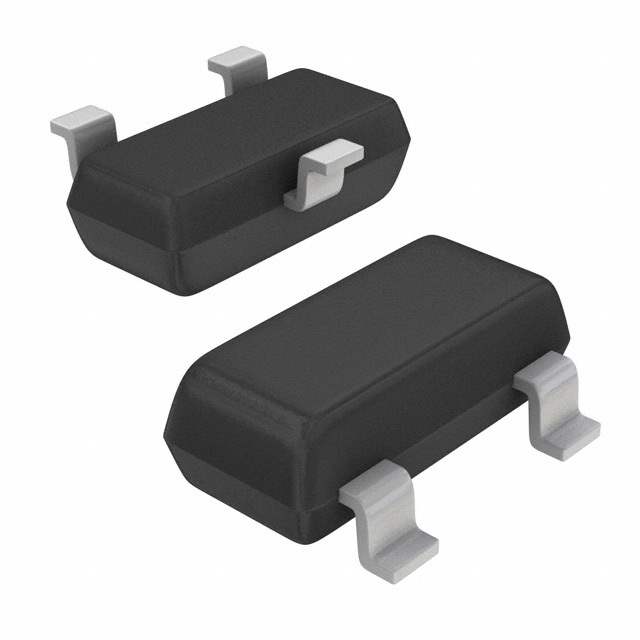
50V VCEO, 100mA collector ceiling, 150mW dissipation, EMT3 package, built-in 2.2k and 10k resistors
Quick Engineering Summary
| Field | Value |
|---|---|
| Manufacturer | Rohm Semiconductor |
| Category | Transistors (BJT) - Single, Pre - Biased |
| Package | EMT3 |
| Core function | TRANS PREBIAS PNP 50V 0. |
| Key electrical range | Collector Cut-off Current(Max): 500nA; Frequency - Transition: 250MHz; Maximum Current Collector: 100mA; Maximum Power Dissipation: 150mW |
| Reported stock | 6900 pcs reported — confirm on RFQ |
Good for new builds, with one clear boundary
Use it.
An Active lifecycle removes the supply-side objection to new design-in, and reel packaging plus 6900 stock supports normal SMT purchasing rather than one-off bench use.
The real boundary is electrical. The 50V VCEO is a collector-emitter ceiling, the 100mA maximum collector current is a load-current ceiling, and the 150mW maximum power dissipation keeps the part in small-signal switching territory. EU RoHS is compliant. That mix suits compact bias-and-switch functions, not loads that press on current or heat.
Not for power switching; right for resistor-fixed drive
This part is wrong for circuits that need bias freedom or much thermal margin. The built-in 2.2k base resistor and 10k emitter-base resistor fix the bias network, so any design that needs to tune base drive, turn-off behavior, or input impedance runs into the resistor network first.
It fits better in a compact PNP stage where fewer externals and a predictable bias structure matter more than adjustability. The listed 300mV max VCE(sat) at 500µA, 10mA is a light-current characterization point, not a blanket low-drop promise up to the 100mA ceiling. The 33 minimum hFE at 10mA, 5V is enough to frame low-current switching behavior, but it does not settle a decision on heavier collector loading.
And the package keeps it in the small-signal lane
And that package choice reinforces the same point. EMT3, with SMD mounting and the SC-75, SOT-416 package note, points to dense board-level logic inversion, level shifting, and simple load gating where board area matters more than adjustable bias.
The 250MHz transition frequency says the transistor itself is not unusually slow, but that number alone does not tell you how the integrated resistors shape edge speed in the actual network. Leakage is at least well behaved on paper: 500nA maximum collector cut-off current helps when the off-state has to stay quiet. What still blocks final signoff is missing heat-flow and connection detail, not the headline limits.
Can you keep a line running on it?
Can you buy enough of it? Yes. Reel supply and the listed 6900 stock support a running SMT line, assuming EMT3 is already qualified on the board.
The missing datasheet items are the real review blockers
150mW is the decisive number.
It is the ceiling most likely to get crossed by accident once DTA123YETL is used as a switch instead of a bias element, and the listing does not give the thermal context needed to judge how close a real board can run to that limit under actual ambient and layout conditions.
The first gap is thermal resistance or a derating curve. Without either, the 150mW figure stays a bare ceiling and cannot be translated into ambient headroom on a real PCB. The second gap is pinout and package drawing. EMT3 and the SC-75, SOT-416 note identify the footprint family, but they do not settle pad orientation or assembly detail.
The third gap is fuller saturation behavior. You get 300mV max at 500µA, 10mA, which is useful, but there is no forward-drop curve across a wider current range, and that is the curve that shows where dissipation starts to crowd the package. The fourth gap is any transient current rating. No surge or pulse handling figure appears here, so the part should be treated as a small-signal transistor with fixed resistive bias until the full datasheet fills in those limits.
View the Win-Source product page for DTA123YETL.
Key Takeaways for Engineers & Buyers
- Keep DTA123YETL below the 100mA collector ceiling; that number does not buy pulse or thermal headroom.
- Use the built-in 2.2k R1 and 10k R2 as fixed bias values, not tunable placeholders.
- Pull the full datasheet for pinout and thermal data before freezing the EMT3 footprint.