
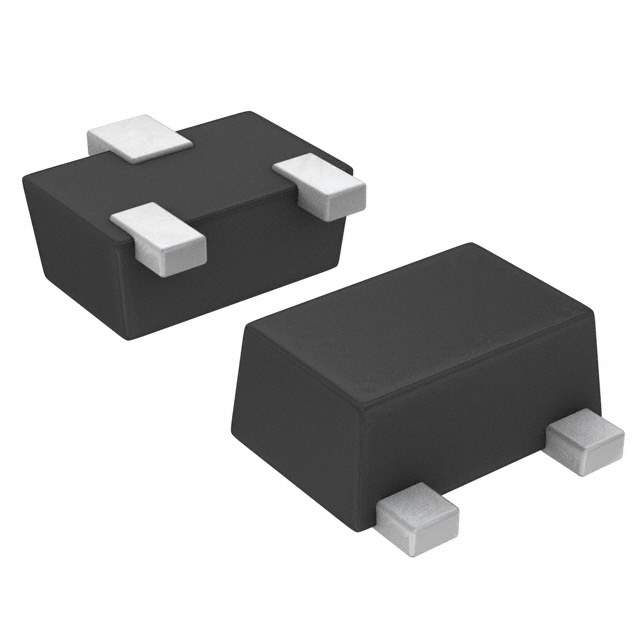
SOT-723/VMT3 and 50 V, 100 mA, 150 mW ceilings decide if this pre-biased PNP fits.
Quick Engineering Summary
| Field | Value |
|---|---|
| Manufacturer | Rohm Semiconductor |
| Category | RF Transistors (BJT) |
| Package | Tape & Reel |
| Core function | TRANS PREBIAS PNP 50V 0. |
| Key electrical range | Current - Collector (Ic) (Max): 100 mA; Current - Collector Cutoff (Max): 500nA; DC Current Gain (hFE) (Min) @ Ic, Vce: 33 @ 10mA, 5V; Frequency - Transition: 250 MHz |
| Reported stock | 5800 pcs reported — confirm on RFQ |
Tiny package first, then the case for using it
The weak point comes first: SOT-723 and a 150 mW maximum leave little room for sloppy dissipation. That ceiling does not give you ambient headroom, pulse behavior, or copper-spread relief, so this is not the transistor to choose when it will spend real time hot, saturated, or both.
What pulls it back into consideration is the integration. DTA123YMT2L is a PNP pre-biased transistor with R1 at 2.2 kOhms and R2 at 10 kOhms, which makes it a neat fit for compact bias, level-shift, and small-signal switching stages where removing two external resistors matters almost as much as the transistor itself. The 50 V collector-emitter breakdown sets the rail ceiling for modest high-side control nodes, but it does not turn the part into a power switch, and the 100 mA collector maximum is still only a ceiling. In practice, the 150 mW limit will usually tighten first, long before that current number feels comfortable on a real board.
So the case is straightforward. For dense low-power control circuitry, it fits. Active lifecycle, EU RoHS compliance, and MSL 1 reduce the usual adoption friction as well.
300mV tells you where saturation is still tidy
300mV @ 500µA, 10mA is the useful switching clue. It shows DTA123YMT2L reaching a defined low-drop saturated state at 10mA collector current with 500µA base drive. Don't stretch that into a promise at 100 mA.
So where does DTA123YMT2L actually belong?
So that points to the circuits that hate extra parts. The built-in resistor pair makes DTA123YMT2L a clean fit for logic-driven PNP stages, pull-up control, inverter functions, and small interface glue where board area matters and the bias network is better fixed than recreated around a bare transistor.
It does not belong in load switching that leans on the full 100 mA collector ceiling for long periods. It is also a poor match when the listing alone must settle thermal questions. The 250 MHz transition frequency is interesting, but here it does less decision work than the package and power ceiling; the part is categorized under RF transistors, yet the pre-biased structure and tiny VMT3 body point more toward compact control circuitry than toward a transistor chosen mainly for RF gain staging.
5800 pieces is the real buying constraint
5800 pieces is enough to keep a line moving, but it falls short of the 8,000 standard package. If DTA123YMT2L is going onto a fresh build, align the order to reel consumption rather than assuming a full standard pack is there.
The bigger technical gap isn't stock. The listing does not include pinout, package drawing, thermal resistance, or a derating curve, and those are the missing items that close footprint release and dissipation review for DTA123YMT2L.
View the Win-Source product page for DTA123YMT2L.
Key Takeaways for Engineers & Buyers
- Keep DTA123YMT2L on low-dissipation bias and switching duties; 150 mW is the hard ceiling.
- Use the built-in 2.2 kOhms and 10 kOhms network intentionally; it sets the drive scheme before layout starts.
- Buy to reel usage: stock is 5800 while standard package is 8,000.