
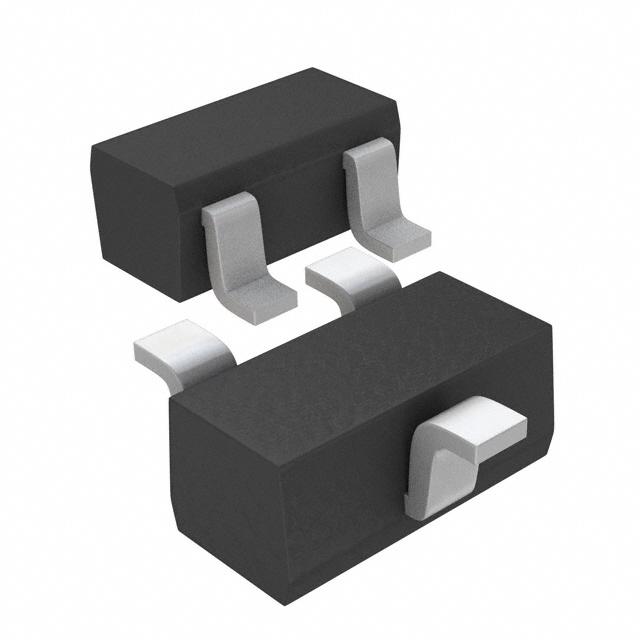
50V VCEO ceiling, 30mA collector limit, 150mW dissipation ceiling, EMT3 with built-in 22k/22k bias resistors
Quick Engineering Summary
| Field | Value |
|---|---|
| Manufacturer | Rohm Semiconductor |
| Category | Transistors (BJT) - Single, Pre - Biased |
| Package | EMT3 |
| Core function | TRANS PREBIAS PNP 50V EMT3 |
| Key electrical range | Collector Cut-off Current(Max): 500nA; Frequency - Transition: 250MHz; Maximum Current Collector: 30mA; Maximum Power Dissipation: 150mW |
| Reported stock | 15200 pcs reported — confirm on RFQ |
So yes, you can design this in—but only for small loads
And that is really the point of DTA124EEBTL: it saves two external bias resistors, not board power. The built-in 22k R1 and 22k R2 suit simple high-side PNP switching or level-shift duties where predictable biasing matters and a very small EMT3 footprint helps keep the circuit compact.
The ceilings decide the fit. VCEO is 50V, so that is the listed breakdown ceiling for rail exposure. Maximum collector current is 30mA, and maximum power dissipation is 150mW. Those numbers shut the door on treating DTA124EEBTL like a general-purpose small-signal transistor with much thermal margin, especially once switching loss, transient behavior, or inductive kick enter the picture, because none of that is shown here.
The listed Max Vce(sat) is 300mV @ 500nA, 10mA, which is useful as a bounded saturation drop at that stated condition. It does not say what the drop will be at the 30mA ceiling, and that missing view is where heat surprises tend to start.
Lifecycle is straightforward. Active with no conflict, and EU RoHS is listed. For new design-in, the answer is yes when current and dissipation stay in the background instead of becoming the main design problem.
What would stop a buyer from putting it on a running line?
What would stop a buyer first? Package commitment.
Lifecycle is not the issue. Stock shows 15200 pieces and packaging is Reel - TR, so it fits automated SMT assembly. Once the board is committed to EMT3, though, it is also committed to the integrated 22k/22k resistor network and PNP polarity that come with this device.
That matters more than the medium popularity tag. A pre-biased PNP is only interchangeable when resistor values, polarity, and package line up. Here the listing gives 22k for R1 and 22k for R2 with PNP polarity. If that network matches the logic drive, it belongs on the running line. If the circuit was tuned around a different resistor ratio, stop before release.
The numbers point to control paths, not power paths
The constraint is thermal and current headroom. 30mA and 150mW place DTA124EEBTL in signal and light-load switching territory, which fits a pre-biased PNP in EMT3.
It belongs in enable lines, pull-up switching, and compact interface stages where the built-in resistors cut BOM count and placement count. It does not belong where the transistor must absorb much thermal stress, and the 250MHz transition frequency does not change that.
The hFE figure is listed as 56 @ 5mA, 5V, so it shows characterization under small-signal conditions. It does not justify operation at the 30mA ceiling without a clearer view of saturation and heat there. Collector cut-off current is 500nA max, a useful leakage ceiling when an off node must stay quiet. If the concern is turn-off behavior into stored charge or capacitive loads, this page does not answer it.
What the listing still does not answer
Wrong for final layout signoff as-is.
Right for shortlist screening. The missing items are the package drawing and pinout, resistor tolerance on the 22k/22k network, and thermal resistance or derating data behind the 150mW ceiling. DTA124EEBTL also lacks switching detail here beyond the 250MHz transition figure.
View the Win-Source product page for DTA124EEBTL.
Key Takeaways for Engineers & Buyers
- Keep DTA124EEBTL below its 30mA collector-current ceiling; that limit, not the 250MHz figure, decides load fit.
- Budget around the 150mW dissipation ceiling before using DTA124EEBTL as a saturated switch in EMT3.
- Confirm the EMT3 pinout and package drawing before layout; the listing names the package but not the lead assignment.