
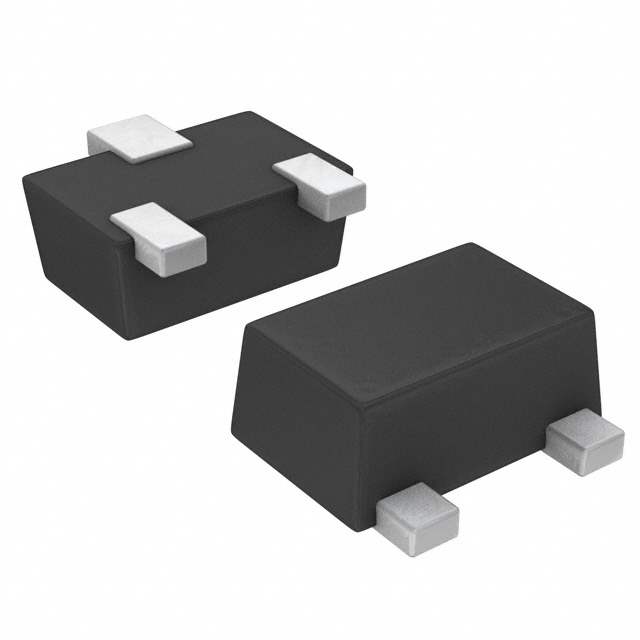
50V VCEO, 30mA collector ceiling, 150mW dissipation limit, VMT3 pre-biased PNP with 22k/22k resistors
Quick Engineering Summary
| Field | Value |
|---|---|
| Manufacturer | Rohm Semiconductor |
| Category | Transistors (BJT) - Single, Pre - Biased |
| Package | VMT3 |
| Core function | TRANS PREBIAS PNP 50V VMT3 |
| Key electrical range | Collector Cut-off Current(Max): 500nA; Frequency - Transition: 250MHz; Maximum Current Collector: 30mA; Maximum Power Dissipation: 150mW |
| Reported stock | 3200 pcs reported — confirm on RFQ |
50V is useful, but the current limit decides the job
50V is the attention-getter. It puts DTA124EMT2L on higher-voltage small-signal rails than many logic-side transistors, but it does not make the part a load driver.
The real boundary is 30mA maximum collector current, with a 150mW maximum power dissipation ceiling behind it. That points to signal steering, level shifting, and simple high-side PNP switching where the built-in bias network saves parts.
So the call is clear: DTA124EMT2L works as a new design-in for compact control paths, not for circuits that treat 30mA as a normal operating point. Active lifecycle. EU RoHS is compliant.
300mV saturation is fine at 10mA, not a blank check
300mV @ 500µA, 10mA is the listed VCE(sat) ceiling. Useful at that test point, yes. Near the 30mA collector ceiling, no such promise is stated, and the 150mW dissipation limit still sets the boundary.
Can you keep a line running on it?
Can you actually buy enough of it? Yes, if your build is reel-friendly and demand stays modest.
The stock figure shown is 3200, packaging is Reel - TR, and supply-demand status is Balance. That supports a running line better than a hand-to-mouth buy, though it is still a finite lot, so line up the reel requirement with your near-term build count before pushing DTA124EMT2L into broad production.
Mechanically, the fit is just as practical. VMT3, with SOT-723 also called out, is a very small SMD footprint. Good for dense boards. Less forgiving if your assembly flow dislikes tiny discretes.
The resistor pair is the real design-in filter
And that is where the part either fits neatly or stops making sense.
22k on R1 and 22k on R2 decide the base-drive path and the turn-off bias, so DTA124EMT2L belongs in designs that want a fixed pre-biased PNP stage and want to remove two external resistors. If the logic source, pull structure, or timing needs a different resistor ratio, the package convenience loses its value.
The rest of the listed electricals back that up. Minimum hFE is 56 @ 5mA, 5V, which places the part in low-current transistor duty rather than brute-force switching. Collector cut-off current is 500nA, low enough that leakage will not dominate many light-load control nodes. In short, DTA124EMT2L suits compact bias-defined switching stages, not open-ended transistor footprints where resistor choice is still part of the design.
What the listing still doesn't answer
The weak point is detail, not availability.
Lifecycle is Active, the stock picture is usable, and EU RoHS compliance shows no conflict. What is still missing is the information that closes a real schematic and layout decision, and that gap matters more here because the integrated resistor pair makes the part attractive only when the electrical and mechanical fit are both clean.
There is no pinout here, no package drawing, and no thermal resistance figure such as RθJC, so board placement, orientation, and ambient headroom remain open. There is also no switching waveform data beyond the 250MHz transition frequency, and that is not the same as turn-on or turn-off behavior in the actual bias network. For DTA124EMT2L, that missing view is concrete: you can see the topology, the resistor values, and the ceilings, but you still cannot close edge behavior or package implementation from this listing alone.
View the Win-Source product page for DTA124EMT2L.
Key Takeaways for Engineers & Buyers
- Keep collector current below the 30mA ceiling; this part is for small-signal switching, not load drive.
- Match the bias network to the built-in 22k R1 and 22k R2 before freezing the logic interface.
- Buy to reel planning now if 3200 pieces is near your build window.