
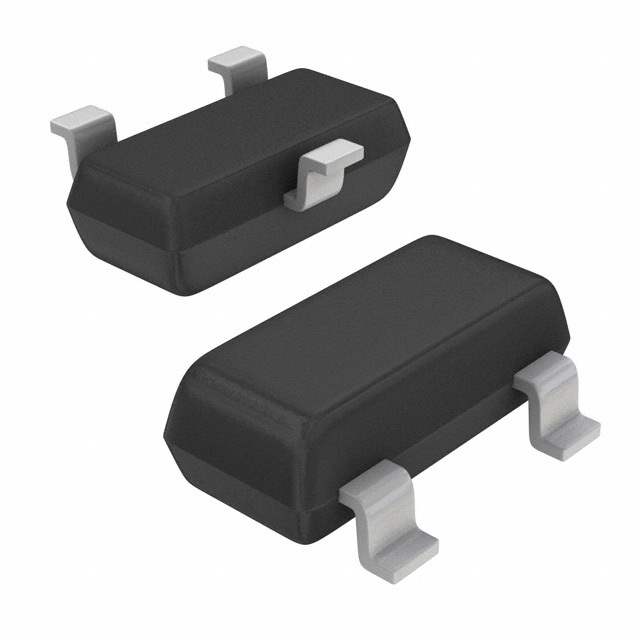
50V VCEO ceiling, 50mA collector limit, 150mW cap, EMT3 package with built-in 22k and 47k resistors
Quick Engineering Summary
| Field | Value |
|---|---|
| Manufacturer | Rohm Semiconductor |
| Category | Transistors (BJT) - Single, Pre - Biased |
| Package | EMT3 |
| Core function | TRANS PREBIAS PNP 50V EMT3 |
| Key electrical range | Collector Cut-off Current(Max): 500nA; Frequency - Transition: 250MHz; Maximum Current Collector: 50mA; Maximum Power Dissipation: 150mW |
| Reported stock | 6000 pcs reported — confirm on RFQ |
The real constraint is power, not just voltage
The tightest constraint here is heat. New design-in makes sense for small-signal switching when the internal bias network is the reason to choose the part. Active status supports that call, and EU RoHS is compliant.
The numbers that shut the door fastest are 150mW maximum power dissipation and 50mA maximum collector current. Both are ceilings, not operating targets. They place DTA124XETL in light-load bias and interface work, not in spots where a transistor is expected to carry meaningful current for long, because a 50V VCEO ceiling gives rail margin but does nothing to save a design that runs too hot in a tiny EMT3 body.
50V is the rail limit; 22k and 47k decide the circuit
50V is the first cutoff. If the node can exceed that collector-emitter breakdown ceiling, DTA124XETL is out. If it cannot, the real question becomes whether the built-in resistor pair matches the way you want to drive a pre-biased PNP.
DTA124XETL fixes R1 at 22k and R2 at 47k. That is both the convenience and the lock-in. You drop external parts and placement steps, but you also lose freedom to tune the base network around a different source impedance or turn-off behavior. When a design already wants that resistor ratio, the part cleans up both schematic and assembly. When the circuit needs a different bias current or a different bleed path, the internal network is the reason to walk away.
The saturation figure is bounded tightly: 300mV maximum at 500µA and 10mA. Treat it as a ceiling at that test point, not as a promise across the full load range. It helps in modest-current switching where headroom matters, but it does not define dissipation in every use case. The listed hFE minimum is 68 at 5mA and 5V, which confirms signal-level intent, yet raw gain matters less here than the resistor network because the bias is already baked in.
The weak spot is missing detail
The weak point comes first: key details are missing. There is no pinout, no package drawing, no thermal resistance, and no derating curve. For DTA124XETL, those are the items that close layout and ambient headroom when 150mW is already a small ceiling.
Buy it for the built-in bias, not as a generic PNP
Good fit.
DTA124XETL belongs in compact SMT control paths, level shifting, and simple load switching where a PNP with fixed bias resistors removes two external parts and current stays modest. The 250MHz transition frequency shows it is not sluggish, but that figure alone does not make it an RF choice; the package, missing capacitance data, and pre-biased structure point to fast small-signal switching instead.
The buy-side constraint is packaging discipline, not lifecycle. Reel - TR suits automated assembly, but only if your line is already set for EMT3. If your circuit needs a plain PNP with adjustable base resistors, don't force DTA124XETL into that role just because the voltage rating looks comfortable.
View the Win-Source product page for DTA124XETL.
Key Takeaways for Engineers & Buyers
- Keep DTA124XETL on rails that stay inside the 50V VCEO ceiling.
- Budget collector load against the 50mA limit and the 150mW dissipation cap together.
- Match the built-in 22k R1 and 47k R2 to the drive network before freezing DTA124XETL.