
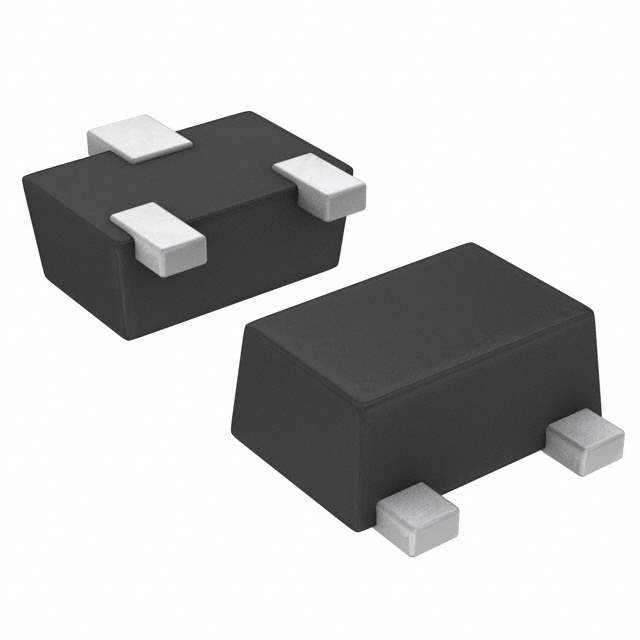
50V VCEO ceiling, 50mA collector limit, 150mW cap, VMT3 package, built-in 22k and 47k resistors
Quick Engineering Summary
| Field | Value |
|---|---|
| Manufacturer | Rohm Semiconductor |
| Category | Transistors (BJT) - Single, Pre - Biased |
| Package | VMT3 |
| Core function | TRANS PREBIAS PNP 50V VMT3 |
| Key electrical range | Collector Cut-off Current(Max): 500nA; Frequency - Transition: 250MHz; Maximum Current Collector: 50mA; Maximum Power Dissipation: 150mW |
| Reported stock | 2 pcs reported — confirm on RFQ |
The real limit is power, not just collector current
The constraint is thermal budget. With 150mW maximum power dissipation, 50mA maximum collector current, and a VMT3 package, this device fits small-signal switching and biasing work, not jobs with much thermal slack.
The 50mA figure is a ceiling, not a working point. The 150mW limit is the tighter call because voltage drop and current spend that budget together, and the listing gives no thermal resistance or derating curve to show how much ambient headroom the package really has. The 50V VCEO ceiling helps with rail selection, but it does not save a design that runs hot in a tiny package.
The built-in resistor pair decides whether it saves parts or causes trouble
That is also why the integrated bias network matters more here than the 250MHz transition frequency. This is a pre-biased PNP with R1 at 22k and R2 at 47k, so the decision is made early: either that fixed ratio suits the drive scheme and trims parts count, or it works against the source and locks the stage into behavior you did not want.
The listed 300mV maximum VCE(sat) at 500µA and 10mA is useful, but only in that stated corner. It shows the part can reach a low saturation voltage there; it does not answer what happens at other collector currents or under different base-drive conditions, especially when the resistor network is already fixed and the package leaves little room for thermal forgiveness.
The minimum hFE of 68 at 5mA and 5V supports the same reading. This is a modest-current signal transistor. It can clean up a logic-driven high-side small-signal stage when the built-in resistors line up with the circuit, board area matters, and the collector current stays comfortably inside a small-signal envelope. It is a poor fit when base impedance needs tuning, when thermal margin is thin, or when package details are being treated as something to sort out later. Small package, fixed bias, limited power. That's the trade.
Can you actually put it on a running line?
Can you buy enough of it? Not yet in volume. Lifecycle is Active and supply-demand is listed as Balance, but stock is shown at 2 and packaging is Reel - TR, so the immediate constraint is straightforward: do not release DTA124XMT2L onto a build plan until supply is lined up beyond sample quantity.
On the compliance side, the picture is cleaner. EU RoHS is listed, and storage calls for a dry storage cabinet and humidity protection package. That points to a normal SMT handling flow, not a special-case material issue.
The missing details are the ones that close the review
The weak point is documentation depth. DTA124XMT2L still needs pinout details, thermal resistance, and a derating curve to close layout and ambient-headroom questions.
View the Win-Source product page for DTA124XMT2L.
Key Takeaways for Engineers & Buyers
- Keep DTA124XMT2L off rails that can exceed the 50V collector-emitter ceiling.
- Budget around the 150mW dissipation ceiling before using the full 50mA collector rating.
- Match the drive network to the built-in 22k R1 and 47k R2, or use a different bias scheme.