
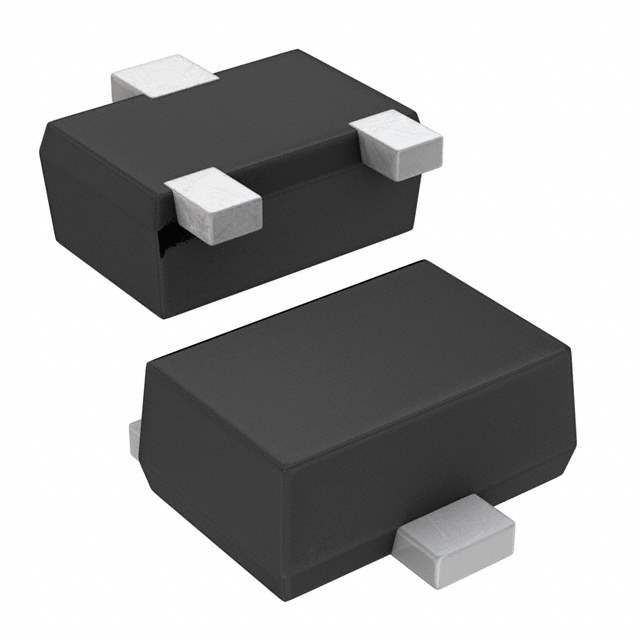
50V VCEO ceiling, 100mA collector limit, 150mW dissipation ceiling, EMT3F pre-biased PNP
Quick Engineering Summary
| Field | Value |
|---|---|
| Manufacturer | Rohm Semiconductor |
| Category | Transistors (BJT) - Single, Pre - Biased |
| Package | EMT3F (SOT-416FL) |
| Core function | TRANS PREBIAS PNP 50V 0. |
| Key electrical range | Collector Cut-off Current(Max): 500nA; Frequency - Transition: 250MHz; Maximum Current Collector: 100mA; Maximum Power Dissipation: 150mW |
| Reported stock | 6000 pcs reported — confirm on RFQ |
Not for power switching; fine for compact bias-defined control
This is the wrong part for anything that needs current headroom or thermal slack. DTA143EEBTL tops out at 100mA collector current and 150mW maximum power dissipation, so a load switch, relay driver with little margin, or any stage that lives near its limits runs out of room fast.
It fits better in small-signal high-side or pull-up style switching where the built-in resistor pair is the point. The 4.7k base resistor and 4.7k emitter-base resistor remove two externals and make bias behavior more predictable at the schematic level. With Active lifecycle, EU RoHS compliance, and Reel - TR packaging, DTA143EEBTL is a reasonable new design-in choice when board area matters more than raw drive capability.
50V is the rail ceiling; 150mW is the real design limiter
50V is a ceiling, not permission to run a 50V switching node without the rest of the datasheet in hand. For DTA143EEBTL, that VCEO limit settles one decision cleanly: it belongs on low-voltage to moderate-voltage rails that stay inside 50V. It does not answer transient behavior, avalanche tolerance, or safe operation under switching stress, because none of that is shown here.
The number that usually stops the design first is 150mW maximum power dissipation. Pair that with the 100mA maximum collector current and the message is plain: this transistor is for modest loads in a very small package, not for designs that expect current surges or much thermal forgiveness. The listing also gives 300mV max VCE(sat) at 500μA and 10mA, which is useful only in that stated test condition. It shows the part can pull low with a modest saturation drop there, but it says nothing about what the drop looks like near the 100mA ceiling, where dissipation risk starts to matter most.
The 500nA collector cut-off current max helps in leakage-sensitive bias networks and battery-fed housekeeping paths. Small number. Real consequence. If off-state leakage is what corrupts your node, DTA143EEBTL is easier to justify than a part with no leakage figure at all.
The 30 minimum hFE at 10mA and 5V is also bounded to that condition. Read it as a floor at that test point, not as a blanket gain promise across the operating range.
And the built-in resistors decide the use case
And that 4.7k/4.7k network is the whole reason to pick DTA143EEBTL. It suits logic-driven bias and simple level-shift duties where fixed input behavior helps, and it does not suit designs that need to tune base drive independently of the transistor.
The buy call is easy; the datasheet gaps are not
The weak point is visibility, not availability. Stock is listed at 6000 and packaging is Reel - TR, so DTA143EEBTL lines up with production placement rather than hand-build convenience.
What still blocks a confident electrical signoff is the missing detail around the small package. There is no thermal resistance, no derating curve, no pinout, and no package drawing here. For a 150mW transistor in EMT3F, those are not nice-to-haves; they set ambient headroom, land pattern confidence, and whether the part can survive the board conditions you actually have. The listing also omits switching behavior such as reverse-recovery time, which matters less for a pre-biased BJT than it would for a diode, but it still leaves dynamic performance largely undescribed.
View the Win-Source product page for DTA143EEBTL.
Key Takeaways for Engineers & Buyers
- Keep DTA143EEBTL on rails that stay inside the 50V VCEO ceiling.
- Treat 100mA collector current and 150mW as linked limits, not simultaneous targets.
- Match the drive network to the built-in 4.7k R1 and 4.7k R2 before freezing the BOM.