
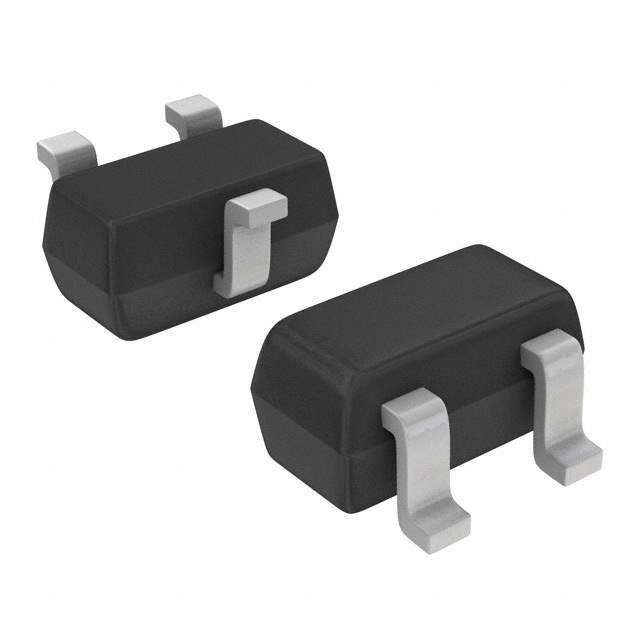
50 V, 100 mA, 200 mW pre-biased PNP in SC-75, SOT-416 with 4.7 kOhms / 4.7 kOhms built in
Quick Engineering Summary
| Field | Value |
|---|---|
| Manufacturer | ON Semiconductor |
| Category | Transistors (BJT) - Single, Pre - Biased |
| Package | SC-75, SOT-416 |
| Core function | TRANS PREBIAS PNP 50V 0. |
| Key electrical range | Supply and Demand Status: Balance |
| Reported stock | 3860 pcs reported — confirm on RFQ |
50 V is the first gate, not the whole answer
50 V is the first screen. If the rail exceeds that collector-emitter breakdown ceiling, DTA143EET1G is out; if it fits, you still have to clear switching loss, transient behavior, and thermal headroom before the part really belongs in the design.
The other limits decide the usable operating space. The 100 mA collector current is a ceiling, and the 200 mW maximum power is often the tighter constraint when the transistor sits on with meaningful voltage across it. In practice, that matters more than the headline current rating, because a small SC-75, SOT-416 device can run out of dissipation budget quickly even when the current number still looks comfortable.
What makes this device worth choosing is the built-in resistor network: 4.7 kOhms at the base and 4.7 kOhms at the emitter. That cuts two external parts and gives the bias arrangement a fixed, predictable shape at the schematic level. It also fixes the ratio. If your threshold or base-drive behavior needs tuning, this is the wrong device class.
The commercial signals are straightforward. The part is Active, stock is listed, and EU RoHS is compliant, so there is no lifecycle or compliance reason to avoid a new design-in.
Can you keep DTA143EET1G on a running line?
Can you buy it in a way that actually fits production? Yes, with one practical caveat.
The stock figure is 3860, the package is Reel - TR, and quantity per package is 3000. That lines up with a reel-fed SMT flow far better than ad hoc replenishment, especially for a very small SC-75, SOT-416 part. Buy to the reel and avoid partial-quantity handling around a package this small.
The rest of the supply picture is calm: lifecycle is Active, supply and demand is Balance, and estimated lead time is 1 Weeks. That's a better fit for a running line than a bench-only build.
Wrong for adjustable bias, right for compact PNP switching
Wrong for circuits that need resistor-selection freedom. DTA143EET1G is a pre-biased PNP, so it fits compact high-side switching, simple inverter stages, and logic-interface work where the integrated network is the reason to use the part.
The package points the same way. SC-75, SOT-416 saves board area, but it gives you less thermal slack and less probing convenience during debug. The listed hFE minimum of 15 at 5mA, 10V and VCE saturation maximum of 250mV at 1mA, 10mA reinforce the fit: this is a small-signal switching transistor with integrated bias resistors, not a choice for heavy load drive or for pushing saturation drop as low as possible.
The missing numbers are the real review stop
The constraint is missing detail. Pinout, package drawing, thermal resistance, and a switching-speed figure are not listed here, so layout closure and edge-rate judgment stop until those numbers are in hand.
View the Win-Source product page for DTA143EET1G.
Key Takeaways for Engineers & Buyers
- Keep VCEO at or below the 50 V ceiling; it does not buy transient margin by itself.
- Budget dissipation against the 200 mW maximum before using the full 100 mA collector rating.
- Buy in reel multiples of 3000 if DTA143EET1G is going onto a running SMT line.