
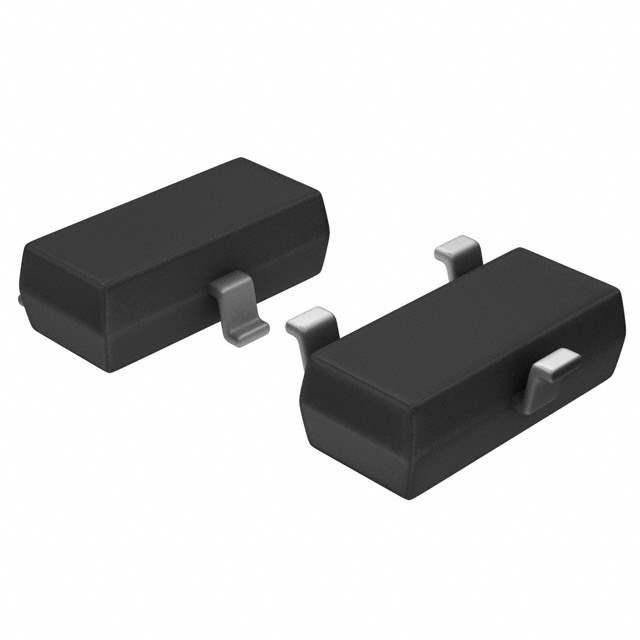
50V VCEO, 100mA collector ceiling, 200mW dissipation limit, SMT3 pre-biased PNP with 4.7k base resistor
Quick Engineering Summary
| Field | Value |
|---|---|
| Manufacturer | Rohm Semiconductor |
| Category | Transistors (BJT) - Single, Pre - Biased |
| Package | SMT3 |
| Core function | TRANS PREBIAS PNP 50V 0. |
| Key electrical range | Collector Cut-off Current(Max): 500nA (ICBO); Frequency - Transition: 250MHz; Maximum Current Collector: 100mA; Maximum Power Dissipation: 200mW |
| Reported stock | 11800 pcs reported — confirm on RFQ |
Then the real question is whether the limits fit
And for new work, yes—with caveats. DTA143TKAT146 is Active and EU RoHS compliant, and its 50V VCEO ceiling, 100mA maximum collector current, and 200mW maximum power dissipation place it firmly in small-signal switching rather than load-driving duty.
The built-in bias network is only partly described. R1 is given at 4.7k, which is enough to show that this is meant to be used as a pre-biased PNP rather than as a bare transistor, but no R2 value is listed and the row data says only R1 is included. That rules out assuming a full resistor pair. DTA143TKAT146 makes sense for design-in when a single-resistor topology is what the circuit expects.
The ceilings are modest, and they decide the use case
They are modest.
The 100mA maximum collector current is a ceiling, not a working promise, and the 200mW maximum power dissipation is what keeps that current rating honest. If your load case leans on both at once, DTA143TKAT146 stops looking like a casual drop-in and starts demanding a thermal check that this listing cannot complete.
The 50V collector-emitter breakdown rating is the other hard gate. It decides rail eligibility and rules out any design that treats 50V as normal operating headroom instead of the device limit. The listed 300mV max VCE(sat) at 250µA and 5mA helps, but only at that stated test point; it says little about saturation loss near the 100mA ceiling. Leakage is at least bounded cleanly on paper: 500nA ICBO max is low enough to matter in high-impedance bias networks, especially when off-state drift shows up as a false turn-on instead of a clean open circuit.
The fit is control and level-shift, not power switching
The weak point is missing network detail; the strong point is that the rest of the numbers hang together. DTA143TKAT146 is aimed at compact board-level control functions where a pre-biased PNP saves parts count and placement, while the SMT3 package keeps it in dense SMD layouts.
The 4.7k base resistor and 100 minimum hFE at 1mA, 5V point toward logic-driven biasing and small-signal switching, but they do not support broad assumptions across every drive condition because the listing gives only one gain point and one saturation point. In practice, that matters. If you are using DTA143TKAT146 to pull up, invert, or gate a modest signal or small load from a rail comfortably below the 50V ceiling, the part shape fits; if you are trying to switch something that lives near the 100mA ceiling for long periods, the 200mW dissipation limit becomes the first objection.
Frequency at 250MHz says the transistor itself is not unusually slow, yet that still falls short of a high-speed switching endorsement because the listing omits resistor-network behavior over frequency, capacitance, and switching-time data. DTA143TKAT146 belongs in housekeeping circuitry, interface biasing, and compact discrete logic functions. It does not read like a part for power stages.
What the listing still doesn't settle
11800 pieces.
Supply-and-demand is marked Limited, so don't leave DTA143TKAT146 as an uncommitted late BOM choice. The open items are concrete: no pinout or package drawing, no thermal resistance, no switching times or capacitance, and no fuller resistor-network detail beyond R1 at 4.7k.
View the Win-Source product page for DTA143TKAT146.
Key Takeaways for Engineers & Buyers
- Keep VCEO below the 50V ceiling; that number decides whether DTA143TKAT146 belongs on the rail at all.
- Treat 100mA collector current and 200mW dissipation as linked ceilings, not a guaranteed load point.
- Lock reel usage early; stock shows 11800 while supply-and-demand is marked Limited.