
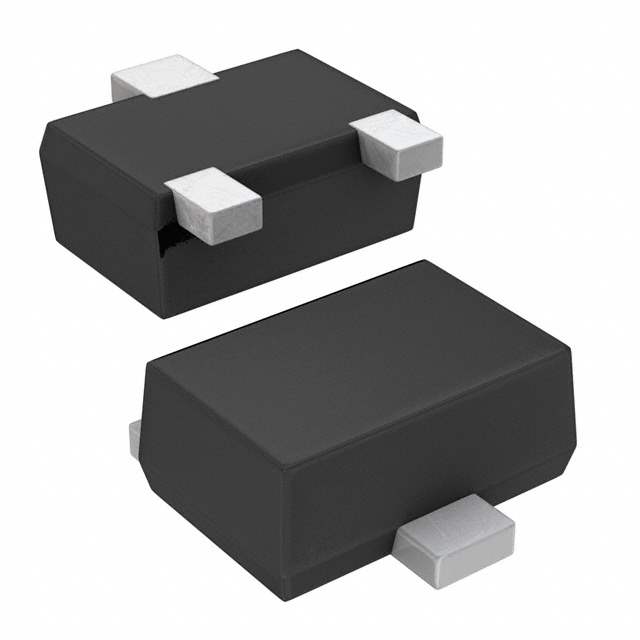
50V VCEO ceiling, 100mA collector ceiling, 200mW limit, UMT3F package with 4.7k and 47k bias resistors
Quick Engineering Summary
| Field | Value |
|---|---|
| Manufacturer | Rohm Semiconductor |
| Category | Transistors (BJT) - Single, Pre - Biased |
| Package | UMT3F |
| Core function | TRANS PREBIAS PNP 50V UMT3F |
| Key electrical range | Collector Cut-off Current(Max): 500nA; Frequency - Transition: 250MHz; Maximum Current Collector: 100mA; Maximum Power Dissipation: 200mW |
| Reported stock | 104850 pcs reported — confirm on RFQ |
50V is the first gate, and it clears it
50V sets the first pass-fail check. If the rail can push collector-emitter stress past that ceiling, DTA143ZUBTL is out before any other parameter matters.
That clears only the voltage question. It does not settle switching loss, transient behavior, or thermal headroom, because the needed curves and thermal data are not listed here.
The lifecycle call is straightforward: Active with no conflict signals, so DTA143ZUBTL fits new design-in rather than a sustaining-only buy. EU RoHS is compliant. The real decision is whether a pre-biased PNP with fixed internal resistors matches the control topology already on the board.
Treat 100mA and 200mW as hard ceilings
This part is small.
The 100mA maximum collector current and 200mW maximum power dissipation are hard ceilings. In a UMT3F device, those two limits will stop a casual design-in faster than the 250MHz transition frequency, because load current and package dissipation decide whether the transistor survives the load and board temperature, and the listing gives no thermal resistance or derating curve to show how much ambient margin is left.
The listed 300mV max VCE(sat) at 250μA and 5mA is useful, but only at that test point. It shows low saturation voltage under that stated bias and collector current. It does not describe behavior near the 100mA collector ceiling, so don't turn it into a general conduction-loss assumption.
Can you keep DTA143ZUBTL on a running line?
Can you keep buying it without turning the BOM into a weekly exception? On the numbers here, yes. Stock quantity is listed at 104850, supply and demand status is Balance, and packaging is Reel - TR, which fits a production line better than bench rework or hand-loaded service stock.
Availability is only part of the call. DTA143ZUBTL is a pre-biased PNP, not a plain small-signal transistor, and that matters more than the stock line because the built-in 4.7k base resistor and 47k emitter-base resistor are both the appeal and the constraint.
When those values line up with the source impedance and turn-off behavior you want, the part simplifies a digital or logic-driven high-side interface and removes parts from the schematic. When they do not, the same network gets in the way of choosing base-network values directly, trimming edge behavior, or forcing a different bias current than the internal network allows.
Fit is narrow in a useful way. DTA143ZUBTL belongs in compact board-level switching and interface work where SMD assembly, a UMT3F footprint, and a fixed resistor network are exactly the point. It does not belong in designs that need a bare transistor, higher collector current headroom, or a thermal model supported by package data alone.
The 500nA collector cut-off current ceiling helps leakage-sensitive bias nodes, and the 80 minimum hFE at 10mA and 5V gives a floor for gain at that stated point, but neither number fixes a mismatch between your drive scheme and the built-in 4.7k / 47k network.
One practical note remains: DTA143ZUBTL appears in both the main stock field and the line-item stock field, but the larger listed quantity is the one that matters for a running line decision here.
The missing data is exactly what closes the review
The weak point is documentation depth. The headline limits are clear enough, but the missing items that matter are the pinout, package drawing, thermal resistance, and derating curve.
Those are the details that close footprint release and ambient headroom. ECAD access is gated, but that is secondary. More important, there is no switching-time data beyond the 250MHz transition frequency, so circuits that care about edge speed or storage behavior will not get an answer from this page.
View the Win-Source product page for DTA143ZUBTL.
Key Takeaways for Engineers & Buyers
- Keep VCEO below the 50V ceiling; that number decides rail fit, not switching behavior.
- Check the drive network against the built-in 4.7k R1 and 47k R2 before freezing the schematic.
- Reserve reel handling for production builds; DTA143ZUBTL is listed only in Reel - TR packaging.