
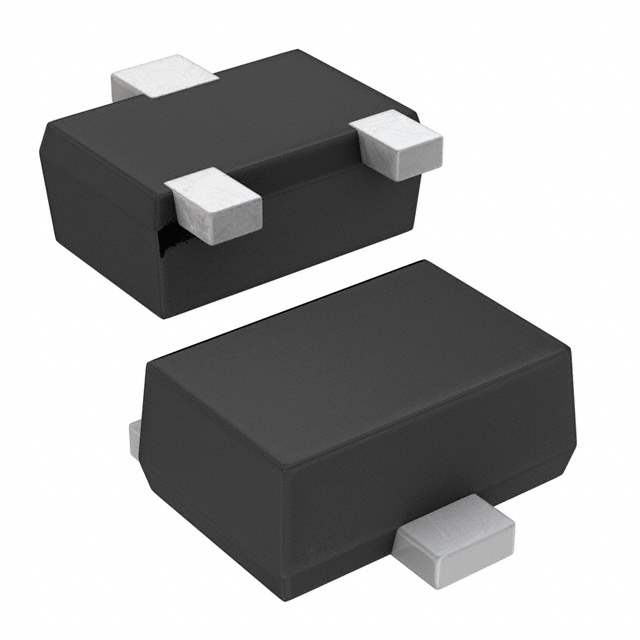
50V VCEO ceiling, 30mA collector ceiling, 150mW ceiling, EMT3F (SOT-416FL) package
Quick Engineering Summary
| Field | Value |
|---|---|
| Manufacturer | Rohm Semiconductor |
| Category | Transistors (BJT) - Single, Pre - Biased |
| Package | EMT3F (SOT-416FL) |
| Core function | TRANS PREBIAS PNP 50V EMT3F |
| Key electrical range | Collector Cut-off Current(Max): 500nA; Frequency - Transition: 250MHz; Maximum Current Collector: 30mA; Maximum Power Dissipation: 150mW |
| Reported stock | 2848 pcs reported — confirm on RFQ |
A sensible new design-in for tiny biased PNP stages
Yes, with limits.
For new design-in, the fit is clear when the circuit wants a pre-biased PNP with the resistor network inside the device and the board can take EMT3F (SOT-416FL). Here that means DTA144EEBTL with R1 at 47k and R2 at 47k, not a near match and not a flexible bias option.
The limits define the job fast. 50V VCEO is the collector-emitter ceiling. 30mA is the maximum collector current ceiling, which keeps it in signal switching, level shifting, and simple interface gating rather than load driving. The 150mW maximum power dissipation ceiling matters just as much, because a very small package gives little room for casual thermal margin if the design sits near saturation or carries current continuously for long stretches. EU RoHS is compliant, and lifecycle status is Active with no conflict noted.
50V matters less than the 47k/47k network
50V sets the voltage ceiling, but the built-in 47k/47k pair is the real selection point. That resistor network decides whether DTA144EEBTL belongs in the circuit at all, because it trades two external resistors and their placement area for a fixed internal bias scheme.
The rest of the listed data shows how far that convenience goes. VCE(sat) is listed as 300mV @ 500μA, 10mA, useful at that test point and no further. Collector cut-off current is 500nA max, so off-state leakage is bounded for high-impedance nodes. The 250MHz transition frequency says the transistor itself is not unusually slow, but it does not answer switching behavior in the finished network or what the integrated resistors do to edge shape.
Can you keep a line running on it?
Can we still buy it for production?
Yes. Stock is listed at 2848, supply and demand is marked sufficient, and packaging is Reel - TR.
The missing data is exactly what closes the review
The weak point is missing detail.
There is enough here to screen fit, but not enough to finish release work without the full datasheet. No pinout is shown, and on a tiny EMT3F device that decides whether footprint and orientation are correct. No package drawing is shown, so land pattern and assembly clearances stay open. No thermal resistance or derating curve is listed, leaving the link between the 150mW ceiling and real ambient headroom unresolved. No switching waveform data is listed either, so edge timing or storage behavior remains open where that matters.
View the Win-Source product page for DTA144EEBTL.
Key Takeaways for Engineers & Buyers
- Keep DTA144EEBTL on low-current switching nodes; 30mA collector and 150mW are hard ceilings.
- Match the bias network before release; DTA144EEBTL fixes both R1 and R2 at 47k.
- Buy on reel for the running line while stock shows 2848 and packaging is TR.