
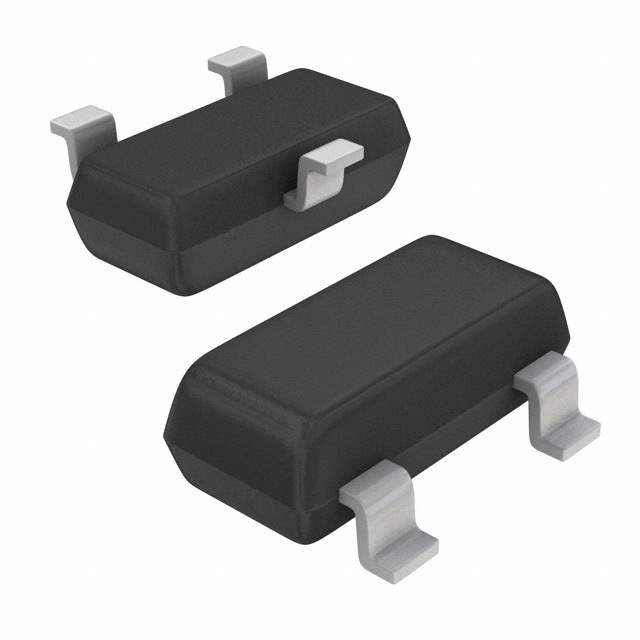
50V VCEO, 30mA collector ceiling, 150mW dissipation, EMT3 package, and 47k/47k built-in bias resistors
Quick Engineering Summary
| Field | Value |
|---|---|
| Manufacturer | Rohm Semiconductor |
| Category | Transistors (BJT) - Single, Pre - Biased |
| Package | EMT3 |
| Core function | TRANS PREBIAS PNP 50V EMT3 |
| Key electrical range | Collector Cut-off Current(Max): 500nA; Frequency - Transition: 250MHz; Maximum Current Collector: 30mA; Maximum Power Dissipation: 150mW |
| Reported stock | 61200 pcs reported — confirm on RFQ |
50V is the first gate, not the whole answer
50V decides whether DTA144EETL belongs on the shortlist at all. That VCEO figure is a collector-emitter breakdown ceiling, so it answers the rail-margin question first and fast.
It doesn't answer the whole job. Maximum collector current is 30mA, and maximum power dissipation is 150mW. Those are ceilings, not operating points, and together they keep DTA144EETL in low-power biasing, level shifting, and light switching work rather than anything that asks a small package transistor to absorb real load energy.
Good fit for resistor-defined switching, not for tuning later
It fits, or it doesn't.
The appeal here is the fixed network. DTA144EETL builds in 47k for R1 and 47k for R2, which removes two external parts when the circuit already wants that resistor pair and keeps behavior more consistent from BOM to BOM. If the design needs resistor changes to tune base drive, edge speed, or input threshold, the same feature is the reason to pass.
The listed electrical data points in the same direction. Max VCE(sat) is 300mV @ 500μA, 10mA, so the part is characterized in a small-signal switching region, not as a load transistor you run up to its 30mA ceiling and ignore. Typical gain is listed as 68 @ 5mA, 5V, and frequency transition is 250MHz, enough to place DTA144EETL in fast-enough control paths and compact SMT logic interfaces, but not enough to say much about switching loss or waveform cleanliness because the time-domain data is missing.
Package choice reinforces the point. EMT3 and SMD mounting suit dense board-level layouts, and the built-in resistors do the real space-saving work there. In practice, DTA144EETL makes sense in compact pre-biased PNP stages where the resistor values already match the circuit instead of needing to be negotiated later.
The weak point is the missing dynamic data
The gaps are real. No pinout, package drawing, thermal resistance, or switching data is listed here, and those missing details are what settle layout, heat, and edge-rate questions for DTA144EETL.
Can you keep a running line on it?
Can we keep buying it? Yes, with one practical condition: treat it as a reel-managed SMT line item, not an ad hoc bench part. Lifecycle is Active, supply-and-demand status is listed as Sufficient, and stock quantity is 61200, which supports both new builds and existing production better than a thin-availability transistor would.
The handling side matters too. Packaging is Reel - TR, and storage calls for a dry storage cabinet and humidity protection package, so DTA144EETL belongs in normal moisture-sensitive SMT receiving and floor control. The open-market fake threat is listed at 45 pct., high enough to keep sourcing disciplined even when availability looks comfortable.
View the Win-Source product page for DTA144EETL.
Key Takeaways for Engineers & Buyers
- Keep DTA144EETL on rails that stay inside the 50V VCEO ceiling.
- Budget collector load against the 30mA limit and the 150mW dissipation ceiling together.
- Check the fixed 47k R1 and 47k R2 network before dropping DTA144EETL into a logic-bias stage.