
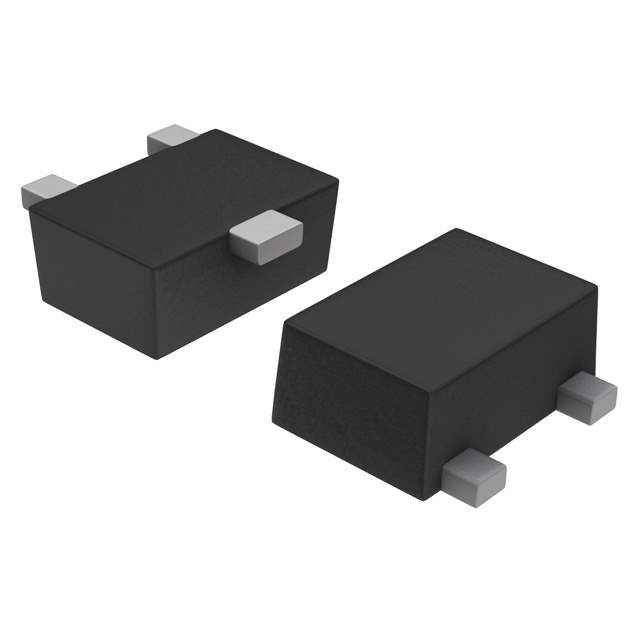
50V VCEO ceiling, 100mA collector ceiling, 260mW limit, SOT-723 package
Quick Engineering Summary
| Field | Value |
|---|---|
| Manufacturer | ON Semiconductor |
| Category | Transistors (BJT) - Single, Pre - Biased |
| Package | SOT-723 |
| Core function | TRANS PREBIAS PNP 50V SOT723 |
| Key electrical range | Collector Cut-off Current(Max): 500nA; Maximum Current Collector: 100mA; Maximum Power Dissipation: 260mW; Supply and Demand Status: Balance |
| Reported stock | 800 pcs reported — confirm on RFQ |
So no, this is not a fresh design-in part
And that settles the first decision: keep DTA144EM3T5G in sustaining designs, not new schematic capture. Lifecycle is EOL, and the 800 units listed on reel may cover a short build window or a controlled service run, but they do not justify adding a new dependency to an active program. EU RoHS compliance is fine, yet it does nothing to offset the lifecycle call.
The electrical profile still matters if this device is already on a board. It is a PNP pre-biased transistor in SOT-723 with 47k on R1 and 47k on R2, which puts it in compact bias-and-switch roles where the integrated resistor pair is the whole point. The 50V VCEO figure is a collector-emitter ceiling, not a suggested rail, and the 100mA collector current is also a ceiling, not a normal operating target. The 260mW power limit matters just as much, because in a tiny SOT-723 package it quickly becomes the constraint that decides whether the current number is usable at all.
That combination makes the part easy to place in an existing low-power design and hard to defend in a new one. Use the remaining stock deliberately, tie demand to actual builds, and move the migration work forward now rather than after the last reel becomes the schedule problem.
Buy only for running lines
Sustaining only.
With EOL status and 800 listed on reel, this is a continuity buy for existing production, not a part to leave open for general use.
The resistor pair is the reason to use it
The weak point comes first: EOL ends the case for new work. The useful part is the structure. DTA144EM3T5G is not just a small PNP; it is a pre-biased PNP with 47k on the base resistor and 47k on the emitter-base resistor, and that built-in network determines whether it saves parts or conflicts with the bias plan.
Those 47k values fit cases where the external resistor network only existed to tame a logic drive into a simple high-side transistor function. They rule it out when base current or turn-off behavior needed discrete tuning, because the resistor pair is already fixed. The listed 250mV max VCE(sat) at 300μA and 10mA is useful in a narrow way: it shows saturation under that stated condition, but it does not describe behavior across the rest of the load range. The 80 minimum hFE at 5mA and 10V helps with a sanity check, not with replacing missing switching curves.
50V is enough only if the missing data agrees
50V is the decisive ceiling. It keeps DTA144EM3T5G in low-power high-side switching and bias roles where collector-emitter stress stays below that number, but it does not clear the part for fast switching, pulse-heavy loads, or thermal corners where package behavior matters more than nominal voltage.
The missing items are concrete. There is no pinout here, no package drawing, no thermal resistance, and no derating curve. For a SOT-723 transistor with a 260mW limit, thermal resistance and derating are what show how much ambient headroom is real. There is also no switching data, so if turn-on or turn-off speed matters, this page does not close that question. DTA144EM3T5G can still be serviceable on an existing board, but those gaps are exactly what stop reuse from being automatic.
View the Win-Source product page for DTA144EM3T5G.
Key Takeaways for Engineers & Buyers
- Block DTA144EM3T5G from new BOM releases; lifecycle is EOL.
- Check collector load against the 100mA ceiling and the 260mW dissipation limit.
- Confirm the 47k/47k pre-bias network matches the drive source before freezing the schematic.