
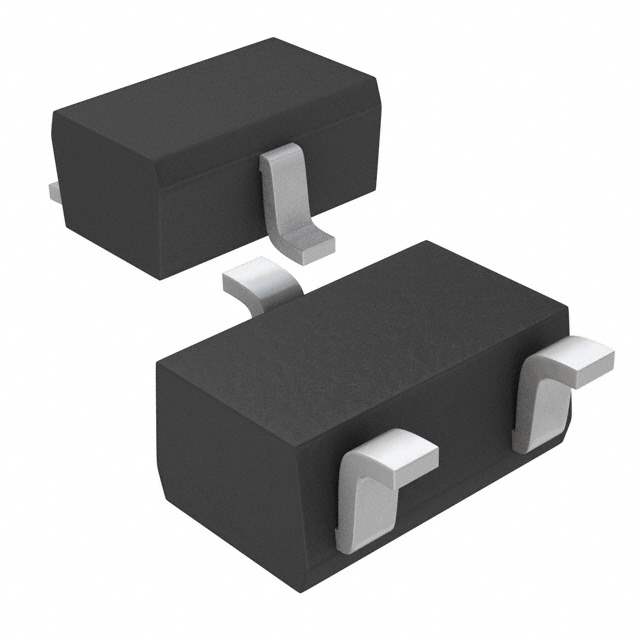
50V VCEO ceiling, 30mA collector limit, 200mW dissipation cap, UMT3 package, PNP pre-biased transistor
Quick Engineering Summary
| Field | Value |
|---|---|
| Manufacturer | Rohm Semiconductor |
| Category | Transistors (BJT) - Single, Pre - Biased |
| Package | UMT3 |
| Core function | TRANS PREBIAS PNP 50V UMT3 |
| Key electrical range | Collector Cut-off Current(Max): 500nA; Frequency - Transition: 250MHz; Maximum Current Collector: 30mA; Maximum Power Dissipation: 200mW |
| Reported stock | 82000 pcs reported — confirm on RFQ |
The lifecycle conflict is the real design constraint
The real constraint is lifecycle ambiguity, not electrical capability. DTA144EUAT106 is marked Active, yet another lifecycle field says not suitable for new design, and that conflict is enough to keep it out of a fresh platform unless there is already a reason to stay with this exact device.
For an existing production build, the picture is better. 82000 units are listed, supply and demand is marked sufficient, and the part ships on Reel - TR for normal SMT flow. That supports a running line. It does not remove the risk for a new design. EU RoHS is fine, but compliance does not settle the lifecycle question.
50V and 30mA set the envelope, not the operating point
50V is the collector-emitter breakdown ceiling. It sets rail compatibility for DTA144EUAT106 in small-signal high-side or pull-up jobs, but it does not say the transistor should sit near that limit across temperature or switching stress.
The 30mA maximum collector current is another ceiling, and the 200mW maximum power dissipation behind it keeps the margin tight. Get casual with voltage across the device while asking for collector current and the thermal budget disappears fast, especially in UMT3.
The listed 300mV @ 500μA, 10mA VCE(sat) matters only at that test point. It shows the part can keep saturation loss down in a light-load switching role, not that every load near the current limit will behave the same way.
The built-in 47k network decides where it belongs
47k is the decisive value. DTA144EUAT106 is not a general-purpose PNP you bias however you like; it already carries 47k on R1 and 47k on R2, so it belongs where that resistor ratio is the reason to use the part.
It fits compact inverter and level-shift stages, plus simple load-switch control where board area matters and discrete bias resistors are just overhead. It is a poor fit when you need to tune base drive, push collector current hard, or shape switching behavior with resistor values other than the built-in pair.
The 250MHz transition frequency and 68 @ 5mA, 5V gain figure show the transistor itself is not unusually slow. The resistor network still drives the design decision.
What the listing still does not tell you
The weak point is documentation depth. The strong point is that the missing items are concrete, and they are the ones that decide whether DTA144EUAT106 is merely convenient or actually safe to release into hardware that has to survive layout, assembly, and real operating conditions.
There is no pinout here, and for a pre-biased transistor in UMT3 that matters immediately because the internal resistor network only helps if the pads land on the right nodes. There is no package drawing either, even though the text ties the device to SC-70, SOT-323 and supplier package UMT3; footprint control still needs the actual drawing.
Thermal detail is also thin. You get 200mW maximum power dissipation, but no thermal resistance and no derating curve, so ambient headroom is still open. On the switching side, there is no junction capacitance and no switching-time data, which leaves edge speed and charge storage behavior unresolved for pulse work. Those are the gaps that close the review, not another pass through the headline limits.
View the Win-Source product page for DTA144EUAT106.
Key Takeaways for Engineers & Buyers
- Treat 30mA collector current as a ceiling; keep load cases below the listed maximum.
- Check the 47k/47k internal resistor network against your drive source before locking DTA144EUAT106 into a logic path.
- Use existing stock for running builds, but hold new BOM releases on DTA144EUAT106 until the lifecycle conflict is resolved.