
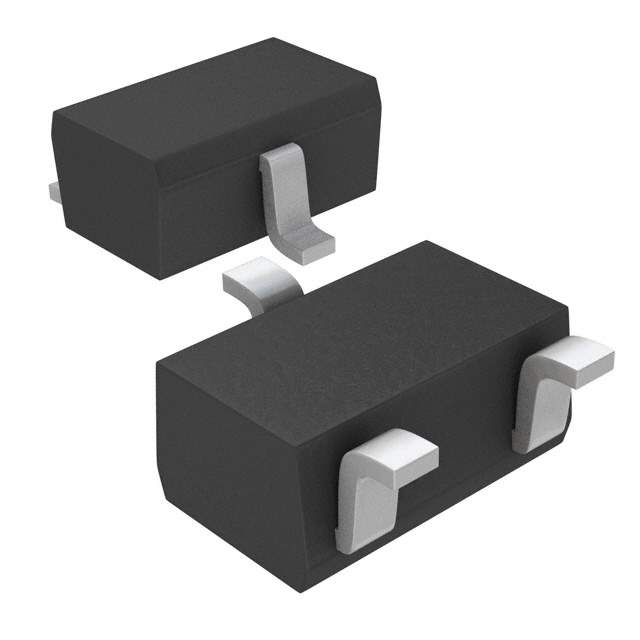
50V VCEO, 100mA collector ceiling, 200mW dissipation, UMT3 package decide where this pre-biased PNP fits
Quick Engineering Summary
| Field | Value |
|---|---|
| Manufacturer | Rohm Semiconductor |
| Category | Transistors (BJT) - Single, Pre - Biased |
| Package | UMT3 |
| Core function | TRANS PREBIAS PNP 50V 0. |
| Key electrical range | Collector Cut-off Current(Max): 500nA (ICBO); Frequency - Transition: 250MHz; Maximum Current Collector: 100mA; Maximum Power Dissipation: 200mW |
| Reported stock | 1 pcs reported — confirm on RFQ |
So yes, you can design it in—but not blindly
And the real decision turns less on the headline 50V than on what the part already locks in. DTA144GUAT106 is a pre-biased PNP in UMT3 with a listed 47k base resistor, and that built-in resistor is the commitment: if your drive scheme wants that value, you drop an external component; if it does not, you inherit a fixed constraint you can't tune out later.
The lifecycle call is straightforward. Active keeps it in play for new work, and EU RoHS compliance keeps regulatory status from becoming the issue. Supply is the issue. Stock is listed at 1, so treat DTA144GUAT106 as orderable, not as a comfortable basis for a running line until supply is secured.
The ceilings are modest, and they decide the use case
The weak point first: 200mW is a tight power budget. It is a ceiling, not a target, and it rules out any casual assumption that DTA144GUAT106 can serve as a comfortable higher-dissipation switch just because the collector current ceiling is 100mA.
The better news is that the limits line up cleanly for small-signal work. VCEO is 50V, which gives decent rail compatibility for high-side switching, but says nothing about transient survival beyond that ceiling. Maximum collector current is 100mA, also a ceiling. Pair that with the listed Max Vce(sat) of 300mV at 500µA and 10mA, and the picture sharpens: the saturation figure is anchored at 10mA, not at the full 100mA limit, so the listing supports light-load switching much better than it supports assumptions near the current ceiling. Leakage helps the off-state case. Collector cut-off current is 500nA.
Wrong for adjustable drive paths, right for compact fixed-bias switching
Not for circuits that need resistor selection freedom, and not for jobs where package thermal behavior has to be nailed down early. DTA144GUAT106 fixes the bias approach up front, so it belongs in control paths that already want a pre-biased PNP rather than in analog or switching stages where base drive is part of the tuning.
Where it does fit is dense SMT logic interfacing and small-load switching on rails up to the listed 50V ceiling, especially when board area matters enough that removing one resistor is worth more than keeping every bias value open. The UMT3 package points that way, and the SC-70, SOT-323 note reinforces that this is a very small-footprint device.
That small package cuts both ways. It helps density, but it also means the 200mW ceiling arrives quickly in real layouts, and without a thermal resistance figure in the listing you cannot translate that ceiling into ambient headroom with much confidence. The gain number needs the same discipline: hFE is listed as 68 at 5mA and 5V, which is enough to place DTA144GUAT106 in the small-signal region, not enough to generalize behavior across the full current range. The 250MHz transition frequency is interesting, but secondary here, because in a pre-biased transistor the built-in resistor and the saturation condition usually define the practical switching role before ft does.
Use it where fixed bias and low board area are the point. Skip it where you need adjustable base networks, more dissipation margin, or a closed thermal model.
The real blocker is what the listing omits
1 unit in stock is a buy constraint, but the bigger engineering gap is missing detail. The listing does not give pinout, package drawing, thermal resistance, or resistor-network clarification beyond the 47k entry, while the row text mentions only R2.
View the Win-Source product page for DTA144GUAT106.
Key Takeaways for Engineers & Buyers
- Match the bias network to the listed 47k resistor before committing DTA144GUAT106.
- Keep collector load inside the 100mA ceiling and treat 200mW as the dissipation limit.
- Secure reel supply first; listed stock is 1.