
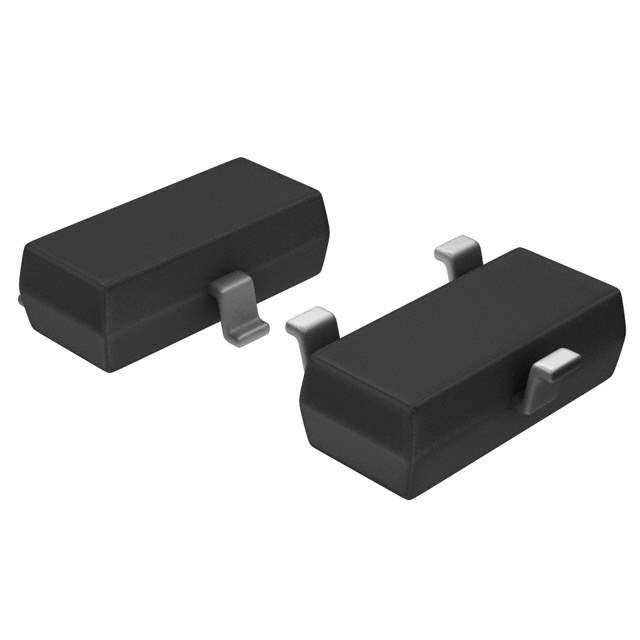
50V VCEO, 100mA collector ceiling, 200mW dissipation, SMT3 package, and a lifecycle conflict that changes the call
Quick Engineering Summary
| Field | Value |
|---|---|
| Manufacturer | Rohm Semiconductor |
| Category | Transistors (BJT) - Single, Pre - Biased |
| Package | SMT3 |
| Core function | TRANS PREBIAS PNP 50V 0. |
| Key electrical range | Collector Cut-off Current(Max): 500nA (ICBO); Frequency - Transition: 250MHz; Maximum Current Collector: 100mA; Maximum Power Dissipation: 200mW |
| Reported stock | 5236 pcs reported — confirm on RFQ |
Sustaining only is the right call
Do not start new here.
The decision turns on lifecycle, not on transistor basics. DTA144TKAT146 carries an awkward split: Lifecycle Status is Active, while Status says Not For New Designs. That conflict is enough to rule out a clean new design-in even though the part is still orderable. For an existing production build, the picture is better. It is a PNP pre-biased transistor in SMT3, supplied on reel, with EU RoHS compliance and 5236 pieces listed, so it remains usable when the schematic already expects this resistor-equipped topology.
Not for power switching, fine for small biased PNP stages
Wrong for power switching, fine for small biased PNP stages.
Current headroom and thermal margin are limited here. The 100mA maximum collector current is a ceiling, not a normal operating point, and the 200mW maximum power dissipation sets another hard ceiling that the package can reach quickly if the circuit spends meaningful time in saturation or voltage drop. This part belongs in small-signal gating, level shifting, and logic-facing bias networks where the built-in 47k base resistor is the reason to use it.
The 50V VCEO ceiling answers a different question: rail compatibility. It does not say the transistor is comfortable across that rail under every load condition. The listed 300mV max VCE(sat) at 500µA and 5mA is useful only at that test point, so it supports light-load pull-down behavior and nothing broader.
Can you still buy it in a usable way?
Can you still get enough parts?
Yes, for a running line. DTA144TKAT146 shows 5236 pieces and reel packaging, so the practical move is to cover near-term builds now rather than read the Active flag as permission for a new BOM.
The missing details are exactly the ones that finish the review
The weak point is documentation depth.
The basic identity is clear enough: DTA144TKAT146 is easy to place in the right class of part from the listing alone. What you cannot close from the listing are the details that finish layout, stress, and behavior checks, and those are the details that matter once a sustaining decision is already on the table.
Start with pinout and package definition. The row mentions TO-236-3, SC-59, SOT-23-3, and supplier package SMT3, but it does not carry the terminal assignment, and that is the detail that decides whether a footprint or symbol mapping is actually safe. Then there is thermal context. No thermal resistance or derating curve appears here, so the 200mW maximum power dissipation remains only a ceiling with no ambient story attached, which leaves too much unanswered for board-level stress judgment.
The internal resistor detail is also thinner than it needs to be. A 47k R1 is listed, but no tolerance is given, and in a pre-biased transistor that value directly sets base drive and turn-on behavior. Switching information is thin as well. Beyond a 250MHz transition frequency, there is no capacitance figure, no time-domain switching detail, and no curve set showing how DTA144TKAT146 behaves away from the single 300mV at 500µA, 5mA saturation point.
View the Win-Source product page for DTA144TKAT146.
Key Takeaways for Engineers & Buyers
- Hold DTA144TKAT146 to existing builds unless the 50V and 100mA ceilings already match the released circuit.
- Check the 47k base resistor against the drive source; this part only includes R1.
- Buy reel stock around the current 5236-piece availability if the line is already qualified.