
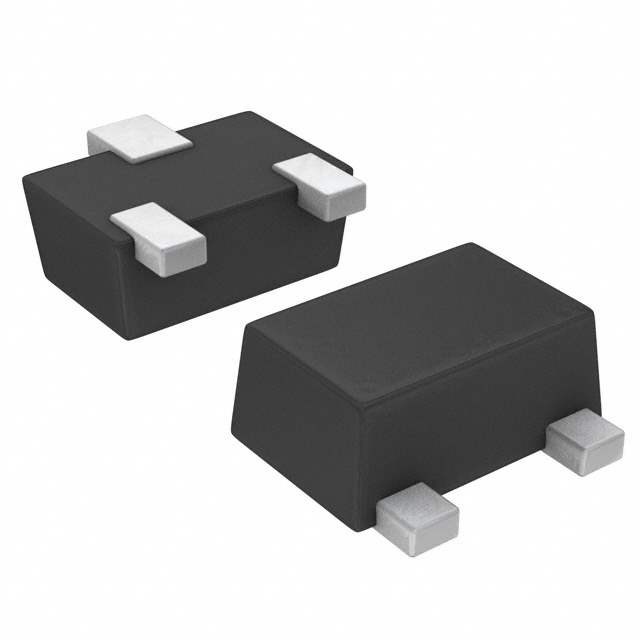
50V VCEO, 100mA collector ceiling, 150mW dissipation limit, VMT3 pre-biased PNP
Quick Engineering Summary
| Field | Value |
|---|---|
| Manufacturer | Rohm Semiconductor |
| Category | Transistors (BJT) - Single, Pre - Biased |
| Package | VMT3 |
| Core function | TRANS PREBIAS PNP 50V 0. |
| Key electrical range | Collector Cut-off Current(Max): 500nA (ICBO); Frequency - Transition: 250MHz; Maximum Current Collector: 100mA; Maximum Power Dissipation: 150mW |
| Reported stock | 1 pcs reported — confirm on RFQ |
Active, but only if the tiny package really fits
Yes, for new work.
DTA144TMT2L is Active, the lifecycle signals agree, and EU RoHS is compliant. The real catch is physical: VMT3 with reel packaging suits automated SMT builds, while the listed stock quantity of 1 does not support an immediate line start.
50V and 150mW are the numbers that decide this part
50V sets the rail ceiling.
That is the collector-emitter breakdown limit, so it decides whether DTA144TMT2L belongs on the rail you have in mind. It does not tell you how much margin remains under transients, because no derating curve or surge behavior is listed.
The 150mW maximum power dissipation is the other hard stop, and it matters more than the 100mA maximum collector current if you want to use this as a general small-signal switch without hand-waving the loss picture. The current rating is a ceiling, not a promise that the package can shed heat comfortably at that load. The listed 300mV max VCE(sat) at 500µA, 5mA is useful only at that test point; it shows the device can pull low with modest drop there, but it does not close saturation loss at higher collector current. The 47k base resistor is the built-in behavior you are buying, so DTA144TMT2L fits where that resistor value matches the drive network, not where you need to tune base bias externally.
Can you actually buy DTA144TMT2L for a build?
Can you get it now?
Not safely, based on this listing alone. Stock quantity is 1, even though another quantity field shows 8000, so availability needs a live check before you tie DTA144TMT2L to a scheduled build.
Packaging is reel - TR, which is the right format for SMT production once supply is there. For a running line, reserve parts against the reel flow you need instead of assuming this one can be pulled ad hoc from shelf stock.
The real review gap is around behavior, not lifecycle
The constraint is missing behavior data.
You have enough to classify the device, but not enough to close a serious schematic or layout decision with confidence. The listing gives you a 50V ceiling, a 100mA collector ceiling, 150mW dissipation, 47k for R1, and hFE min 100 at 1mA, 5V. That frames the part clearly as a pre-biased PNP in a very small package, yet it still leaves key design questions open.
What is absent matters just as much as what is present. There is no pinout in the listing, and that alone can stall a footprint release in a VMT3 or SOT-723 body where orientation mistakes are easy to make and expensive to catch late. There is no package drawing here either, so pad geometry and courtyard still depend on the full datasheet.
And the electrical gaps are not minor. No thermal resistance is listed, so the 150mW limit cannot be tied to board conditions. No switching times are listed, despite the 250MHz transition frequency, so that frequency number is not a direct answer for edge speed in a logic path. DTA144TMT2L may still be the right pre-biased PNP, but the missing pinout, package drawing, thermal resistance, and switching-time detail are what hold the decision open.
View the Win-Source product page for DTA144TMT2L.
Key Takeaways for Engineers & Buyers
- Keep VCEO below the 50V ceiling; that number closes rail fit, not switching behavior.
- Budget around the 150mW dissipation limit before using the full 100mA collector rating.
- Place DTA144TMT2L on a reel-driven build only after confirming VMT3/SOT-723 land pattern.