
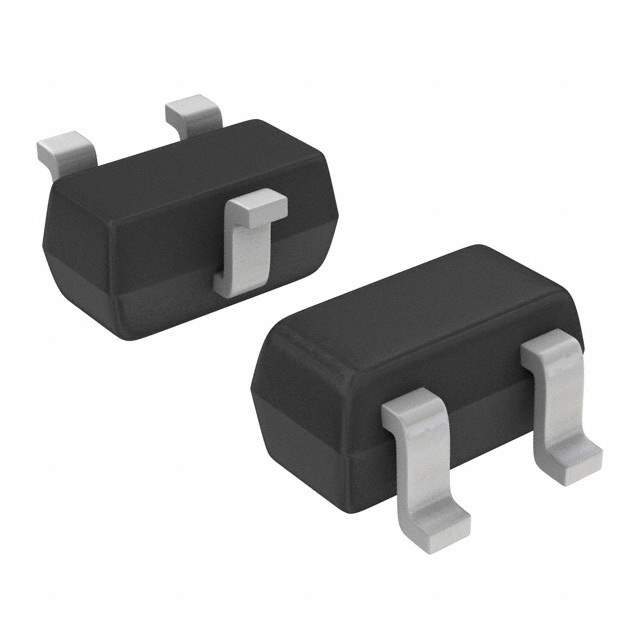
50 V, 100 mA, and 200 mW ceilings show where this pre-biased PNP fits in the signal path.
Quick Engineering Summary
| Field | Value |
|---|---|
| Manufacturer | ON Semiconductor |
| Category | Transistors (BJT) - Single, Pre - Biased |
| Package | SC-75, SOT-416 |
| Core function | TRANS PREBIAS PNP 50V 0. |
| Key electrical range | Current - Collector (Ic) (Max): 100 mA; Current - Collector Cutoff (Max): 500nA; DC Current Gain (hFE) (Min) @ Ic, Vce: 80 @ 5mA, 10V; Power - Max: 200 mW |
| Reported stock | 1 pcs reported — confirm on RFQ |
Good for new builds, with one obvious buy-side catch
It fits.
Active status is clear, and the lifecycle signals agree. This is a small-signal pre-biased PNP for bias-and-switch work where the built-in resistor network matters more than raw current.
The catch is supply, not lifecycle. Packaging is Reel - TR with a standard package of 3,000, while listed stock is 1, so it is not the line item to leave until the last minute. EU RoHS is compliant, MSL is 1 (Unlimited), and REACH is unaffected, which removes the usual handling and compliance friction without changing the immediate quantity mismatch.
50 V is the rail ceiling; 200 mW is the real limiter
50 V sets the first boundary. It tells you the part can sit on higher-voltage control rails than many tiny signal transistors, but it says nothing about switching speed, transient behavior, or how much thermal headroom remains once the device is dropping voltage in real use.
The tighter limit is usually power. The 100 mA collector rating is a ceiling, and the 200 mW power maximum is another, so this belongs in light-load control paths rather than jobs that ask a tiny SC-75, SOT-416 body to carry current and burn voltage at the same time for long periods. The listed 250mV @ 300µA, 10mA saturation point helps place the intended operating neighborhood: modest collector current with modest base drive through the internal network.
Can you keep DTA144WET1G on a running line?
Can I actually get it?
That is the first buyer question, and the answer is mixed in a very specific way: lifecycle says yes, immediate availability says be careful. There is no NRND or EOL warning, so nothing in the lifecycle status blocks use on an existing production build. But listed stock is 1, and the shipping format is Reel - TR with a standard package of 3,000, so the constraint is execution rather than policy.
For sustaining demand, use it where the pre-biased topology is doing real work. The internal resistors are fixed at 47 kOhms for R1 and 22 kOhms for R2, so this is not a generic PNP you tune later with external bias values; those resistor values are the design choice. That makes it a clean fit for compact level shifting, pull-up inversion, and simple load gating when the bias network already lines up with 47 kOhms and 22 kOhms.
It is a poor fit when turn-off speed, edge shape, or bias current needs trimming, because the resistor network is baked in and the listing gives no switching figures to show what that trade costs. The gain number points the same way. hFE is listed as 80 @ 5mA, 10V, which is enough to show small-signal characterization, but not enough to predict behavior across the full 100 mA ceiling. If the running line depends on exact switching delay or storage behavior, wait until the datasheet closes that gap.
The fixed resistor pair decides where it belongs
47 kOhms is the decisive number. Along with 22 kOhms, it is the reason to choose this device at all.
Those built-in values make it attractive when you want one placement instead of a transistor plus bias resistors, and when board area or assembly count matters more than bias flexibility.
That same convenience rules out a lot of uses. In analog bias shaping, fast switching stages, or any circuit where base current must be set by calculation rather than accepted as a fixed network, it is the wrong tool. The package points the same way: SC-75, SOT-416 is for dense surface-mount signal work, not for parts of the design that need thermal mass or generous lead spacing.
What the listing still doesn’t answer
The constraint is missing detail.
Pinout, package drawing, thermal resistance, and switching data are still absent. Those gaps decide layout fit, ambient headroom, and whether the pre-biased network is fast enough for the edge rates you need.
View the Win-Source product page for DTA144WET1G.
Key Takeaways for Engineers & Buyers
- Keep VCE below the 50 V breakdown ceiling; that number closes rail fit, not switching behavior.
- Budget dissipation against the 200 mW maximum before using the 100 mA collector limit.
- Check stock before committing to reel use or line support; listed quantity is 1 and standard package is 3,000.