
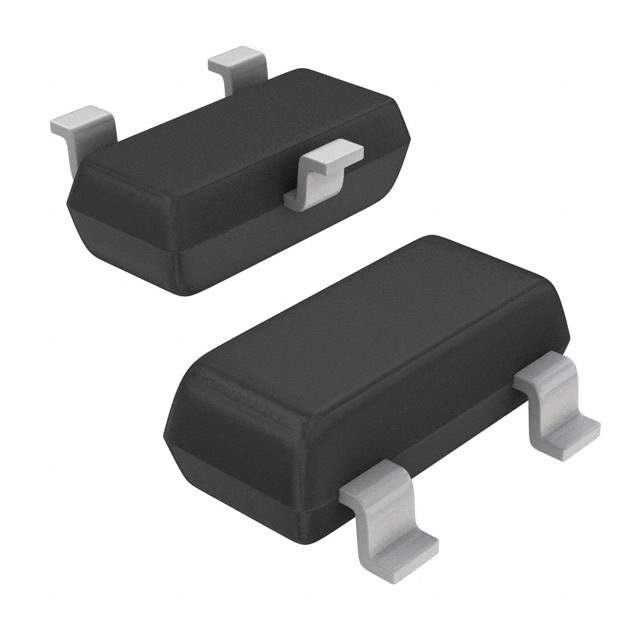
50V VCEO ceiling, 30mA collector limit, 150mW dissipation, EMT3 package, PNP pre-biased transistor
Quick Engineering Summary
| Field | Value |
|---|---|
| Manufacturer | Rohm Semiconductor |
| Category | Transistors (BJT) - Single, Pre - Biased |
| Package | EMT3 |
| Core function | TRANS PREBIAS PNP 50V EMT3 |
| Key electrical range | Collector Cut-off Current(Max): 500nA; Frequency - Transition: 250MHz; Maximum Current Collector: 30mA; Maximum Power Dissipation: 150mW |
| Reported stock | 18000 pcs reported — confirm on RFQ |
50V and 30mA keep this in small-signal territory
50V is the first number to look at. It lets DTA144WETL sit on higher-voltage control rails than many tiny pre-biased BJTs, but it does not make the part a serious load switch when the collector current ceiling is 30mA and the power dissipation ceiling is 150mW.
That puts it in signal steering, level shifting, and simple transistor-interface work where the built-in resistors save parts count. It does not settle a relay, lamp, or other load-driving choice on its own. The listed 300mV VCE(sat) at 500µA, 10mA is useful because it shows characterization in a low-current switching condition, not because it promises the same headroom across the full current range.
Can you still buy it for a running line?
Can you keep it on an existing BOM? Yes, with caution. Stock is listed at 18000 and packaging is Reel - TR, so it fits SMT production flow rather than hand-load service work.
The real issue is lifecycle, not availability. One field says Active, another says Not For New Designs, and that conflict is enough to rule out a clean new design-in. For an existing production build, secure the quantity you need and keep it on programs that already use the 47k and 22k internal resistor network. EU RoHS is straightforward and doesn't change that call.
Use the internal resistor pair, or don’t use this part
This is a sustaining part.
DTA144WETL only earns its place when the pre-biased structure is the reason you picked it. The 47k base resistor and 22k emitter-base resistor are not side details; they set the interface behavior and give you less freedom than a plain PNP transistor. If your drive source, leakage budget, or turn-off behavior wants different resistor values, this is the wrong shortcut.
The 500nA collector cut-off current ceiling helps in low-leakage control paths, and the 250MHz transition frequency says the transistor itself is not especially slow, but neither number fixes a mismatch in the built-in bias network. Get that wrong and the stage will not bias the way you expected.
The missing thermal and switching data still matters
And those gaps still matter. There is no reverse-recovery time because this is not that kind of device, but there is also no thermal resistance, no derating curve, no pinout, and no package drawing here.
View the Win-Source product page for DTA144WETL.
Key Takeaways for Engineers & Buyers
- Keep DTA144WETL off new BOMs; the status conflict lands on Not For New Designs.
- Check rail and load against the 50V VCEO ceiling and 30mA collector ceiling before reuse.
- Confirm the built-in bias network matches your drive math: R1 is 47k and R2 is 22k.