
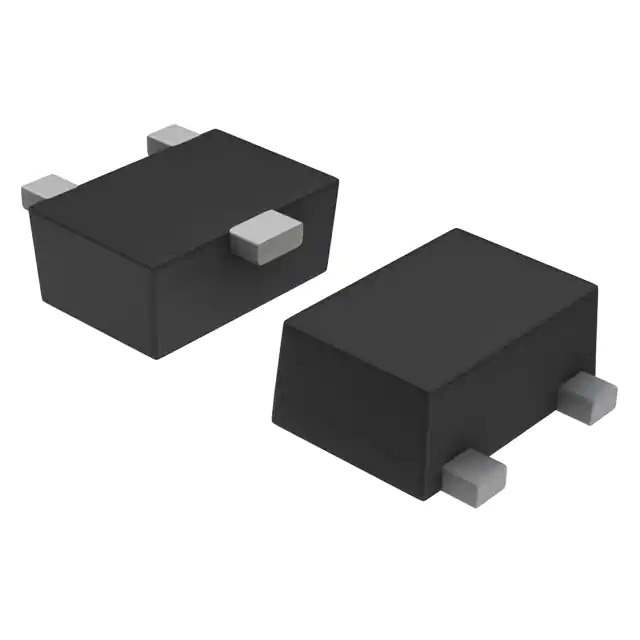
50 V VCEO ceiling, 100 mA collector ceiling, 260 mW limit, SOT-723, with built-in 47 kOhms and 22 kOhms
Quick Engineering Summary
| Field | Value |
|---|---|
| Manufacturer | ON Semiconductor |
| Category | Transistors (BJT) - Single, Pre - Biased |
| Package | Tape & Reel |
| Core function | TRANS PREBIAS PNP 50V SOT723 |
| Key electrical range | Current - Collector (Ic) (Max): 100 mA; Current - Collector Cutoff (Max): 500nA; DC Current Gain (hFE) (Min) @ Ic, Vce: 80 @ 5mA, 10V; Power - Max: 260 mW |
| Reported stock | 2320 pcs reported — confirm on RFQ |
50 V is the reason to consider it
50 V is the collector-emitter breakdown ceiling, and it is the first number that puts this part on the shortlist. It gives a small pre-biased PNP room for higher-voltage sense, pull-up, and level-shift duties where a lower-voltage digital transistor would be out immediately.
The rest is simple. DTA144WM3T5G is Active, the lifecycle signals agree, and nothing here argues against new design-in for ordinary commercial builds. EU RoHS is compliant, and REACH is listed as unaffected. What the listing does not settle is a switching-speed or thermal case, so use it where the built-in bias network is the point, not where edge-rate behavior carries the design.
Can you keep a running line on DTA144WM3T5G?
Can this part stay on a BOM without turning into a line-stop problem? Mostly yes, with one practical catch. Lifecycle is Active and listed stock is 2320, so this is not an end-of-life cleanup exercise. The catch is packaging: Tape & Reel is the package form, and the standard package is 8,000 pcs, which matters if your build plan expects loose-piece flexibility or very small replenishment lots.
The electrical limits are modest, and they set the boundaries fast. The 100 mA collector current is a ceiling, not a working target, so DTA144WM3T5G belongs in signal and bias jobs rather than load drive with much thermal slack. The 260 mW power limit points the same way, and in a small package it will end the conversation before anyone treats the current rating as comfortable operating room.
The built-in network is just as important. R1 is 47 kOhms and R2 is 22 kOhms, so this is not a generic PNP you can swap into any existing base-drive scheme and expect the same thresholds or turn-off behavior. Those resistor values define the part. If the circuit wants a different bias ratio, DTA144WM3T5G is the wrong starting point before board space even enters the discussion.
One more number is worth keeping in context: VCE(sat) is listed as 250mV @ 300µA, 10mA. Useful, yes. But only at that test point. It supports low-current switching assumptions around 10mA; it does not say what saturation looks like near the 100 mA ceiling, and it does not change the fact that package size and dissipation keep this device in a small-budget role.
Not for power switching; right for dense bias control
Not for power switching. DTA144WM3T5G is a surface-mount SOT-723 pre-biased PNP, and every listed limit pushes it toward compact control circuitry instead of load drive.
Where it fits is dense board work where saving external resistors matters: enable lines, pull-up inversion, simple level translation, and housekeeping control around rails that can reach 50 V. The minimum hFE of 80 @ 5mA, 10V is enough to place it in signal duty, but that test condition is narrow, so don't stretch it into a broad gain promise across the whole operating range. The 500nA collector cutoff ceiling helps in low-leakage bias paths, yet dynamic behavior is still open. Footprint and resistor integration are the win here.
The missing numbers are the real review gap
And those open points matter. This listing still needs a pinout or package drawing to finish layout work, and it omits thermal resistance, any derating curve, and switching figures such as transition frequency or capacitance.
View the Win-Source product page for DTA144WM3T5G.
Key Takeaways for Engineers & Buyers
- Keep DTA144WM3T5G on low-current control nodes; 100 mA collector and 260 mW are hard ceilings.
- Match the drive network to the built-in 47 kOhms base resistor and 22 kOhms emitter-base resistor before dropping it into a logic interface.
- Buy in reel terms: standard package is 8,000 pcs, while listed stock is 2320.