
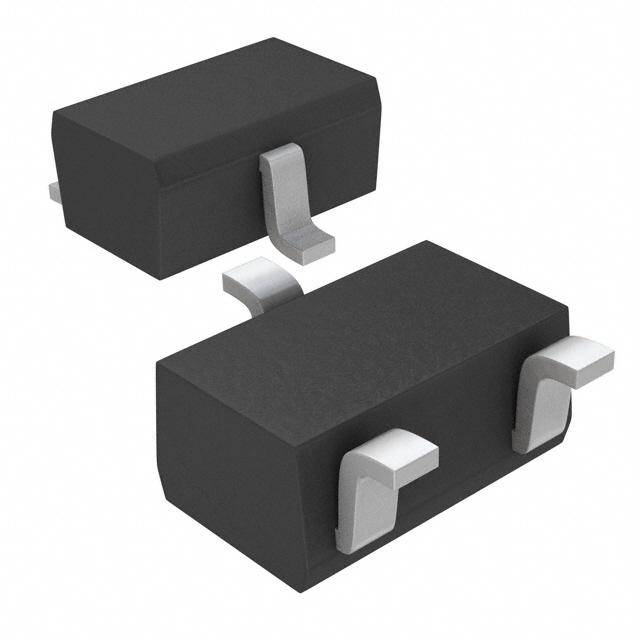
50V VCEO ceiling, 30mA collector ceiling, 200mW dissipation ceiling, UMT3 pre-biased PNP
Quick Engineering Summary
| Field | Value |
|---|---|
| Manufacturer | Rohm Semiconductor |
| Category | Transistors (BJT) - Single, Pre - Biased |
| Package | UMT3 |
| Core function | TRANS PREBIAS PNP 50V UMT3 |
| Key electrical range | Collector Cut-off Current(Max): 500nA; Frequency - Transition: 250MHz; Maximum Current Collector: 30mA; Maximum Power Dissipation: 200mW |
| Reported stock | 6440 pcs reported — confirm on RFQ |
50V is useful, but 30mA and 200mW decide the fit
50V is the decisive ceiling. It settles one question quickly: DTA144WUAT106 can sit on higher-voltage small-signal rails where a lower-voltage digital transistor drops out at once.
That still doesn't answer whether it fits the job. The collector current ceiling is 30mA, and maximum power dissipation is 200mW, so those are the limits that really govern placement in the circuit. They rule out relay, lamp, and other heavier switching paths even when the voltage figure looks comfortable, because current and dissipation run out first in this class of part.
The listed 300mV max VCE(sat) at 500µA and 10mA is useful, but only as a bounded low-current switching point. It is not evidence for every collector current up to the 30mA ceiling. If the design depends on a hard saturated switch, that test condition marks where the listing is specific and where it goes quiet.
Just as important, you are not choosing only a transistor here. You are choosing a fixed input network built around the built-in 47k base resistor and 22k emitter-base resistor, and that can matter more to drive compatibility and turn-off behavior than the package name or the headline voltage rating.
Good for compact bias-and-switch jobs, not load driving
Good fit here.
The UMT3 package and SMD mounting suit dense boards where dropping two external resistors is worth something. DTA144WUAT106 fits level shifting, pull-up side switching, and simple interface stages that stay comfortably inside the 30mA collector ceiling. The 500nA collector cut-off current max also helps on high-impedance nodes where off-state leakage matters.
It does not fit paths dominated by startup surge, thermal rise, or forced saturation beyond the listed 10mA test point. The 200mW ceiling arrives fast in a package this small, and there is no thermal curve here to show ambient headroom.
Can you keep a line running on it?
Can you still buy it for the line?
Yes. DTA144WUAT106 is Active, stock is 6440, and packaging is Reel - TR.
And the missing data is what closes the real review
And that is only the supply side. There is no pinout here, no package drawing, and no thermal resistance figure, so board fit and dissipation margin still depend on the full datasheet. There is also no switching-time data and no capacitance data, which leaves edge speed and node loading unanswered even though the transition frequency is listed as 250MHz.
For DTA144WUAT106, those omissions separate a quick BOM call from a finished schematic decision. The listing is enough to say the part is live, small, pre-biased, and bounded by 50V, 30mA, and 200mW. It is not enough to sign off footprint, thermal headroom, or dynamic behavior.
View the Win-Source product page for DTA144WUAT106.
Key Takeaways for Engineers & Buyers
- Check that the built-in 47k and 22k bias network matches the drive source and turn-off behavior you need.
- Keep collector load inside the 30mA ceiling; that limit, not the package name, decides whether DTA144WUAT106 belongs in the path.
- Use DTA144WUAT106 on reel builds only if TR packaging fits the line setup and the current 6440 stock covers the build window.