
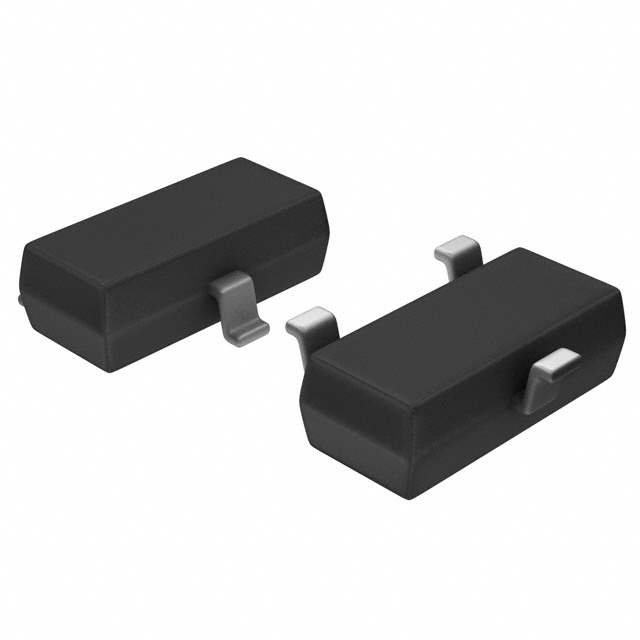
50V VCEO, 500mA collector ceiling, 200mW dissipation in an SMT3 pre-biased PNP
Quick Engineering Summary
| Field | Value |
|---|---|
| Manufacturer | Rohm Semiconductor |
| Category | Transistors (BJT) - Single, Pre - Biased |
| Package | SMT3 |
| Core function | TRANS PREBIAS PNP 50V 0. |
| Key electrical range | Collector Cut-off Current(Max): 500nA; Frequency - Transition: 200MHz; Maximum Current Collector: 500mA; Maximum Power Dissipation: 200mW |
| Reported stock | 30000 pcs reported — confirm on RFQ |
The weak point is power, not lifecycle
The 200mW limit is the first reason to hesitate; Active status is the reason not to walk away. DTB114EKT146 is a sensible new design-in choice for small-signal switching, but only when the circuit never asks this pre-biased PNP to act like a power transistor just because the collector current ceiling is 500mA.
That 500mA figure is a ceiling, not a working target, and the same applies to the 50V VCEO limit. Those numbers define the rail and load envelope it can survive, but they do not settle junction temperature or loss. EU RoHS is straightforward here. For supply planning, the useful fact is simpler: lifecycle is Active and stock is listed at 30000, so this is not a sustaining-only buy.
200mW decides the design window
200mW decides it. DTB114EKT146 is a control transistor, not a load-driving workhorse, even with a 500mA collector-current ceiling and 50V VCEO.
Wrong for analog bias tricks, right for tidy digital drive
Wrong for circuits that need a freely chosen base network. The built-in resistors are fixed at 10k for R1 and 10k for R2, so DTB114EKT146 fits places where that ratio is the point of the part: logic-level inversion, simple load switching, and bias-controlled interfaces that benefit from one less external resistor pair.
The listed 300mV @ 2.5mA, 50mA VCE(sat) ceiling helps because it ties switching behavior to an actual test condition instead of leaving saturation vague. It shows what the transistor can do at 50mA collector current with 2.5mA base drive at that point, but not how it behaves across the rest of the load range. The 56 @ 50mA, 5V gain figure helps only as a minimum at that stated point. Use DTB114EKT146 where the embedded bias network simplifies assembly and the load current stays comfortably in small-signal territory.
The buying constraint is package commitment
Package commitment is the constraint the numbers create. Reel packaging is the practical issue here. DTB114EKT146 is listed as Reel - TR in SMT3, with stock shown at 30000, so it fits a line that wants feeder-ready parts and steady replenishment rather than loose-piece service stock.
One supply-side caution deserves action: the open-market fake threat is listed at 70 pct. Keep purchases on authorized channels and avoid spot buys when a running line depends on this exact pre-biased network.
What the listing still doesn't answer
And that leaves the page short on the details that actually close a schematic and layout decision, because DTB114EKT146 is easy to place at a high level while the missing items are the ones that determine whether it drops cleanly into a real board.
There is no pinout here, even though this is a 3-pin SMT3 device and a pre-biased transistor is useless if the resistor-connected terminals are not nailed down. There is no package drawing either; the row text mentions TO-236-3, SC-59, and SOT-23-3, but the mechanical dimensions that settle land pattern and courtyard are absent.
Thermal detail is thin too. You get 200mW maximum power dissipation, but no thermal resistance and no derating curve, so ambient headroom cannot be judged from this listing alone. The switching picture is incomplete as well: no capacitance data, no storage time, and no turn-on or turn-off behavior. For a resistor-equipped transistor, those omissions matter more than the 200MHz transition frequency headline, because they decide whether DTB114EKT146 is merely convenient or actually clean in the edge rates your board needs.
View the Win-Source product page for DTB114EKT146.
Key Takeaways for Engineers & Buyers
- Keep DTB114EKT146 in low-dissipation switching paths; 200mW is the hard thermal ceiling.
- Use the built-in 10k/10k bias network only where that resistor ratio matches the drive scheme.
- Book reel demand against the listed 30000 stock if this stays on a running line.