
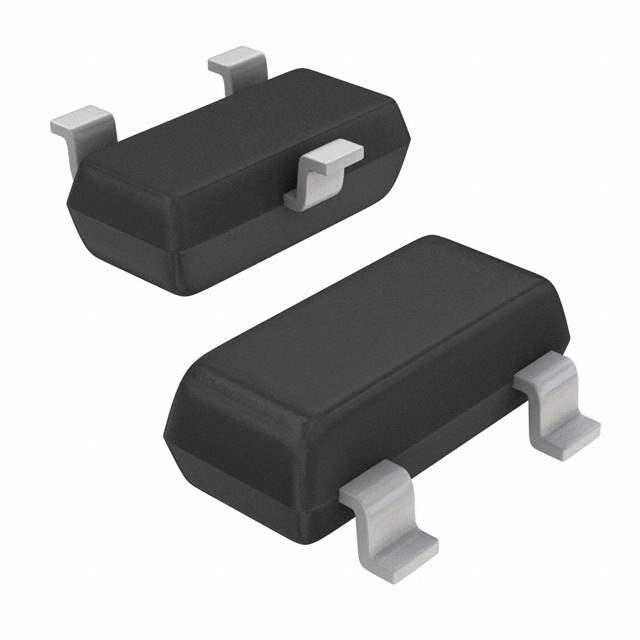
12V VCEO, 500mA collector ceiling, 150mW limit, EMT3 pre-biased PNP with 1k/10k resistors
Quick Engineering Summary
| Field | Value |
|---|---|
| Manufacturer | Rohm Semiconductor |
| Category | Transistors (BJT) - Single, Pre - Biased |
| Package | EMT3 |
| Core function | TRANS PREBIAS PNP 12V 0. |
| Key electrical range | Collector Cut-off Current(Max): 500nA; Frequency - Transition: 260MHz; Maximum Current Collector: 500mA; Maximum Power Dissipation: 150mW |
| Reported stock | 1 pcs reported — confirm on RFQ |
12V is the first gate on DTB513ZETL
12V decides this part fastest. DTB513ZETL is a PNP pre-biased transistor with a 12V collector-emitter breakdown ceiling, so it fits low-voltage switching and bias duties, not rails that crowd that limit and leave no fault headroom.
From there, the rest falls into place. Active lifecycle with no conflict keeps it viable for new design-in, and EU RoHS compliance removes a common blocker. The real hinge is the built-in resistor pair: 1k on R1 and 10k on R2 mean you are not starting with a bare BJT and choosing the base network later. If those values suit the logic drive and turn-off behavior you need, DTB513ZETL is a neat fit. If they do not, the convenience is the constraint.
This is not a power switch
It isn't.
The 500mA maximum collector current and 150mW maximum power dissipation are ceilings, and they answer different questions. The current rating marks the upper edge the device is rated to withstand. The dissipation limit is the sharper warning in real layouts, because an EMT3 body runs out of thermal budget quickly.
The listed 300mV max VCE(sat) at 5mA and 100mA is useful, but only at that test corner. It shows DTB513ZETL can reach a low saturation drop at 100mA collector current with 5mA base current under that condition, not across every load current. The 140 minimum hFE at 100mA and 2V helps on gain margin in a linear reading, but this remains a pre-biased switching transistor first, and the internal resistor network is part of the behavior whether you want it or not.
The weak point is missing detail, not the transistor
The weak point is missing detail, not the transistor. The strong point is that the listing still gives enough to place DTB513ZETL in the right class of work: small-signal, low-voltage, board-level switching where a built-in bias network saves parts count and placement.
Package and mounting matter here. EMT3, with SMD mounting and reel packaging, points to automated assembly and dense layouts rather than hand-tuned through-hole fixes or thermally generous fixtures. The 260MHz transition frequency says the transistor itself is not inherently slow, but that number alone does not settle edge behavior in the actual circuit because the internal 1k and 10k resistors shape how the base is driven and discharged.
That leaves a clear boundary around the part. DTB513ZETL makes sense for inverter stages, level-controlled enables, and compact load switching on low-voltage boards. It does not suit designs that need a freely chosen base network or that sit near the 12V rail by default.
Several omissions still matter before release, and they are concrete ones. The listing does not include a pinout, package drawing, or thermal resistance, which blocks footprint confirmation and any serious ambient-to-junction judgment. It also does not show switching waveforms or storage time, where you find out whether the pre-biased network behaves the way your timing budget expects.
Buy it only after the quantity mismatch is cleared
And that buy call is simple. One stock field shows 1, while another quantity field shows 8613. Clear that discrepancy before placing DTB513ZETL on a build-critical BOM.
View the Win-Source product page for DTB513ZETL.
Key Takeaways for Engineers & Buyers
- Check the control node against the built-in 1k R1 and 10k R2 before freezing the drive circuit.
- Treat 12V VCEO and 500mA collector current as ceilings; keep DTB513ZETL out of rails and loads that lean on either limit.
- Resolve the quantity mismatch now: one stock field shows 1 while another shows 8613.