
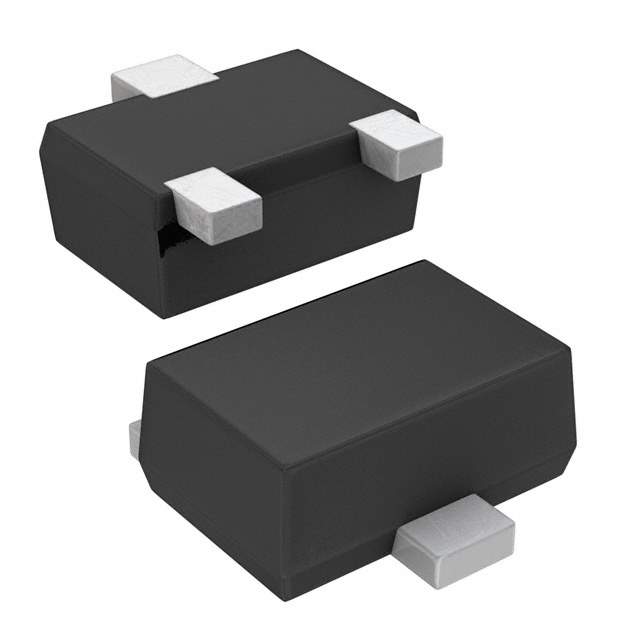
50 V, 100 mA, 150 mW pre-biased NPN in EMT3F; the voltage and power ceilings set the fit.
Quick Engineering Summary
| Field | Value |
|---|---|
| Manufacturer | Rohm Semiconductor |
| Category | Transistors (BJT) - Single, Pre - Biased |
| Package | Reel - TR |
| Core function | TRANS PREBIAS NPN 50V 0. |
| Key electrical range | Supply and Demand Status: Limited |
| Reported stock | 27000 pcs reported — confirm on RFQ |
Can you design DTC013ZEBTL into a new board?
Can I put this into a new design without creating a sourcing or lifecycle problem? Yes. The listing shows DTC013ZEBTL as Active, the lifecycle signals agree, and EU RoHS compliance removes the usual status conflict that pushes a device into sustaining-only territory.
The real fit comes down to the ceilings. A 50 V collector-emitter breakdown limits rail exposure, and 100 mA collector current does not by itself make this a comfortable switch because the same listing caps power at 150 mW. That combination puts DTC013ZEBTL in light switching and bias-network work, where the integrated resistor network saves placement and BOM lines, rather than in positions that spend meaningful time with both current and voltage across the device.
The resistor values lock in the use case. R1 is 1 kOhms and R2 is 10 kOhms, so this is not a generic small-signal NPN you tune later around whatever base-drive scheme the circuit happens to need. It is a pre-biased transistor with a defined behavior envelope, and that is exactly why it can simplify dense control circuitry when the surrounding logic matches those built-in values.
Not for power switching; right for compact logic interfacing
Power switching is where this part runs out of room first. A 100 mA collector ceiling and 150 mW maximum power rule out relay, lamp, or similar switch positions where dissipation can accumulate, even when the rail stays under 50 V.
It fits much better in compact control circuitry. The EMT3F package and the integrated 1 kOhms and 10 kOhms resistors point to level shifting, inverter stages, simple enable lines, and MCU-facing transistor functions where board area matters more than raw drive.
The listed hFE minimum of 30 at 5mA, 10V and VCE(sat) maximum of 150mV at 500µA, 5mA are useful anchors for that kind of work, but only at those test points. In short, DTC013ZEBTL belongs in signal-path switching, not power-path switching.
The real buy constraint is 51 Weeks
Lead time is the constraint here. Active status keeps lifecycle risk low, and 27000 pieces on hand helps, but the listing also marks supply and demand as Limited, so easy replenishment is not something to count on.
Buy in reel terms if this device is headed into production. The package is Reel - TR with 3000 per package, which lines up better with scheduled builds than with ad hoc top-ups. If DTC013ZEBTL is line-critical, cover more than the next build window now rather than letting the 51 Weeks lead time set the schedule for you.
What the listing still doesn't tell you
150 mW is useful, but it is not enough to close the thermal picture. There is no pinout here, no package drawing, and no thermal resistance figure, so board escape, land pattern confidence, and ambient headroom remain open.
Two electrical gaps matter too. The listing gives no switching times and no junction capacitance, so if DTC013ZEBTL is meant to clean up a fast edge or sit in a timing-sensitive path, this page cannot answer that. There is also no derating curve or surge figure, leaving transient and temperature margin unresolved.
View the Win-Source product page for DTC013ZEBTL.
Key Takeaways for Engineers & Buyers
- Treat 50 V VCEO as a ceiling; keep rail transients inside it.
- Budget dissipation against the 150 mW maximum, not just the 100 mA collector limit.
- Place the buy now if DTC013ZEBTL is line-critical; lead time is listed at 51 Weeks.