
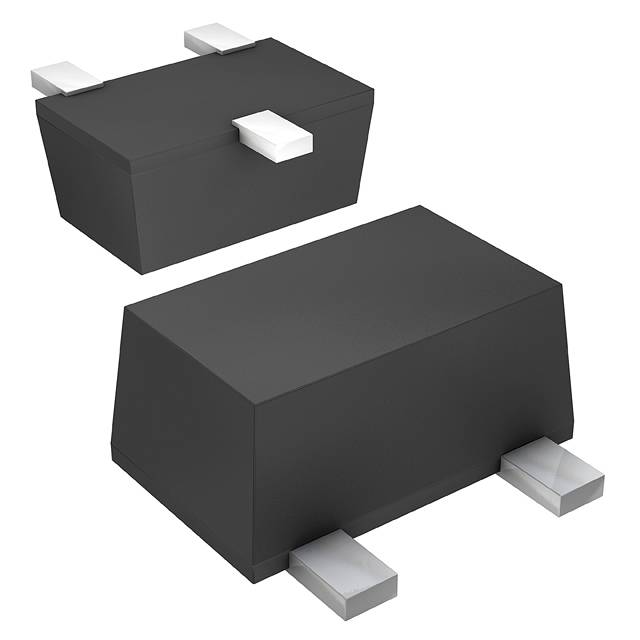
50V VCEO, 100mA collector ceiling, 200mW dissipation limit, UMT3F package, 10k base resistor
Quick Engineering Summary
| Field | Value |
|---|---|
| Manufacturer | Rohm Semiconductor |
| Category | Transistors (BJT) - Single, Pre - Biased |
| Package | UMT3F |
| Core function | TRANS PREBIAS NPN 50V UMT3F |
| Key electrical range | Collector Cut-off Current(Max): 500nA (ICBO); Frequency - Transition: 250MHz; Maximum Current Collector: 100mA; Maximum Power Dissipation: 200mW |
| Reported stock | 173000 pcs reported — confirm on RFQ |
Use it for compact low-power switching
Good fit.
An Active pre-biased NPN in UMT3F, DTC014TUBTL works for new design-in when the goal is to lose an external base resistor and keep the footprint small. The decision comes down to three ceilings: 50V VCEO, 100mA maximum collector current, and 200mW maximum power dissipation. That puts it on modest control rails and small loads, not in the general-purpose power-transistor bucket.
The built-in 10k R1 is the other fact that shapes the choice. It simplifies biasing, but it also fixes part of the drive network from the start, so this part belongs in circuits that actually want that resistor value. EU RoHS is compliant.
Not for load driving beyond the small-signal edge
Heavy load driving is where this part runs out of road.
The 100mA maximum collector current is a ceiling, not a target, and the 200mW maximum power dissipation usually becomes the tighter limit on a real board. If load current or ambient leaves little thermal room, DTC014TUBTL is too small to bail the design out.
It does fit low-power level shifting, pull-down duty, and simple switching where the 50V collector-emitter breakdown ceiling gives rail margin and the pre-biased NPN structure trims BOM count. The listed 150mV VCE(sat) at 500µA and 5mA is useful, but only for that stated test condition. It says little about saturation at heavier collector current, and that missing curve matters when low-level loss or logic-low margin is tight.
The built-in resistor is the real design commitment
Flexibility is the weak point.
The payoff is simplicity: DTC014TUBTL makes a very specific interface stage easy to place and easy to assemble because the internal 10k base resistor removes one external part and one routing stub in a package this small.
That convenience also locks in a constraint. You are not choosing only an NPN transistor; you are choosing an NPN transistor plus 10k at the base. In a board where the upstream driver, edge rate, or input current budget was built around some other resistor value, DTC014TUBTL can be the wrong pre-biased transistor even when the 50V and 100mA ceilings look comfortable, because the resistor choice is already baked into the device and can’t be tuned later without changing parts.
The listed hFE minimum of 100 at 5mA and 10V helps only in that exact test neighborhood. It supports the case for small-signal switching, but it does not settle behavior across the rest of the intended operating range.
Frequency transition at 250MHz keeps it from looking unusually slow, yet that number alone does not qualify it for analog gain stages or fast switching edges. For those calls, the missing curves matter more than the headline frequency. Treat DTC014TUBTL as a compact biased switch, not as a transistor to stretch into every small-signal job just because the package is convenient.
Buy it as a reel part, not as a one-off convenience
That same logic carries into purchasing. Reel - TR packaging and listed stock of 173000 make DTC014TUBTL a sensible line item for automated SMT builds, especially when the board already wants a pre-biased NPN in UMT3F.
Lock the reel format into the BOM and feeder plan now. For sustaining demand, the same choice keeps handling consistent with the dry storage cabinet and humidity protection package note.
What the listing still doesn't answer
150mV is only one point.
DTC014TUBTL still needs pinout, RθJC, and saturation or forward-drop curves beyond the single 150mV at 500µA and 5mA point. ECAD is also not present here; it is only listed as contact to download.
View the Win-Source product page for DTC014TUBTL.
Key Takeaways for Engineers & Buyers
- Keep DTC014TUBTL on low-power switching nodes; 200mW is the dissipation ceiling.
- Match the drive network to the built-in 10k R1 before dropping DTC014TUBTL into a logic interface.
- Buy on Reel - TR if the line is automated; listed stock is 173000.