
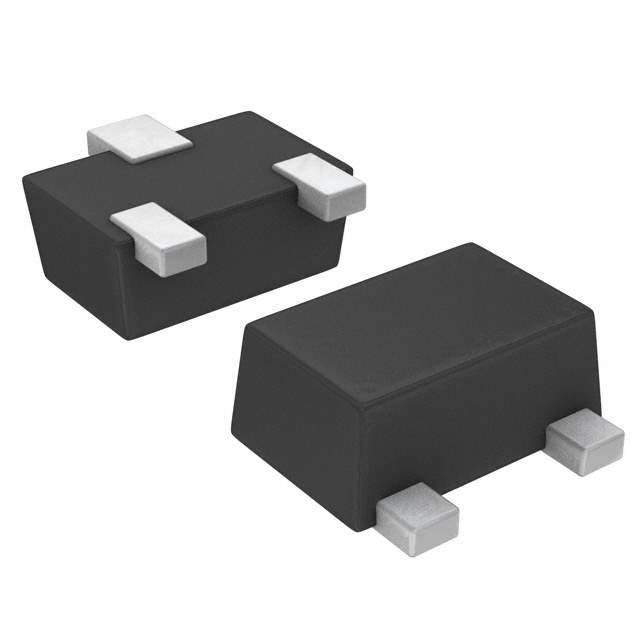
50 V in VMT3 sounds easy. The real fit is set by the 70 mA and 150 mW ceilings.
Quick Engineering Summary
| Field | Value |
|---|---|
| Manufacturer | Rohm Semiconductor |
| Category | Transistors (BJT) - Single, Pre - Biased |
| Package | VMT3 |
| Core function | TRANS PREBIAS NPN 50V VMT3 |
| Key electrical range | Supply and Demand Status: Limited |
| Reported stock | 16000 pcs reported — confirm on RFQ |
Use it for new builds, but buy it like a constrained line
Good for new design-in.
Active status, aligned lifecycle signals, EU RoHS compliance, REACH listed as Unaffected, and MSL 1 (Unlimited) remove the usual status objections to a fresh BOM for DTC014YMT2L.
Availability is the real issue. Stock is listed at 16000, but supply and demand is marked Limited and estimated production lead time is 24 Weeks. If DTC014YMT2L is headed for a running line, plan beyond the first build and account for the reel quantity.
The real ceiling is power, not the 50 V headline
The constraint is cumulative.
A 70 mA current ceiling, a 150 mW power ceiling, and a VMT3 body leave little room for casual use, even though the 50 V collector-emitter breakdown looks generous at first glance.
That 50 V figure is a ceiling, not an operating point. It answers the voltage-stress question for higher-voltage logic or control nodes, but it does not create current margin once the device is switching, and it does not answer how the package behaves thermally in the board stackup.
The 70 mA collector current is also a ceiling. For DTC014YMT2L, it rules out loads that creep upward at startup or under fault conditions, because there is no listed surge current or derating curve here to show how much abuse the device can absorb before it turns into a field return.
Power is tighter still. The 150 mW maximum is the limit most likely to decide the fit, because a modest-looking load can still become a package-heating problem in a very small outline.
The listed VCE(sat) is 150 mV at 500 µA and 5 mA, and the minimum hFE is 80 at 5mA and 10V. Useful numbers, yes, but they do not close performance at the 70 mA ceiling. They support a small-signal, low-current switching role for DTC014YMT2L, not a general-purpose load-driving one.
Best fit is housekeeping logic, not load driving
10 kOhms and 47 kOhms set the tone.
DTC014YMT2L is a pre-biased NPN with R1 at 10 kOhms and R2 at 47 kOhms, so it fits where saving external resistor placements and keeping the control path compact are the point. That puts it in enable lines, level-conditioned logic switching, and similar low-current transistor work.
The package points the same way. VMT3, with SOT-723 called out, is a very small surface-mount footprint, and paired with 150 mW maximum power it is not the place for anything that behaves like a load switch, relay driver, or lamp driver. The 250 MHz transition frequency is listed, but the practical takeaway is simpler: DTC014YMT2L belongs in dense control circuitry, not in jobs that burn real power.
The missing datasheet items are the ones that close risk
The weak point comes first.
No pinout, no package drawing, no thermal resistance, and no collector cutoff current value are listed. For DTC014YMT2L, those gaps leave layout, thermal headroom, and off-state leakage unresolved.
View the Win-Source product page for DTC014YMT2L.
Key Takeaways for Engineers & Buyers
- Hold DTC014YMT2L to low-current switching only; 70 mA and 150 mW are hard ceilings.
- Reserve reel planning early: package is Reel - TR, 8000 per package, with 24 Weeks lead time.
- Confirm the built-in bias network against your drive source: R1 is 10 kOhms and R2 is 47 kOhms.