
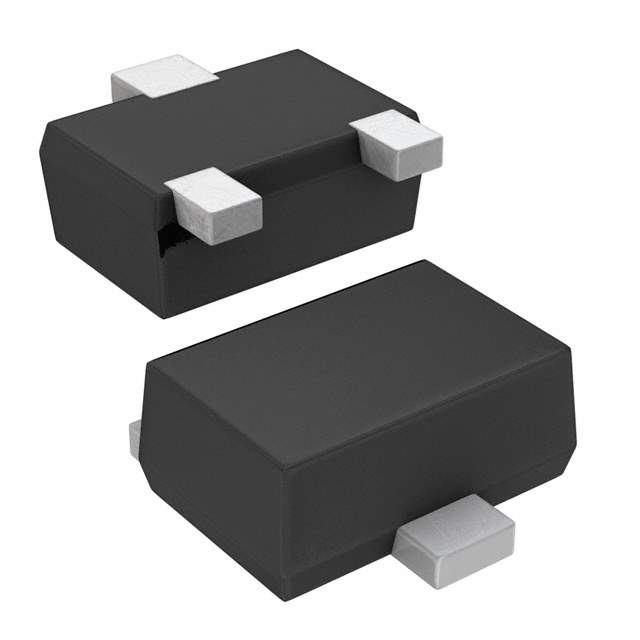
50 V, 70 mA, 200 mW in UMT3F; built-in 10 kOhms and 47 kOhms decide the fit
Quick Engineering Summary
| Field | Value |
|---|---|
| Manufacturer | Rohm Semiconductor |
| Category | Transistors (BJT) - Single, Pre - Biased |
| Package | UMT3F |
| Core function | TRANS PREBIAS NPN 50V UMT3F |
| Key electrical range | Supply and Demand Status: Balance |
| Reported stock | 490 pcs reported — confirm on RFQ |
50 V is the first gate, not the whole answer
50 V is the collector-emitter breakdown ceiling, and it decides whether DTC014YUBTL belongs on the rail at all. That settles maximum VCE exposure. It does not settle switching loss, saturation behavior across temperature, or transient tolerance, because those details are not carried here.
Still, the overall read is favorable. The part is Active with low lifecycle risk, stocked at 490, and marked EU RoHS with REACH unaffected, so there is no compliance conflict hanging over a new design. For compact low-current switching, a pre-biased NPN in UMT3F can save external resistors when the footprint already fits.
70 mA and 200 mW set the real ceiling
70 mA is the decisive current limit. For DTC014YUBTL, collector current tops out there, so any load that needs real margin above that during startup or fault conditions is out.
The 200 mW maximum matters just as much. This is a small package, and thermal room disappears quickly even when a schematic looks harmless at first glance. The listed VCE(sat) is 150 mV at 500 µA and 5 mA, which at least shows characterization for low-current saturated switching, but there is no forward-drop curve versus current and temperature here, so the dissipation budget is still open. The hFE minimum of 80 at 5mA and 10V helps in that same low-current region. It does not justify assumptions near the 70 mA ceiling.
The resistor pair is the reason to pick it
The weak point comes first: flexibility is limited. DTC014YUBTL fixes R1 at 10 kOhms and R2 at 47 kOhms, so if the bias network wants different values, the part is wrong before layout starts.
That same constraint is the advantage when the values line up with the drive source. You drop two external resistors and keep the switch stage compact in UMT3F. It suits dense board-level control and interface circuits where a pre-biased NPN handles simple level shifting or low-current load switching. Small part. Narrow job.
Buy for continuity, not for comfort stock
And that is what drives the buy call. The real constraint is lead time, not lifecycle status. The listing shows 19 Weeks, while stock is 490 and reel quantity is 3000, so DTC014YUBTL is available, but not with the kind of depth that supports a relaxed replenishment plan on a running line.
Package format matters in a practical way. Reel - TR fits what most SMT lines already want, and MSL 1 (Unlimited) removes a common floor-handling nuisance once reels are opened, but neither point changes the replenishment risk created by a long lead time when usage is steady or demand shifts faster than expected.
There is no reason to lean on open-market sourcing as an easy backup. Keep DTC014YUBTL on authorized channels, tie orders to actual build demand, and plan around the stated lead time instead of letting Active status and visible stock create false comfort.
What the listing still doesn't answer
Wrong for closing package and thermal questions. What is still missing is pinout, package drawing, thermal resistance, and collector cutoff current; switching waveforms are absent too, so edge behavior cannot be judged from this page alone.
View the Win-Source product page for DTC014YUBTL.
Key Takeaways for Engineers & Buyers
- Match the base network to the built-in 10 kOhms and 47 kOhms before releasing DTC014YUBTL.
- Treat 70 mA collector current and 200 mW as ceilings; check the load line, not just the logic drive.
- If this is a running line, cover the 19 Weeks lead time before the 490 on hand disappears.