
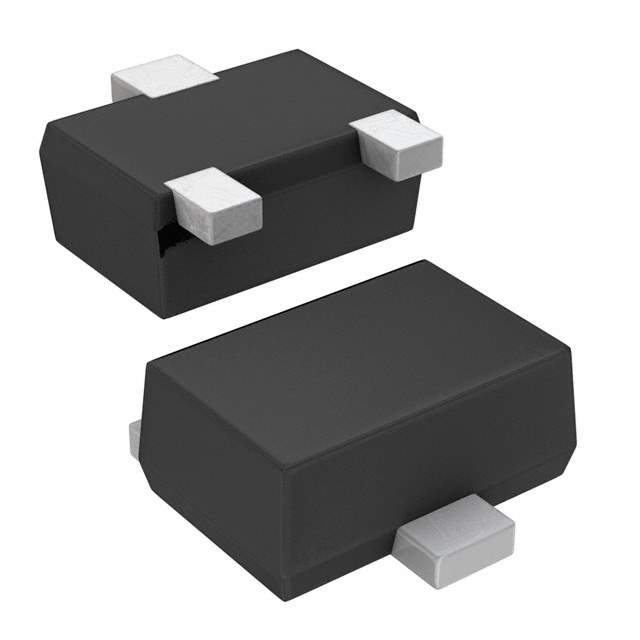
50 V, 20 mA, 150 mW in EMT3F (SOT-416FL): a small pre-biased NPN with tight current and power ceilings
Quick Engineering Summary
| Field | Value |
|---|---|
| Manufacturer | Rohm Semiconductor |
| Category | RF Transistors (BJT) |
| Package | Tape & Reel |
| Core function | TRANS PREBIAS NPN 50V EMT3F |
| Key electrical range | Current - Collector (Ic) (Max): 20 mA; DC Current Gain (hFE) (Min) @ Ic, Vce: 80 @ 5mA, 10V; Frequency - Transition: 250 MHz; Power - Max: 150 mW |
| Reported stock | 24000 pcs reported — confirm on RFQ |
Active status helps, but the package still decides it
And that is the real verdict: DTC015EEBTL works for new design-in when you actually want a pre-biased NPN in EMT3F (SOT-416FL), not a general small-signal transistor you plan to bias yourself. Active lifecycle, EU RoHS, and MSL 1 remove the usual adoption friction.
20 mA is the ceiling that keeps this part honest
20 mA sets the tone here. That collector-current ceiling keeps DTC015EEBTL in light switching and bias work, not in jobs where the load creeps up during bring-up and then stays there in production.
The voltage rating broadens where you can use it, but it does not relax the power limit. A 50 V collector-emitter breakdown ceiling keeps the part in play on higher-voltage logic-side nodes where many tiny digital transistors run out of headroom, while the 150 mW maximum is the harder boundary once dissipation starts to dominate in the tiny SC-89, SOT-490 body. Treat those two numbers together or the part gets misread.
The listed 100mV saturation figure at 500µA and 5mA is useful, but only at that test point; it shows the device can pull a small node low with little drop under that condition, and nothing more. It does not support assuming the same drop near the 20 mA ceiling, especially in a package this small where thermal margin disappears quickly.
The resistor network is just as important as the transistor itself. R1 is 100 kOhms and R2 is 100 kOhms, so the part belongs in circuits where that fixed bias arrangement is already the right answer. If the drive scheme needs a different divider or stronger base drive, the convenience turns into a limitation.
50 V makes room on the rail, not on the load side
50 V is the decisive number. It makes room for level-detect, pull-down, and small-signal switching work on rails that would rule out lower-voltage pre-biased parts, and the 250 MHz transition frequency says the transistor itself is not the obvious bottleneck in modest RF-adjacent or fast-edge housekeeping roles.
Still, the fit is narrow. The EMT3F (SOT-416FL) package suits dense boards where saving external bias resistors matters and where the controlled resistor pair is part of the design intent. It does not belong in output stages, relay drive without a very small load, or any circuit where collector current can move toward the 20 mA ceiling during fault or startup. Use it as a compact interface transistor with a predefined bias network, not as a blank BJT canvas.
Buy it, but close the missing electrical gaps first
Buyable.
Packaging is the practical constraint, not lifecycle. Stock is listed at 24000 and the standard package is 3,000, so this fits a reel-fed line item better than a one-off hand-load choice. It also carries other ordering names, which matters when AVL entries need to point to the same device form.
The missing detail is the real weak point: no pinout, no package drawing, no collector cutoff current, and no thermal resistance figure. On a part this small, those are release items. Pinout and drawing determine whether the footprint is safe to send forward, while leakage and thermal data determine whether the device stays quiet at temperature or becomes a nuisance current path in the field.
View the Win-Source product page for DTC015EEBTL.
Key Takeaways for Engineers & Buyers
- Keep DTC015EEBTL on low-current bias and switching nodes; 20 mA collector current is a ceiling, not a target.
- Use the built-in 100 kOhms R1 and 100 kOhms R2 only where that bias network matches the drive source.
- Buy in reel multiples of 3,000 when the line is steady; listed stock is 24000 today.