
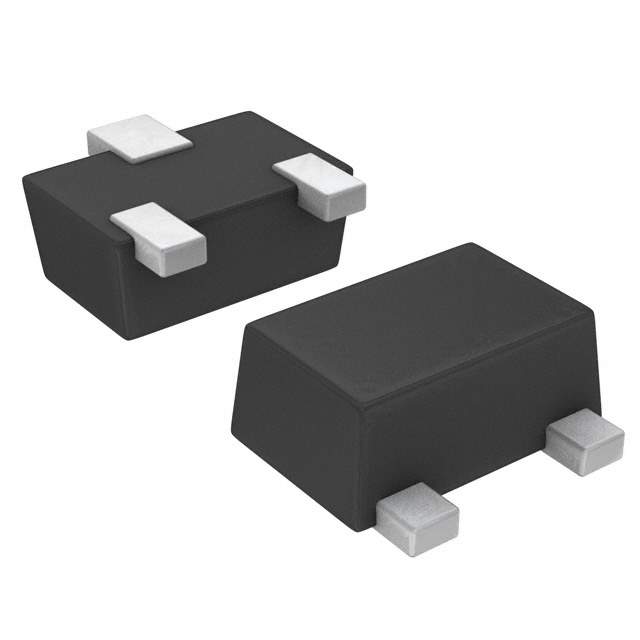
50 V, 20 mA, 150 mW in VMT3; the key question is whether 100 kOhms / 100 kOhms suits your logic.
Quick Engineering Summary
| Field | Value |
|---|---|
| Manufacturer | Rohm Semiconductor |
| Category | Transistors (BJT) - Single, Pre - Biased |
| Package | VMT3 |
| Core function | TRANS PREBIAS NPN 50V VMT3 |
| Key electrical range | Supply and Demand Status: Balance |
| Reported stock | 27404 pcs reported — confirm on RFQ |
50 V is the first gate, not the whole answer
50 V is the collector-emitter breakdown ceiling, and that settles the first screen quickly: DTC015EMT2L belongs on low-voltage switching nodes with real rail margin below that limit. That number alone does not define normal operating stress, and it will not save a design that is boxed in by current or thermal limits somewhere else.
The rest of the picture is clean. DTC015EMT2L is Active with low lifecycle risk, so it fits new design-in and sustaining builds. EU RoHS is compliant, MSL 1 (Unlimited) removes a handling nuisance, and the lifecycle fields do not point in different directions.
20 mA and 150 mW set the real ceiling
20 mA is modest. Here, that collector-current maximum keeps this pre-biased NPN in signal-level switching and biasing work rather than load-driving duty.
The 150 mW power maximum draws the same boundary from the thermal side. If the application leans on collector current for long on-times, DTC015EMT2L runs out of dissipation budget well before it starts to resemble a general-purpose small-signal transistor with external bias flexibility. The listed 100mV at 500µA, 5mA is useful because it shows the device can pull low cleanly in a light-current switch role, but only at that stated test point. The 80 minimum hFE at 5mA, 10V helps when checking whether a logic source can steer the internal resistor network, yet it still falls short of a full transfer picture across current and temperature.
Will it fit the circuit you actually want to build?
Will it save parts without boxing in the schematic later?
That is the real question, because the built-in bias network is either the reason to choose DTC015EMT2L or the reason to avoid it. This part works when you want to collapse a discrete NPN stage and its external bias parts into one VMT3 footprint, and when the listed resistor values already line up with the logic behavior the circuit needs.
R1 and R2 are both 100 kOhms. That makes DTC015EMT2L a sensible fit in simple logic inversion, level interface, and housekeeping control paths where that ratio is already correct and where the circuit does not ask for much collector current. In those cases, the integrated network and small package cut placement count with very little drama.
The tradeoff is just as clear. When the base network needs tuning, this part stops being convenient. If startup timing, noise immunity, or source loading depends on choosing a different resistor pair, DTC015EMT2L locks the schematic too early and takes away one of the easiest knobs to adjust. The listed 250 MHz transition frequency is worth noting, but without switching waveforms or capacitance data it does not qualify the part for fast-edge work by itself. Keep it in compact signal switching, not in spots where dynamic behavior is the whole problem.
The buy call is lead time, not availability
So the purchasing call comes down to 24 Weeks. Stock is 27404 today, and the package is Reel - TR with 8000 per package, so the order lot should track reel usage rather than assume quick replenishment for a running line.
View the Win-Source product page for DTC015EMT2L.
What the listing still does not answer
The weak point is missing depth. The identity is clear enough, but the listing still leaves out the details that close a circuit review.
There is no pinout or package drawing here, even though VMT3 and SOT-723 placement details decide footprint release. Thermal resistance and a derating curve are also absent, so ambient headroom cannot be judged from the 150 mW ceiling alone. Reverse-recovery time does not apply to this BJT, but switching waveforms and junction capacitance are missing, and those are the pieces that matter if edge speed or node loading is under scrutiny.
View the Win-Source product page for DTC015EMT2L.
Key Takeaways for Engineers & Buyers
- Match the drive network to the built-in 100 kOhms R1 and 100 kOhms R2 before freezing DTC015EMT2L.
- Treat 20 mA collector current and 150 mW as ceilings, not operating targets, in VMT3.
- Place the order against the 24 Weeks lead time; reel quantity is 8000 and stock is 27404.