
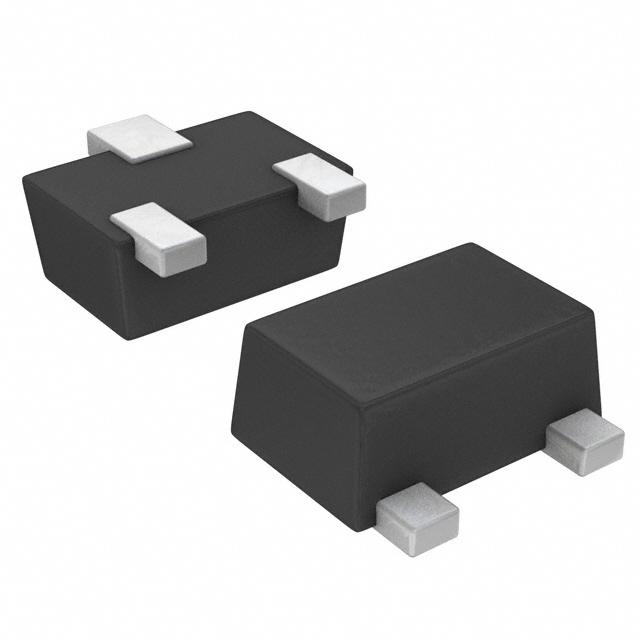
50V VCEO, 100mA collector ceiling, 150mW dissipation limit, VMT3 package, with 2.2k/2.2k built-in bias resistors
Quick Engineering Summary
| Field | Value |
|---|---|
| Manufacturer | Rohm Semiconductor |
| Category | Transistors (BJT) - Single, Pre - Biased |
| Package | VMT3 |
| Core function | TRANS PREBIAS NPN 50V 0. |
| Key electrical range | Frequency - Transition: 250MHz; Maximum Current Collector: 100mA; Maximum Power Dissipation: 150mW; Supply and Demand Status: Balance |
| Reported stock | 7970 pcs reported — confirm on RFQ |
Still, this one is a clean new-design choice
Still, the case is pretty direct: Active lifecycle, no lifecycle conflict, EU RoHS, and a spec set that clearly frames the job. This is a small pre-biased NPN for board-level switching and level handling, not a general-purpose transistor you shape later with external base parts.
The built-in 2.2k base resistor and 2.2k emitter-base resistor are the real draw. They trim the BOM around one defined behavior: simple drive from a logic node into a compact SMT footprint. That makes sense for new designs when the integration is the point. It does not fit analog bias work, higher-current switching, or any use that depends on tuning the base network.
The 150mW limit matters more than the 50V headline
Use it conservatively.
The 50V VCEO rating is a collector-emitter ceiling. It tells you the device can sit on rails and transients below that limit, but it does not tell you how much current remains practical there once the load line, board temperature, copper area, and ambient rise all start working against a tiny VMT3 package.
The 100mA maximum collector current is also a ceiling, not a normal operating point. In practice, the 150mW maximum power dissipation is the tighter boundary, and that matters more than the current headline because a small package runs out of thermal room fast in dense SMT layouts, long before the current number looks dramatic on its own.
The listed 200mV max VCE(sat) at 1mA, 10mA is useful, but only at that stated condition. It supports low-loss switching around that test point. It does not justify assuming the same drop near the 100mA ceiling. The hFE minimum of 20 at 20mA, 10V says much the same thing: enough gain to take the part seriously as a small-signal switch, but not a full transfer picture across current and temperature.
Then there is the 250MHz transition frequency. That says the transistor itself is not unusually slow, yet the switching result still rides on the fixed 2.2k and 2.2k resistor network you inherit with a pre-biased device, so edge behavior stays application-specific.
Where does it fit on a real BOM?
What would I buy it for first? Compact digital or mixed-signal boards that need a one-transistor NPN switch without two extra placements for bias resistors. The category matters: single, pre-biased BJT. That points it toward enable lines, small load switching, level translation, and housekeeping functions where the fixed resistor pair helps more than it limits.
It does not belong where the base network needs tuning, where collector current lives near 100mA, or where dissipation can drift toward 150mW during fault or hot-ambient operation. The VMT3 package helps density, but it does not make this a forgiving power transistor. Small package, small budget.
The buy call is simple: reel stock is the constraint
The weak point is review depth. The strong point is that the supply picture is usable now: packaging is Reel - TR, stock is listed at 7970, and supply-demand status is Balance. For a running line, that supports normal SMT intake instead of special handling.
Act on the package format, not just the quantity. If your build flow wants cut tape or alternate packing, handling friction can show up even when the part is available. Keep storage discipline aligned with the listed dry storage cabinet and humidity protection package requirement.
What the listing still doesn't answer
The constraint is simple: pinout, package drawing, and thermal resistance are not listed. Collector cutoff current and switching-time detail are also missing. Those gaps decide footprint release, leakage behavior, and ambient headroom.
View the Win-Source product page for DTC023EMT2L.
Key Takeaways for Engineers & Buyers
- Keep DTC023EMT2L on low-power switch nodes; 150mW is the dissipation ceiling.
- Match the drive network to the built-in 2.2k R1 and 2.2k R2 before freezing the logic interface.
- Buy on reel for the running line; listed stock is 7970 and packaging is TR.