
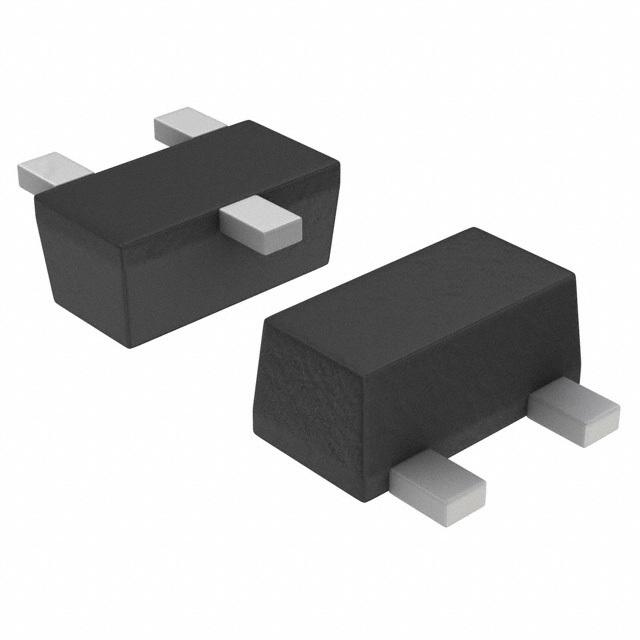
50V VCEO, 100mA collector ceiling, 150mW dissipation limit, EMT3F pre-biased NPN
Quick Engineering Summary
| Field | Value |
|---|---|
| Manufacturer | Rohm Semiconductor |
| Category | Transistors (BJT) - Single, Pre - Biased |
| Package | EMT3F (SOT-416FL) |
| Core function | TRANS PREBIAS NPN 50V 0. |
| Key electrical range | Frequency - Transition: 250MHz; Maximum Current Collector: 100mA; Maximum Power Dissipation: 150mW; Supply and Demand Status: Sufficient |
| Reported stock | 237000 pcs reported — confirm on RFQ |
So yes, this is a real design-in candidate
And that is the core case: Active status, stock at 237000, and a pre-biased NPN instead of a bare transistor. Use it when the fixed 2.2k and 47k network is the point.
EU RoHS is compliant.
The resistor network is the feature and the trap
The weak point comes first. Base drive is not yours to tune, because R1 is 2.2k and R2 is 47k, so the input behavior is set before layout starts. If your control node needs a different bias current or a different turn-off path, this is the wrong starting point even when the voltage and current ceilings look comfortable.
That fixed network is also the reason to use it. In a tiny EMT3F (SOT-416FL) footprint, the built-in resistors remove two external parts and keep a small-signal switch stage compact, which matters more on dense control boards than the headline transistor specs do.
The limits are clear enough. VCEO is 50V as a ceiling, collector current is 100mA as a ceiling, and power dissipation is 150mW as a ceiling. Read together, those numbers place the part in compact switching and bias duties, not in casual low-side switching where the package has to absorb mistakes. The thermal budget is the one that runs out first in a body this small, so a design that looks fine on current alone can still corner itself once dissipation is counted.
The listed 150mV VCE(sat) at 500µA and 5mA is useful, but only at that stated condition. It shows the device can pull low cleanly in light-load logic-style switching. It does not support assuming the same drop near the 100mA collector ceiling, and there is no switching-loss, storage-time, or transient detail here to fill that gap.
250MHz does not make it a power switch
250MHz is the listed transition frequency. That matters only after the current and dissipation limits are read first.
This belongs in compact bias-and-switch jobs, level handling, and small-signal gating where a fixed-resistor NPN saves space and assembly steps. The typical gain figure, 80 at 5mA and 10V, fits that reading. It is a small transistor meant to stay in its stated region, not a load driver dressed up by a generous 50V headline.
Good for dense control circuitry. Poor for anything that treats the package like a power device.
Can you keep a running line on DTC023JEBTL?
Can purchasing keep this on a running line? Yes. The buy-side constraint is packaging, not lifecycle: it is listed on Reel - TR, with supply marked Sufficient and stock at 237000. If this is headed into placement, buy it the way the line will consume it.
What is missing is still concrete. There is no pinout here, no package drawing, no thermal resistance, and no collector cutoff current value. ECAD is listed only as contact-to-download, so land pattern and symbol work still depend on the full datasheet package.
View the Win-Source product page for DTC023JEBTL.
Key Takeaways for Engineers & Buyers
- Check that the 2.2k R1 and 47k R2 match the logic-drive bias you want.
- Keep collector current below the 100mA ceiling; the 150mW limit is the tighter thermal budget in a tiny EMT3F body.
- Buy on Reel - TR for volume; the listed stock is 237000.