
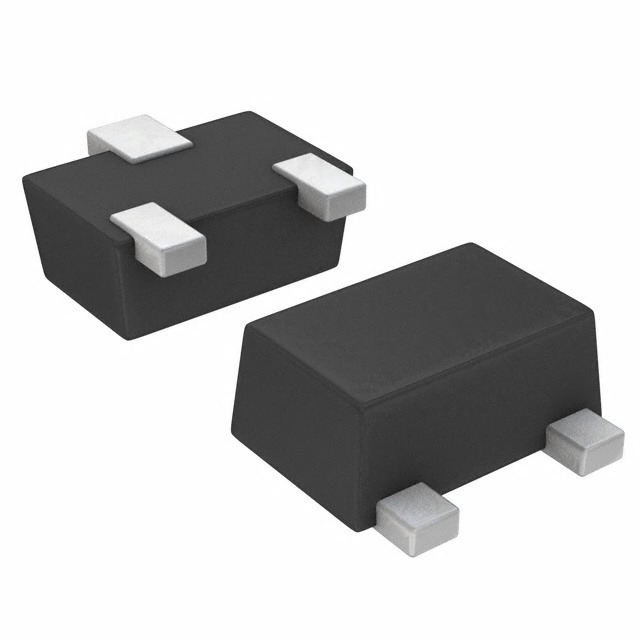
50V, 100mA, 150mW ceilings in VMT3/SOT-723 set the fit for this pre-biased NPN
Quick Engineering Summary
| Field | Value |
|---|---|
| Manufacturer | Rohm Semiconductor |
| Category | Transistors (BJT) - Single, Pre - Biased |
| Package | SOT-723 |
| Core function | TRANS PREBIAS NPN 50V 0. |
| Key electrical range | Current - Collector (Ic) (Maximum): 100mA; DC Current Gain (hFE) (Min) at Ic, Vce: 80 at 5mA, 10V; Frequency - Transition: 250MHz; Power - Max: 150mW |
| Reported stock | 240000 pcs reported — confirm on RFQ |
50V is the reason to consider it
50V is the decisive number here. It gives DTC023JMT2L meaningful rail headroom for small-signal switching and bias work that would rule out lower-voltage digital transistors, but it says nothing by itself about how much current or heat the part can really tolerate once the circuit is doing real work.
The rest of the fit comes from the other ceilings: 100mA collector current and 150mW power max. Those are hard limits, not operating targets, and together they keep the part in housekeeping roles rather than load-driving ones. Sit near either ceiling for long and the package becomes the story quickly, because VMT3 in SOT-723 does not leave much room for dissipation margin. The built-in resistor pair is the other reason to use it at all: 2.2 kOhms for R1 and 47 kOhms for R2 remove two external parts and lock in the input network behavior. That is a real advantage when you want repeatable biasing and a very small footprint, and a real constraint when you need to tune base drive around a particular source.
100mA does not make it a load switch
100mA looks serviceable at first. Next to a 150mW power ceiling, it becomes the practical brake on DTC023JMT2L.
The listing gives one saturation point: 150mV at 500μA and 5mA. That helps, but only in a narrow way. It shows the device can pull down a light load with modest base drive and low saturation voltage at that stated condition. It does not show behavior near the 100mA ceiling, so a 5mA switching point is not evidence for top-end use. The minimum hFE of 80 at 5mA, 10V points the same way. This part fits logic interfacing, level shifting, and small control paths where the integrated bias network saves space and assembly steps. It is not a collector-current workhorse.
The package and resistor values define the fit
The weak point is flexibility. The strong point is integration.
With DTC023JMT2L, you are choosing more than a transistor. You are choosing a pre-biased NPN with a fixed 2.2 kOhms base resistor and 47 kOhms emitter-base resistor in VMT3. That makes it a clean fit for dense SMD boards that need a known input network and do not want separate resistors consuming SOT-723-class board area. The listed 250MHz transition frequency is there, but for most uses of a pre-biased transistor it is not the number that decides the design. The resistor network and the 50V, 100mA, 150mW ceilings decide it first.
On the supply side, the constraint is packaging discipline rather than lifecycle. The part is Active, stock is listed at 240000, supply and demand is marked sufficient, and the manufacturer pack quantity is 8,000 on reel. If it is headed for a running line, plan around reel usage rather than cut-tape handling. EU RoHS compliance and MSL 1 (Unlimited) keep that side straightforward.
What the listing still does not answer
Wrong for final signoff as-is. Right for early selection.
The gaps are concrete and they matter. There is no pinout, no package drawing, no collector cutoff current value, and no thermal resistance figure. For DTC023JMT2L, those missing items matter more than another line of description. Pinout and drawing settle footprint and orientation. Collector cutoff current sets off-state leakage risk on high-impedance nodes. Thermal resistance tells you how much ambient headroom the 150mW ceiling really leaves in this package.
View the Win-Source product page for DTC023JMT2L.
Key Takeaways for Engineers & Buyers
- Keep DTC023JMT2L on low-power switching and bias jobs; 100mA collector current is a ceiling.
- Use the built-in 2.2 kOhms and 47 kOhms network intentionally; it fixes the base-drive behavior.
- Buy in reel form against the 8,000 pack quantity if DTC023JMT2L is going onto an active line.