
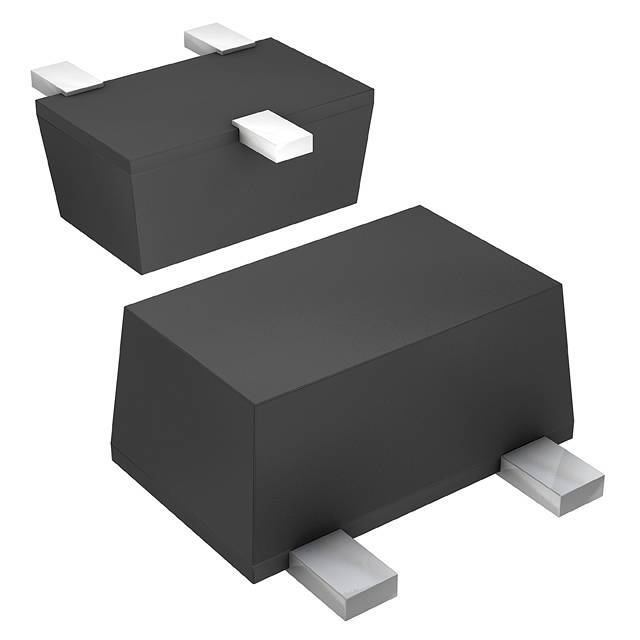
50V VCEO, 100mA collector ceiling, 200mW dissipation limit in UMT3F
Quick Engineering Summary
| Field | Value |
|---|---|
| Manufacturer | Rohm Semiconductor |
| Category | Transistors (BJT) - Single, Pre - Biased |
| Package | UMT3F |
| Core function | TRANS PREBIAS NPN 50V UMT3F |
| Key electrical range | Frequency - Transition: 250MHz; Maximum Current Collector: 100mA; Maximum Power Dissipation: 200mW; Supply and Demand Status: Sufficient |
| Reported stock | 36000 pcs reported — confirm on RFQ |
Still, this is a clean new-design choice
Still, this lands cleanly for new design-in when the goal is a pre-biased NPN rather than a general-purpose small-signal transistor. The lifecycle picture is consistent: DTC023JUBTL is Active, the signals do not conflict, and listed stock of 36000 on Reel - TR supports both new builds and existing production. EU RoHS is compliant, with no lifecycle issue to explain away.
Availability is not the catch. Fit is. The built-in resistor pair is the whole reason to use it, because the 2.2k base resistor and 47k emitter-base resistor already set the interface behavior.
50V and 200mW set the real boundaries
50V is the collector-emitter breakdown ceiling, so this belongs on switching nodes with real rail margin below that limit, not in a circuit that treats 50V as a normal operating point. The 100mA maximum collector current is a ceiling too, not a guarantee of pulse behavior or saturation margin across every load case.
The tighter limit is 200mW maximum power dissipation in UMT3F. That is what keeps the part in signal-level switching and interface duty, because even with a 100mA collector limit, a small package can run out of thermal room first if the voltage drop is not controlled. The listed 150mV max VCE(sat) at 500µA and 5mA helps at that stated condition, but it says nothing about the drop near the 100mA ceiling, so the loss budget for heavier switching remains open.
Wrong for arbitrary base-drive tuning
Wrong for circuits that need free base-network tuning. Better where the built-in 2.2k and 47k resistors cut parts count and the 80 hFE minimum at 5mA, 10V supports the intended collector current.
The missing curves matter more than the stock count
Buyable now.
The release risk is electrical detail, not supply. With 36000 pieces listed, Active lifecycle status, and Reel - TR packaging, the purchasing side is straightforward for builds that already want this exact pre-biased topology.
What slows a serious signoff is the missing information around the 200mW ceiling and how close a real board can run to it. There is no pinout here, no package drawing beyond UMT3F and SC-85 naming, and no thermal resistance or derating curve to show how much ambient headroom is actually left. There is also no collector cutoff current figure, even though leakage can decide whether a pre-biased transistor works on high-impedance nodes, and no saturation behavior beyond 150mV at 500µA and 5mA. That leaves open the practical questions that separate a tidy BOM simplifier from a part that creates debug work later.
View the Win-Source product page for DTC023JUBTL.
Key Takeaways for Engineers & Buyers
- Keep DTC023JUBTL on low-power switch nodes only; 100mA collector current is the ceiling.
- Check the drive math against the built-in 2.2k and 47k resistors before freezing the logic interface.
- Buy on Reel - TR if the line is live now; 36000 pieces listed supports a running build.