
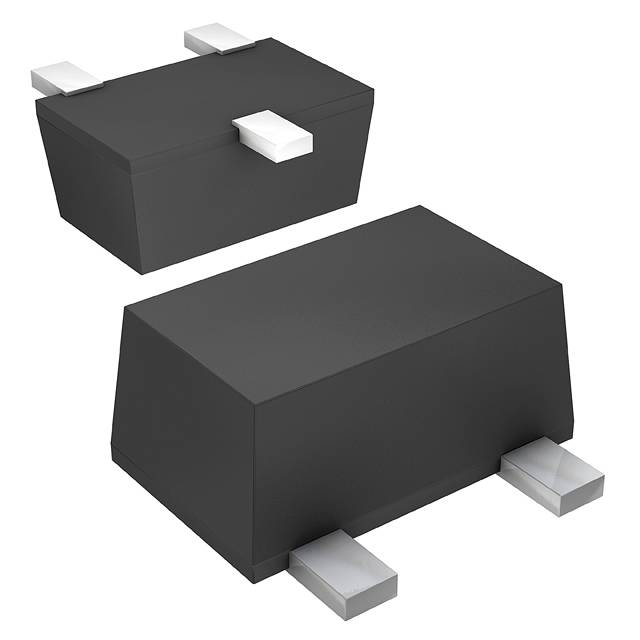
50V VCEO, 30mA collector ceiling, 200mW dissipation limit, UMT3F pre-biased NPN with 22k/22k resistors
Quick Engineering Summary
| Field | Value |
|---|---|
| Manufacturer | Rohm Semiconductor |
| Category | Transistors (BJT) - Single, Pre - Biased |
| Package | UMT3F |
| Core function | TRANS PREBIAS NPN 50V UMT3F |
| Key electrical range | Frequency - Transition: 250MHz; Maximum Current Collector: 30mA; Maximum Power Dissipation: 200mW; Supply and Demand Status: Sufficient |
| Reported stock | 51000 pcs reported — confirm on RFQ |
The real limit here is current, not voltage
Current is the constraint that shapes this part. The headline 50V VCEO ceiling stands out, but the tighter limits are 30mA maximum collector current and 200mW maximum power dissipation. Those numbers push it toward signal switching rather than load driving, and they leave little room to treat the 50V rating as a license for general-purpose high-side or low-side work across a broad range of board conditions.
The more useful read is structural: DTC024EUBTL is a pre-biased NPN with 22k on R1 and 22k on R2 in UMT3F. That makes sense in logic interfacing, level detection, and small control paths where folding the resistor network into the device saves two external parts and keeps placement tight. The listed 150mV max VCE(sat) at 500µA and 5mA is a ceiling at that test point, not a stand-in for behavior at 30mA.
That package choice is the reason to use it
So the package is really the point. UMT3F and SMD mounting make DTC024EUBTL a density play: one placement instead of a transistor plus two discretes, with the resistor network already fixed. On a crowded control board, that's a practical reason to choose it.
The fit narrows once the circuit needs tuning freedom. With R1 at 22k and R2 at 22k, DTC024EUBTL belongs in established bias schemes, not in stages where base drive must be tailored for edge rate, noise margin, or unusual source impedance. The listed hFE minimum of 60 at 5mA and 10V gives a useful anchor around that test condition, and the 250MHz transition frequency says the device is not inherently slow, but neither number answers pulse behavior without switching curves.
Buy it as a running line item
Buyable now.
DTC024EUBTL is Active, supply is marked sufficient, and stock shows 51000 in Reel - TR. Keep it on reel-fed SMT builds rather than introducing it into hand-load or mixed-packaging flow.
The listing is thin where switching parts need detail
The weak point is documentation depth, even though the commercial picture is solid. DTC024EUBTL is easy to place in a BOM as an Active, EU RoHS pre-biased NPN, but the missing electrical detail is exactly what decides whether it stays comfortable in a real switching node or becomes a bench surprise.
The gaps are concrete. Switching waveforms are absent, thermal resistance is absent, pinout detail is absent, and there is no package drawing in the listing. There is also no collector cutoff current figure, even though leakage can decide whether a high-impedance sense node stays clean at temperature. ECAD is only noted as contact-to-download, so layout work still depends on getting the full datasheet package before release.
View the Win-Source product page for DTC024EUBTL.
Key Takeaways for Engineers & Buyers
- Keep DTC024EUBTL on low-current switch nodes; 30mA collector current is the ceiling.
- Budget voltage headroom against the 50V VCEO limit before assigning DTC024EUBTL to any rail-connected node.
- Lock reel usage and feeder setup early; this device ships in Reel - TR and stock shows 51000.