
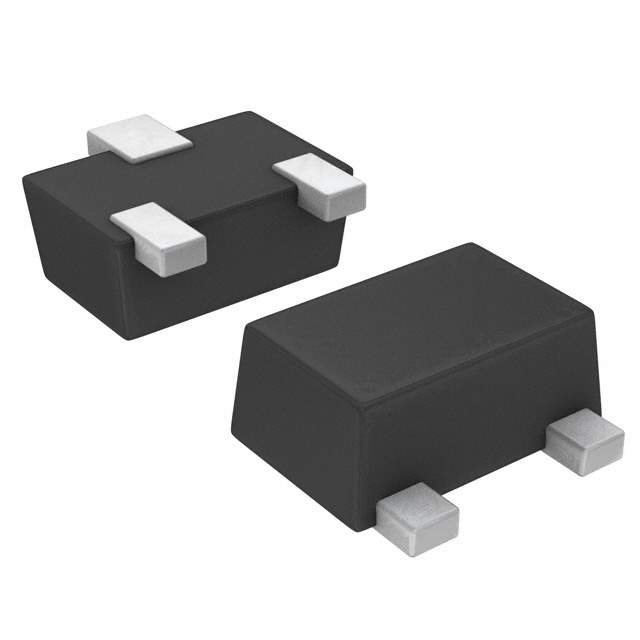
50V, 50mA, and 150mW ceilings decide whether this SOT-723 pre-biased NPN belongs on your next board spin.
Quick Engineering Summary
| Field | Value |
|---|---|
| Manufacturer | Rohm Semiconductor |
| Category | Transistors (BJT) - Single, Pre - Biased |
| Package | SOT-723 |
| Core function | TRANS PREBIAS NPN 50V VMT3 |
| Key electrical range | Current - Collector (Ic) (Maximum): 50mA; Current - Collector Cutoff (Maximum): 500nA; DC Current Gain (hFE) (Minimum) at Ic, Vce: 80 at 5mA, 10V; Frequency - Transition: 250MHz |
| Reported stock | 16000 pcs reported — confirm on RFQ |
The package is tiny, but the verdict is straightforward
The weak point comes first: 50mA collector current and 150mW maximum power are tight ceilings. Still, DTC024XMT2L is Active, stocked at 16000, shipped on reel, and EU RoHS compliant, so it is a credible new design-in choice when you need a pre-biased NPN in SOT-723.
Not for load drive; right for compact logic-level switching
This part is the wrong answer for anything that treats the transistor as a small power stage. The 50mA collector limit is a ceiling, and the 150mW maximum power ceiling can shut the door even sooner in a tiny SOT-723 body.
It fits dense board work that wants the bias network already inside the device. The built-in 22 kOhms base resistor and 47 kOhms emitter-base resistor make it a cleaner fit for simple logic interfacing, pull-down style switching, and space-constrained control nodes where external resistor count matters as much as transistor count. The 50V collector-emitter breakdown ceiling gives rail margin for higher-voltage small-signal nodes, but it does not turn DTC024XMT2L into a high-current switch.
Can you keep a running line on DTC024XMT2L?
Yes. That is the first buying question, and the answer here is better than average.
Active lifecycle, balance in supply and demand, reel packaging, and 16000 in stock all point to a part you can place on a live BOM without treating every order as a spot buy.
The real constraint is popularity marked low. That does not disqualify DTC024XMT2L, but it does argue for discipline: lock the approved package as SOT-723 or VMT3 on the BOM and buy to the reel flow you actually need, because a tiny pre-biased transistor is easy to overlook until a line stop reminds everyone that the footprint and internal resistor values are the part.
The listed numbers settle fit, but not the hard review questions
The limits are clear.
The 50V collector-emitter breakdown rating is a ceiling that tells you whether the transistor can sit on the rail you have in mind; it does not tell you how it behaves during switching stress or transients. The 50mA collector rating is another ceiling, and it rules out using DTC024XMT2L where startup surges or steady load current live near that edge. Then there is the 150mW maximum power rating, the dissipation budget implied by the listing and the number that usually decides whether a tiny package survives continuous use or becomes a field-return generator.
The switching clue that is present is useful but narrow. Vce(sat) is listed as 150mV at 500μA, 5mA, so you do have one anchored point for low-current saturation behavior. The minimum hFE of 80 at 5mA, 10V helps only at that stated test condition; it does not close drive design across the rest of the operating range. The 250MHz transition frequency says this is not a slow transistor by nature, but without switching-time data it still does not answer edge-rate or storage-time questions in a real logic path.
And the missing items are concrete. There is no pinout here, no package drawing, no thermal resistance, and no switching waveform data such as rise, fall, or storage time. Those gaps are what still separate DTC024XMT2L from a released schematic symbol and footprint, because the electrical ceilings tell you whether to keep evaluating it, while the absent mechanical and dynamic details decide whether it can actually be signed off.
View the Win-Source product page for DTC024XMT2L.
Key Takeaways for Engineers & Buyers
- Keep collector current below the 50mA ceiling; this part is for small-signal switching, not load drive.
- Budget dissipation against the 150mW maximum before using DTC024XMT2L as a sustained low-side switch.
- Match the built-in 22 kOhms and 47 kOhms bias network to your drive source before freezing the logic interface.