
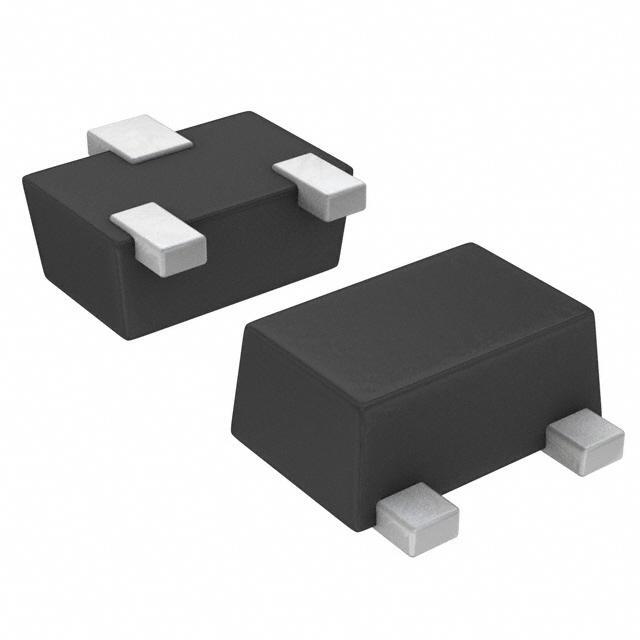
50V VCEO, 100mA collector ceiling, 150mW dissipation limit, VMT3 pre-biased NPN
Quick Engineering Summary
| Field | Value |
|---|---|
| Manufacturer | Rohm Semiconductor |
| Category | Transistors (BJT) - Single, Pre - Biased |
| Package | VMT3 |
| Core function | TRANS PREBIAS NPN 50V 0. |
| Key electrical range | Collector Cut-off Current(Max): 500nA; Frequency - Transition: 250MHz; Maximum Current Collector: 100mA; Maximum Power Dissipation: 150mW |
| Reported stock | 304000 pcs reported — confirm on RFQ |
50V is useful, but 150mW is the real limiter
50V gets attention first. It puts DTC043ZMT2L on higher-voltage control rails than many small-signal digital transistors, but it does not mean the part is comfortable switching heavy load current there.
The tighter limit is 150mW maximum power dissipation, alongside a 100mA maximum collector current. Those are ceilings, not operating points, and they steer DTC043ZMT2L toward light-load level shifting, logic inversion, and simple on-off control where the built-in bias network cuts parts count. The listed 150mV max VCE(sat) at 500µA, 5mA looks good for low-current switching, but that test point is narrow and does not settle loss once collector current moves away from 5mA.
Not for load driving; fine for compact bias-built switching
Load driving is the wrong job. A 100mA collector ceiling and 150mW dissipation ceiling in VMT3 leave little room for thermal slack.
It fits compact SMT control circuitry that benefits from the internal 4.7k base resistor and 47k emitter-base resistor. That's the reason to use this device.
Can you keep DTC043ZMT2L on a running line?
Can you keep buying it without creating a line risk? Yes. Lifecycle is Active, supply-and-demand status is listed as Sufficient, and stock quantity shows 304000, so DTC043ZMT2L does not present an immediate continuity problem for either a new build or an existing production line.
The practical constraint is packaging and fit, not lifecycle noise. This device comes as Reel - TR and mounts as SMD in VMT3, so it belongs on automated assembly rather than a hand-loaded service kit. If your line already uses pre-biased transistors to reduce resistor placements, DTC043ZMT2L is easy to slot in because the internal values are explicit: R1 is 4.7k and R2 is 47k. Those two numbers decide whether the upstream logic can drive the transistor as intended and whether the off-state bias behavior matches the rest of the circuit.
One more electrical point matters. Minimum hFE is 80 at 5mA, 10V, and transition frequency is 250MHz. Useful, but not enough. Neither number should be stretched into a blanket statement about switching speed in your circuit, because the listing does not include the time-domain behavior that would settle that question.
The missing data is exactly what closes the review
The constraint is missing second-order data. There is enough here to screen for voltage, current, package, and built-in resistor values, but not enough to finish a switching or thermal call.
What is absent matters: no pinout, no package drawing, no thermal resistance, and no switching times. For a pre-biased transistor, that leaves board fit unresolved, ambient headroom unresolved, and real edge-rate behavior unresolved. Collector cut-off current is listed at 500nA, which helps with leakage budgeting, but without those missing items you still can't close layout or pulse behavior from this page alone.
View the Win-Source product page for DTC043ZMT2L.
Key Takeaways for Engineers & Buyers
- Keep DTC043ZMT2L on low-dissipation switch nodes; 150mW is the hard thermal ceiling.
- Match the drive network to the built-in 4.7k and 47k resistors before dropping DTC043ZMT2L into a logic stage.
- Use reel planning, not spot buys; stock shows 304000 and packaging is Reel - TR.